


The Office of the United Nations High Commissioner for Human Rights, the primary United Nations body responsible for global human rights, is today beginning the training of Liberian lawyers focused on accountability for past crimes, as momentum rebuilds toward the establishment of a war crimes court in Liberia.
The two-day training—covering international laws including war crimes and crimes against humanity – is bringing together 20 lawyers, according to the U.N.
The U.N. said the sessions were aimed at increasing lawyers’ engagement in accountability efforts for atrocities committed during Liberia’s conflicts, and preparing them to take part in the court process. It is understood that no lawyers practicing in Liberia have prosecuted international crimes before now.
The program is also intended to strengthen the ability of key legal associations — including the Liberian National Bar Association, the Association of Female Lawyers of Liberia, and the Organization for Women and Children — to help them understand the “complex processes involved in litigating international crimes, including gross human rights violations and serious violations of international humanitarian law.”
“This situation highlights the pressing need for targeted capacity-building and technical assistance initiatives aimed at empowering national legal professionals to play a more effective role in promoting accountability and delivering justice,” the U.N. human rights office said in a concept note for the training.
Christian Mukosa, country representative of the body, said in WhatsApp messages that the training was “essential to ensure that national lawyers are equipped to contribute meaningfully to the design, implementation, and operationalization of these two courts in alignment with international human rights norms and standards, including to support victims’ participation and to uphold international due process and fair trial standards.”
Christian Mukosa, country representative of the Office of Human Rights of the United Nations in Liberia speaks at the official local celebration of the 2025 Human Rights Day. Credit: Anthony Stephens/New Narratives.
Facilitators and trainers for the program are drawn from civil society and the Liberian legal community, including Tiawan Gongloe, a veteran human rights lawyer, former presidential candidate and former president of the Bar Association.
“Most of our problems in this country are based on ignorance,” said Gongloe, who is also an assistant professor of law at the Louis Arthur Grimes School of Law and the Liberia School of Law. ”Training, creating awareness can undermine ignorance.”
The training builds on earlier U.N. engagement in Liberia’s transitional justice process. In March, the U.N.’s Human Rights Office trained civil society leaders, court advocates, journalists, victims and survivors of the civil wars on transitional justice principles.
United States organizations have also previously supported similar initiatives. The California-based Center for Justice and Accountability, a human rights organization, held sessions for lawyers, investigators and law enforcement officers in 2024.
The training comes at a critical moment for Liberia, which has yet to prosecute anyone for crimes committed during the civil wars between 1989 and 2003, in which an estimated 250,000 people were killed.
During the conflict and its aftermath, the United Nations deployed about 15,000 peacekeepers to help end the fighting and stabilize the country. More recently, it has provided technical support to the Office for the War and Economic Crimes Court of Liberia, following a request by President Joseph Boakai to António Guterres, the U.N. secretary general. With funding from Sweden, the U.N. Human Rights Office is continuing to support the Office’s work.
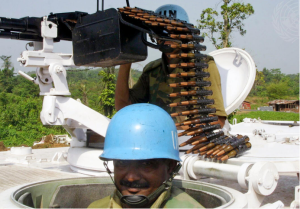
U.N. peacekeepers on board an amoured vehicle near Tubmanburg, Bomi County, during Liberia’s civil war. Credit: Shima Boy/U.N.
The two-day training also comes as six bills related to the establishment of a war and economic crimes court and a national anti-corruption court are currently before the Legislature.
The Office for the War and Economic Crimes Court of Liberia, which is overseeing the court’s establishment, separately submitted its draft legislation to Oswald Tweh, the justice minister, and Bushuben Keita, the president’s legal adviser. In his third annual message to the Legislature on Monday, President Boakai acknowledged the completion of the bills and said they had would be submitted for legislative “review”.
In 2021, the Bar Association submitted its own legislation to the Legislature for a war and economic crimes court, a bill that experts said was based on broad consultations with key stakeholders in the human rights community.
In late October, Senate Pro Tempore Nyonblee Karnga-Lawrence and Senator Joseph Jallah of Lofa County introduced two controversial bills to the Senate’s plenary. One bill seeks to prosecute war crimes through Liberian courts using Liberian law, despite the absence of domestic statutes criminalizing offenses such as rape as a weapon of war, torture, among other so-called international crimes. The other bill would exclude the prosecution of corruption and economic crimes committed during the civil wars, including resource pillaging, bribery, embezzlement, misappropriation of funds and illicit enrichment among others.
Legal experts and civil society groups have criticized the proposals as efforts to undermine accountability and shield alleged perpetrators, including some sitting lawmakers, from prosecution. Jallah told FrontPage Africa/New Narratives the bills were under “a review with more consultation.”
Critics argue that the proposals conflict with both the Legislature’s joint resolution calling for a “U.N.-backed Special War Crimes Court for Liberia” and the presidential executive order that created the office, which envisioned “a war crimes court of an international nature and of an international mix.”
In an exclusive interview on the sidelines of the 21st African Investigative Journalism Conference in South Africa in November, Fatou Bensouda, a former chief prosecutor of the International Criminal Court, urged Liberian lawmakers to reject the proposals, arguing that only a hybrid court would command public trust.
“The credibility of a future court,” she said, depends on “objectivity and impartiality.”
Other bills were separately submitted by civil society groups led by the Independent National Commission on Human Rights.
Disagreements between advocates and Jallah Barbu, the Office’s executive director, have spilled into public view, with the breakaway group of advocates accusing the office’s executive director, Jallah Barbu, of not knowing “what he’s doing,” claims he dismissed as “mischief” and a “distraction.”
In a phone interview, Gongloe said that while the process had been “slow” and “disappointing,” advocates “should not give up.”
“I think the more we have difficulties, the more we feel stimulated to act for the common good of humanity,” said Gongloe, under whose leadership the Bar submitted its bill for a war and economic crimes court to the Legislature. “I stongly believe that the training will create awareness for lawmakers to act or for people to put pressure on lawmakers to act.”
By Anthony Stephens via FPA
This story is a collaboration with New Narratives as part of the West Africa Justice Reporting Project. Funding was provided by the Swedish Embassy in Liberia which had no say in the story’s content.

