

By Paul M. Kanneh
Across Africa, leaders who have held power under controversial circumstances often resort to intense political maneuvering when they realize that the democratic system can no longer shield them or extend their time in office. In such moments, self-preservation becomes paramount.
These leaders frequently turn against allies, weaken institutions, and even undermine their own legacies in a bid to secure protection after leaving power. In doing so, they often marginalize perceived rivals, including loyal friends, relatives, and potential successors whom they view as threats to their post-presidential security.
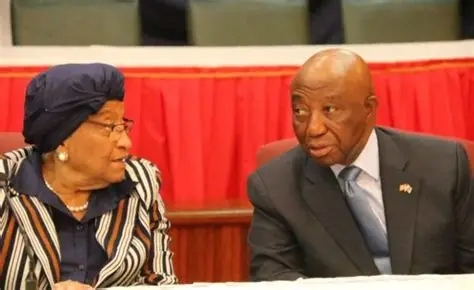
This broader pattern provides important context for understanding the political relationship between Ellen Johnson Sirleaf and Joseph Nyumah Boakai.
From Partnership to Rivalry
For many years, Sirleaf and Boakai worked in relative harmony as President and Vice President. However, their relationship began to deteriorate around 2014, coinciding with the emergence of Sirleaf’s son, Robert Sirleaf, as a political actor.
The 2014 midterm senatorial elections exposed deep fractures within the ruling Unity Party (UP). In Montserrado and Grand Cape Mount Counties in which President Sirleaf and Vice President Boakai openly supported opposing candidates. Sirleaf reportedly backed her son Robert in Montserrado and allegedly supported Foday Kromah in Cape Mount, while Boakai supported Varney Sherman, then Chairman of the Unity Party. This division marked what many observers consider the beginning of a prolonged political conflict between the two leaders.
The Montserrado Controversy
The situation in Montserrado County further deepened tensions. The Unity Party’s candidate, Ali Sylla, abruptly withdrew from the race citing health reasons, only to travel abroad shortly. Reports suggested that his withdrawal may have been influenced by Robert Sirleaf, allegedly with the backing of the President.
Following this development, the Unity Party publicly rebuked Sylla and distanced itself from Robert Sirleaf and declared him persona non grata. In a controversial turn, Sylla was later appointed as Liberia’s Deputy Head of Mission to Qatar, an appointment widely interpreted as political compensation for his abrupt withdrawal from the senatorial race.
Boakai’s Presidential Ambition and Mixed Signals
In 2015, Vice President Boakai accepted a petition to contest the 2017 presidential election. While President Sirleaf initially expressed support for his candidacy, her subsequent remarks raised doubts. In one notable interview, she stated that Boakai would have to “fight for it,” a comment that many interpreted as a withdrawal of full political backing.
At the same time, rumors circulated that Sirleaf was exploring alternative political arrangements, including a possible alliance between the Unity Party and the Liberty Party led by Charles Walker Brumskine. Boakai, however, resisted external influence, insisting on selecting his own running mate.
Political Calculations and Fear of Accountability
Some analysts believe that Sirleaf grew wary of alliances forming around Boakai, particularly those involving prominent civil society actors and human rights advocates such as Tiawan Gongloe and Samuel Kofi Woods. These figures had long advocated for accountability, including the establishment of mechanisms to address corruption and war-related abuses. Such alliances may have heightened concerns about post-presidential scrutiny.
Controversial Appointments and Internal Divisions
The appointment of Jonathan Fonati Koffa, a member of the opposition Liberty Party, as Minister of State without Portfolio raised eyebrows across the political spectrum. His subsequent role in investigating corruption allegations involving Varney Sherman added to perceptions of political targeting of Boakai’s allies within the ruling establishment.
Meanwhile, the Unity Party itself became increasingly fragmented. Two factions emerged: One aligned with Sirleaf and another with Boakai. Key defections, including figures such as Musa Bility and Eugene Nagbe, further weakened party cohesion.
The “Tuna Fish” Incident and Political Undermining
One widely discussed episode involved a shipment of tuna fish donated for Ebola relief, intended for distribution by the Office of the Vice President. According to insider accounts, bureaucratic obstacles, including demands for customs duties, delayed its release, which eventually caused some of the Tuna Fish to riot, raising suspicions of deliberate attempts to embarrass Boakai politically. While difficult to independently verify, such incidents contributed to a broader narrative of internal sabotage and mistrust.
Security Tensions and Political Pressure
In 2014, reports surfaced suggesting that Vice President Boakai was under investigation for alleged involvement in discussions about forming an interim government. Although these claims were publicly denied by authorities, they fueled speculation about efforts to undermine his credibility and find fault to deny him ahead of the 2017 elections.
A Symbolic Snub
In December 2017, President Sirleaf invited opposition leader George Weah to a major groundbreaking ceremony for the Gbarnga–Mendikorma road project, an initiative closely associated with Vice President Boakai. The decision was widely interpreted as a symbolic sidelining of her own deputy and subsequent endorsement of George Weah’s candidacy.
Lingering Influence in 2023 Politics
Even after leaving office, Sirleaf’s perceived involvement in political negotiations, such as reported efforts to influence a potential ticket involving Nyonblee Karnga-Lawrence and Alexander B. Cummings, suggests that past rivalries continue to shape Liberia’s political landscape.
A Lesson for Today’s Leaders
The story of Ellen Johnson Sirleaf and Joseph Nyumah Boakai is not merely about personal rivalry, it reflects deeper challenges within Liberia’s political culture: weak party cohesion, personalization of power, and the absence of trust among leaders.

