

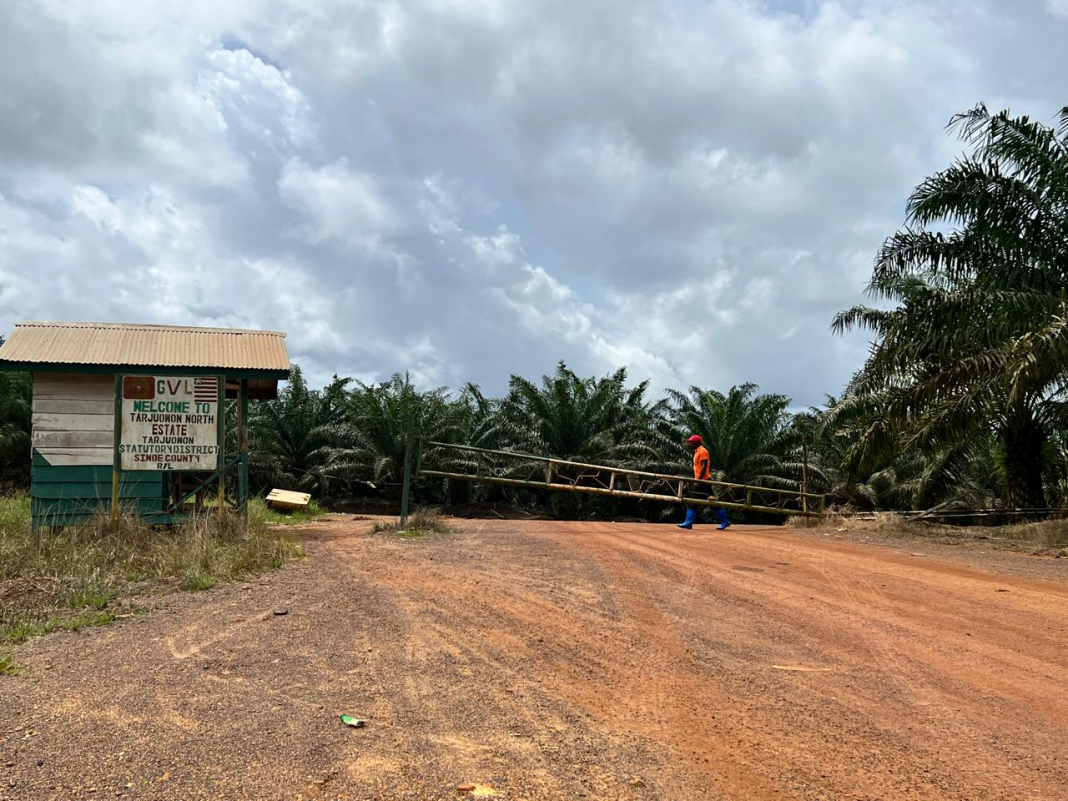
The Sustainable Development Institute (SDI) and Nitrain Community Forest Management Body (NCFMB) filed a complaint with Liberia’s Environmental Protection Agency (EPA) alleging sustained environmental and human rights violations by palm oil company Golden Veroleum Liberia (GVL).
The complaint argues that GVL destroyed 1,000 hectares of globally significant forests, violated communities’ land rights, and has failed to comply with recommendations provided by two international industry bodies, the High Carbon Stock Approach (HCSA) and Roundtable on Sustainable Palm Oil (RSPO).
The complaint alleges that GVL’s operations may violate several Liberian environmental laws and calls on the EPA to investigate the company and hold it accountable for its actions.
“Since GVL appeared on our land the company has taken our forests and damaged our livelihoods,” said Dennis Broh, Representative from the Nitrain Community Forest Management Body.
“For too long we have waited for someone else to hold the company responsible. Today, we call on the Government to act. The Liberian Government should ensure GVL restores the forests it’s destroyed and provides measurable compensation for lands taken from communities without consent. The forests of Liberia should benefit the people, not a company that treats the people and environment with contempt.”
Since GVL began operations in Liberia in 2010, the company has been the subject of numerous controversies. In 2021, the HCSA – a multistakeholder initiative aimed at protecting forests – concluded that GVL had destroyed 1,000 hectares of Liberia’s Upper Guinea forest. The HCSA mandated GVL to conduct forest restoration, develop a land conservation plan, and renegotiate provisional agreements with impacted communities. To date, GVL has failed to fulfill these conditions.
In 2018, the RSPO concluded that GVL had destroyed communities’ sacred sites, forcibly coerced communities to sign agreements with the company, and did not receive the Free, Prior, and Informed Consent (FPIC) from multiple communities to operate on their lands. As part of its decision, the RSPO issued a stop-work order on GVL.
However, in 2025, the RSPO lifted the stop-work order, despite the company not fulfilling RSPO recommendations. In response, over 70 international civil society organizations issued a public letter to the RSPO, calling on the body to maintain the stop-work order on GVL.
“It’s no secret that GVL has destroyed Liberia’s rich forests, grabbed land from communities, and failed to deliver on its promises of development and prosperity,” said James Otto, Campaigner at the Sustainable Development Institute.
“Despite being ordered to restore 1,000 hectares of forests it destroyed, GVL has not complied. The Liberian Government should legally enforce a moratorium on GVL’s expansion until the company remedies the harm it’s done, demonstrates compliance with national law, and respects communities’ land rights. Liberian communities should be supported to develop agroecology projects on their ancestral lands instead of handing over precious forests for destructive monoculture plantations.”
GVL is controlled by Indonesian palm oil company Golden Agri Resources, which maintains ownership over the company through the Verdant Fund, a holding company domiciled in the Cayman Islands. According to Forests & Finance, GAR’s largest financiers include BlackRock, BNP Paribas, Citigroup, Dimensional Fund Advisors, Kopernick Global, Rabobank, Silchester International, and Vanguard.
“For over a decade, GVL has disrespected and desecrated Liberian communities’ forests,” said Gaurav Madan, Senior Forest and Land Rights Campaigner at Friends of the Earth US. “Voluntary initiatives have failed to live up to their standards and compel the company to right its wrongs.
GVL’s deforestation and land grabbing are risky business. Consumer brands and financiers should support the rule of law and the return of land to Liberian communities or risk being complicit in GVL and GAR’s deforestation and land grabbing.”
GVL has yet to comment on these allegations.

