

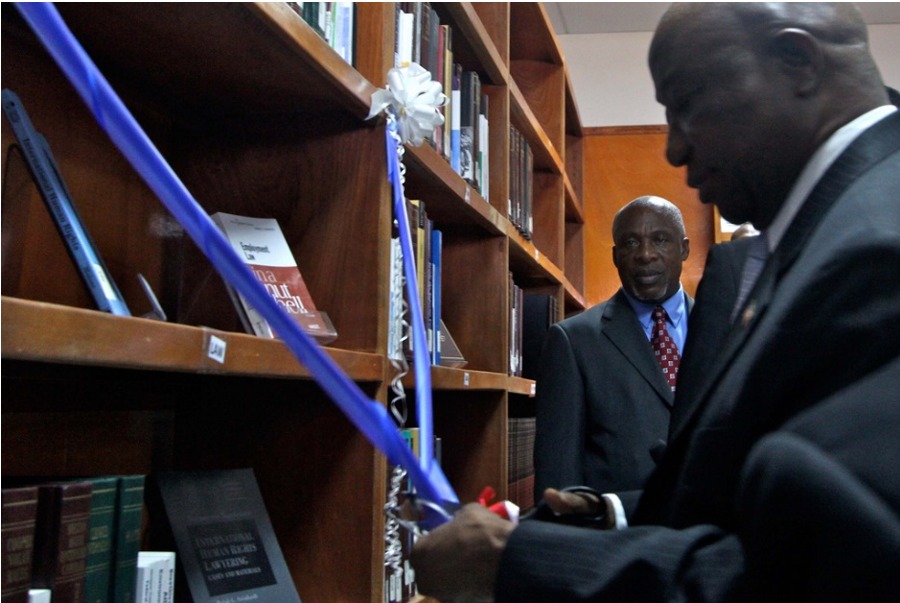
Fifteen years ago, Joseph Nyumah Boakai, then President of the Liberian Senate, stood before lawmakers and cut the ribbon to a refurbished library and archive. His words that day were not ceremonial pleasantries; they were a thunderous call to action. He urged the Legislature to embrace digitalization, to harness information technology for cutting edge research, and to transform Liberia’s governance into a modern, transparent, and efficient system.
Today, that vision has roared back to life. As President of Liberia, Boakai has signed Executive Order No. 163, launched the National Digitalization and Modernization Initiative (NDMI) and established the Office of Technology, Digitalization, and Innovation (OTDI). For the Legislative Information Service (LIS), this is not just policy—it is vindication. It is the fulfillment of a promise made in 2011, now reborn as national law.
McCarthy Weh II, Director of LIS, reflected on the journey: “It is both a testament to President Boakai’s foresight and a stark reminder of the persistent challenges we face.” Those challenges are glaring. Liberia’s Legislature still lacks basic digital systems—electronic voting, modern websites, real time public access, and reliable internet connectivity. Across Africa, parliaments have surged ahead with e Parliament platforms, while Liberia has remained shackled by inefficiency and outdated processes.
Executive Order 163 is designed to break those chains. It is a whole of government mandate, extending beyond the Executive Branch to the Legislature and Judiciary. The LIS has long championed this approach, insisting that true digital transformation must be comprehensive, not piecemeal.
An e Legislature is more than a buzzword. It means digitized lawmaking, streamlined workflows, and enhanced citizen engagement. It means transparency at the click of a button. For years, LIS has pushed for this transformation, even proposing a US$1 million appropriation in the supplementary budget to fund a four-year modernization program. Though only US$475,000 was approved for IT upgrades, the groundwork was laid.
Now, with EO 163, the momentum is unstoppable. The LIS has already drafted an e House program document and resubmitted reform proposals to legislative leaders. The President’s order gives these efforts the national endorsement they desperately needed.
Central to the initiative is the mandatory adoption of electronic voting systems in both chambers. This is no minor upgrade—it is a cornerstone of modern democracy. Electronic voting ensures transparency, accountability, and accurate documentation of legislative actions. The United States Congress embraced it in 1970; Liberia must do the same in 2026.
Despite past support from the World Bank and the National Democratic Institute, electronic voting equipment has languished unused. EO 163 is the chance to integrate these tools into a cohesive modernization agenda. Renovating the Capitol Building is commendable, but bricks and mortar alone cannot modernize democracy. Digital systems must power the institution from within.
The LIS is clear: the 55th Legislature must seize this moment. Support the e Legislature program. Allocate the resources. Break free from the inertia that has plagued governance since 2006. This is not an expense—it is an investment in Liberia’s democratic image, in transparency, in efficiency, and in public trust.
The stakes are high. Regional assessments place Liberia’s Legislature in the lower to middle tier of digital advancement. In 2025, NAYMOTE ranked it 25th out of 33 parliaments, with a score of just 41.67% on the Open Parliament Index. EO 163 is the chance to rewrite that narrative.
The transformation envisioned under EO 163 is sweeping: Electronic voting systems in both chambers, legislative websites covering the entire bicameral body, digitized archives for online access to legislative history, conferencing equipment and wall mounted television systems for plenary monitoring, and stable internet to power a paperless system.
These are not luxuries. They are the minimum standards of modern governance. They are the tools that will finally allow Liberia’s Legislature to stand shoulder to shoulder with its peers across Africa.
The LIS, celebrating its 15th anniversary this year, remains the Legislature’s research powerhouse. Established with support from USAID and the NDI, it serves 103 members’ offices, 60 committees, and 26 departments. It is the knowledge bank of Liberia’s democracy, providing credible, reliable, and nonpartisan analysis.
From its inception, LIS has been a beacon of modernization. Its mission has always been clear: to preserve, document, and disseminate legislative information. EO 163 now empowers it to fulfill that mission on a national scale.
President Boakai’s Executive Order is more than a policy—it is a revolution. It is the moment Liberia steps out of the shadows of inefficiency and into the light of digital democracy. The LIS has pledged its full support, ready to guide the Legislature into this new era.
The message is unmistakable: Liberia will no longer lag behind. With EO 163, the nation is poised to become a digitally empowered democracy, where governance is modern, transparent, accountable, and truly responsive to the people.

