

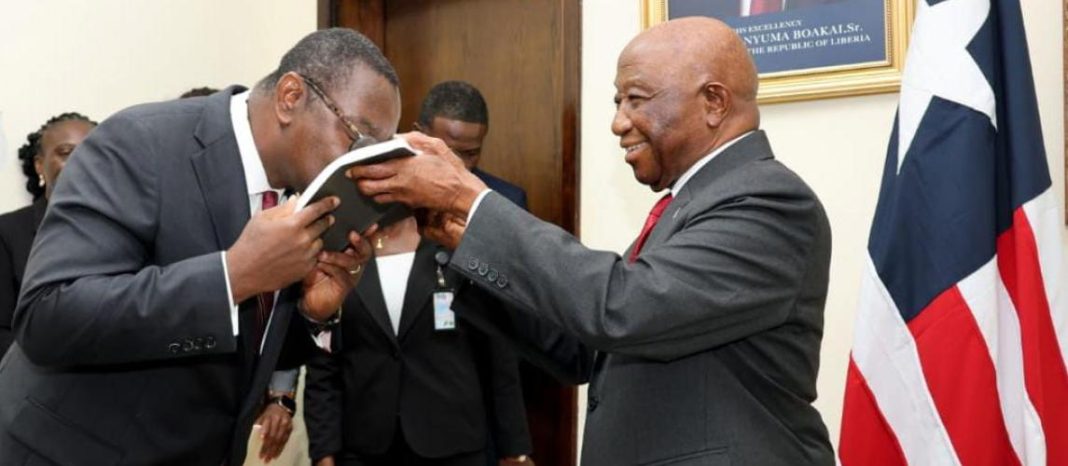
In a sweeping move reminiscent of past reformist crackdowns on government excess, President Joseph Nyuma Boakai has ordered unprecedented restrictions on foreign travel by Cabinet Ministers and senior officials, declaring that Liberia’s urgent national priorities must take precedence over costly trips abroad.
The directive, issued at a Cabinet meeting this afternoon, immediately imposes strict conditions on all official journeys by ministers, agency heads, ambassadors, and top government executives. Boakai warned that unchecked travel has drained resources, disrupted Cabinet deliberations, and deprived the administration of critical leadership at decisive moments.
Observers note that this marks one of the most stringent travel clampdowns in Liberia’s modern political history. Past administrations occasionally curbed foreign missions, but Boakai’s order echoes historic austerity measures taken during periods of national crisis — from President William R. Tolbert’s belt-tightening in the late 1970s to Ellen Johnson Sirleaf’s early reforms aimed at restoring fiscal discipline after years of war.
Boakai’s directive underscores that no official may embark on foreign travel without his explicit prior approval. “Repeated international trips have imposed financial burdens on the Government at a time when resources are needed for urgent national development priorities,” the President declared.
In a bold modernization twist, Boakai introduced a “Virtual Participation First Policy,” mandating ministries and agencies to prioritize platforms such as Zoom and Microsoft Teams for international meetings. Physical attendance will only be sanctioned when “demonstrably necessary” and clearly aligned with Liberia’s national interest.
All travel requests must now include detailed justifications: strategic relevance, estimated costs, funding sources, delegation composition, and explanations for why virtual participation would not suffice.
The directive further stipulates that, except under extraordinary circumstances, no Cabinet Minister or senior official may undertake more than one foreign trip per quarter without presidential authorization. Requests will be denied if an absence threatens Cabinet deliberations, institutional leadership, or urgent decision-making.
Boakai also reinforced compliance with government travel regulations, including restrictions on class of travel, per diem allowances, accommodations, and related expenditures. Oversight will be jointly supervised by the Ministry of State for Presidential Affairs and the Cabinet Office, with exceptions granted only for compelling national interests.
The President cautioned that all officials must fully comply with the new policy “in the interest of responsible governance, operational efficiency, and prudent management of public resources.”
Analysts say the move reflects Boakai’s determination to reassert discipline and focus within his Cabinet, as Liberia grapples with mounting challenges — from economic recovery and infrastructure development to governance reform under his ARREST Agenda.
For many Liberians, the directive signals a historic turning point: a President willing to ground his own officials to ensure that national priorities remain firmly on the runway toward progress.

