

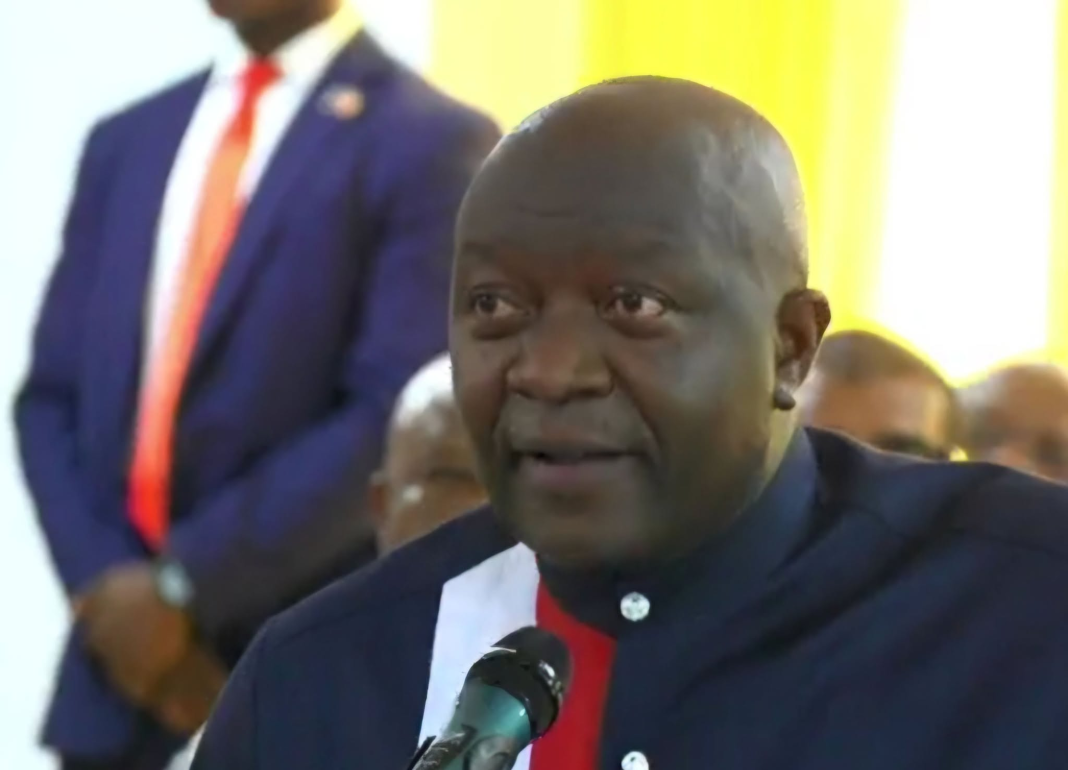
Liberia on Monday commemorated the 179th anniversary of National Flag Day, but the celebration was far more than a ceremonial parade. Finance and Development Planning Minister Augustine Kpehe Ngafuan, delivering an oration under the theme “From Heritage to Hope: The Flag That Unites Us,” transformed the Lone Star into a rallying cry for integrity, unity, and national renewal.
Ngafuan’s message was clear: patriotism must move beyond waving flags and singing anthems. It must become a daily practice of honesty, service, and sacrifice. “Patriotism is not only what we say about Liberia. Patriotism is what we do for Liberia,” he declared, urging citizens to embody the flag in their conduct.
The Liberian flag, first hoisted on August 24, 1847, less than a month after independence, remains a potent symbol of resilience. Designed by a committee of women led by Susannah Lewis, its 11 stripes honor the signatories of the Declaration of Independence, while the lone star represents Liberia as Africa’s first republic.
Ngafuan reminded Liberians that the Lone Star has endured through civil wars, public health crises, and reconstruction. “It is history, but it must also be hope,” he said, challenging citizens to see the flag not as a relic but as a vision of the Liberia they must build.
One of Ngafuan’s most powerful refrains was that unity does not mean uniformity. He likened Liberia’s diversity to schoolchildren in different uniforms marching under the same flag. Ethnic, political, and religious identities, he argued, must exist beneath a broader national identity.
“Our party-centricity must never undermine our country-centricity,” he warned, calling on Liberians to judge one another by character and contribution rather than tribe, county, or political affiliation. “We can disagree and still be Liberians.”
Ngafuan’s oration was filled with vivid examples of what it means to “raise the flag” in everyday life: Public officials who protect government resources, teachers who prepare diligently for class, health workers who care for patients, security officers who enforce laws without bias, business people who pay legitimate taxes, and journalists who responsibly pursue truth.
Each, he said, is “raising the flag” through service and integrity. His appeal to youth was equally urgent: choose education, creativity, and hard work over despair.
Ngafuan tied patriotism directly to development. Roads, schools, electricity, and healthcare, he argued, are not just infrastructure but instruments of unity. Liberia’s ARREST Agenda for Inclusive Development and recent financing agreements — including a US$30 million BADEA loan for the Salayea–Konia road — were cited as examples of turning aspirations into tangible progress.
Yet he cautioned against complacency. A US$1.29 billion national budget, he said, must be judged not by its size but by its impact on ordinary lives. “Its real value must be measured by whether it produces tangible improvements in the lives of ordinary Liberians.”
As Liberia prepares for political competition, Ngafuan urged restraint and tolerance. He proposed a “Patriotic Covenant” — a set of values transcending party lines: Liberia must come first, political power must be pursued peacefully, public resources belong to the people, corruption is wrong regardless of who commits it, truth and responsible discourse matter, and no victory is worth destroying Liberia.
“These should not be government values or opposition values,” he said. “They should be Liberian values.”
In one of his most striking rhetorical turns, Ngafuan asked: What would the flag see if it could look back at Liberia? Would it see leaders putting country above self? Would it see youth empowered with education? Would it see corruption defeated by integrity?
His answer was a challenge: these questions cannot be answered by speeches but by the actions of Liberians themselves.
Ngafuan’s final words were a appeal: “The flag cannot raise itself. We raise the flag when we raise our standards. We raise the flag when we raise our integrity. We raise the flag when we raise our children with knowledge, discipline and hope.”
The 179th Flag Day was thus not merely a commemoration but a national conversation — a reminder that Liberia’s future depends on whether its citizens choose to live the flag: not just salute it but serve it; not just hope for a better Liberia but build one.

