

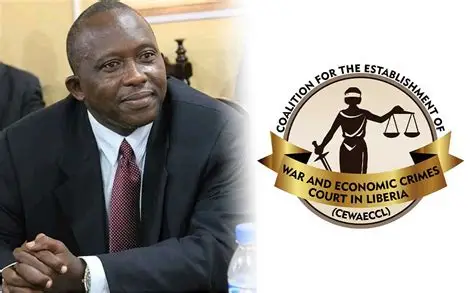
Liberia’s leading civil society organizations renewed pressure on President Joseph Boakai to secure legislative approval for a war and economic crimes court, warning that reliance on executive action alone risks undermining the country’s credibility as it prepares to lead the United Nations Security Council.
The National Civil Society Consortium for Transitional Justice said the administration must move quickly to enact laws establishing and funding the War and Economic Crimes Court and a specialized National Anti-Corruption Court. The courts should be independent, adequately financed and compliant with constitutional and international fair-trial standards, the group said in a statement Tuesday.
The war crimes court, once established by statute, would hear cases linked to serious violations committed during Liberia’s civil wars, including alleged war crimes and crimes against humanity. Victims and survivors have waited more than two decades for accountability, the consortium said.
“Liberia’s leadership on the UN Security Council must be matched by concrete domestic reforms,” the group said. “The country cannot credibly advocate for the protection of civilians, accountability for serious human rights violations and stronger institutions abroad while leaving critical justice and accountability reforms unfinished at home.”
Liberia was elected to a nonpermanent seat on the Security Council for the 2026-2027 term and is scheduled to hold the council’s rotating presidency in December. Civil society groups said the country’s international commitments on peacebuilding, human rights and women’s participation in peace and security require corresponding action at home.
The 55th Legislature passed a joint resolution in April 2024 supporting the creation of the war and economic crimes court, according to the statement. Boakai subsequently created the Office for the Establishment of War and Economic Crimes Court and submitted draft legislation for both courts.
But the consortium said the government has yet to complete the process by securing passage of enabling legislation, allocating funding and making the institutions operational. The delay, it said, risks widening the gap between Liberia’s diplomatic commitments and its domestic record on justice and accountability.
The groups also called for the anti-corruption court to be established without further delay, saying entrenched corruption and misuse of public funds weaken public trust, deepen poverty and limit access to essential services such as health care, education and electricity.
The statement urged Boakai to engage lawmakers to ensure passage of both bills and to include funding for the courts in the 2027 national budget. It also called on the Senate and House of Representatives to avoid using constituency consultations as a pretext for delaying action.
Any court created under the legislation should protect victims and witnesses, allow meaningful victim participation and incorporate gender-responsive procedures, the consortium said. It urged the government to align the courts with the commitments of UN Security Council Resolution 1325 on women, peace and security.
The statement was signed by the Press Union of Liberia, the Center for Transparency and Accountability, the Women’s NGO Secretariat of Liberia, the Association of Female Lawyers of Liberia, the National Muslim Council of Liberia and the Liberia Council of Churches.
The organizations also called on the United Nations, European Union, US and other international partners to support the courts’ establishment and financing. They said Liberia’s December Security Council presidency presents an opportunity for the government to demonstrate that its international advocacy for accountability is backed by action at home.

