

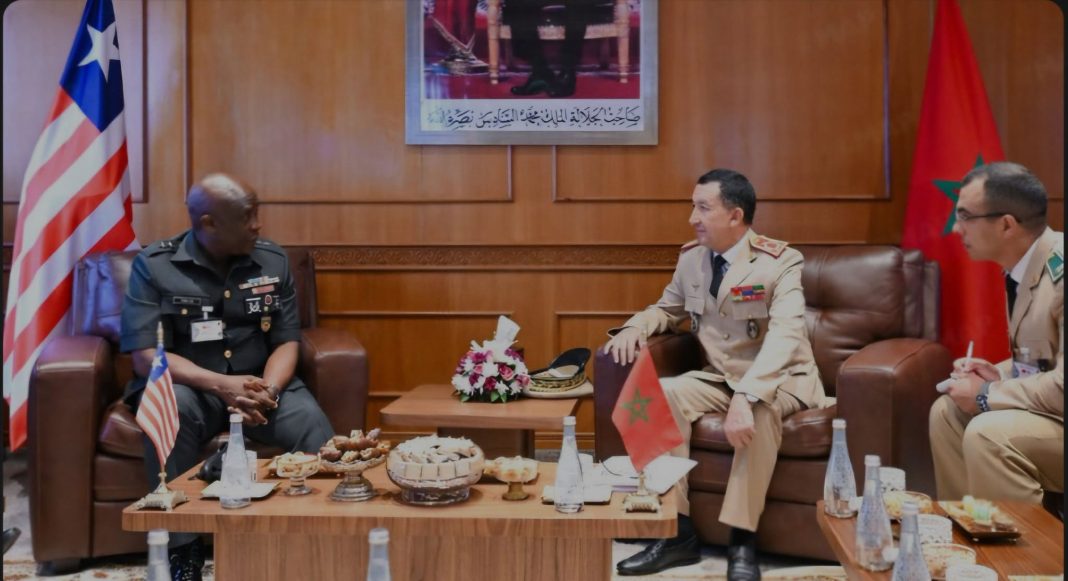
Morocco and Liberia are intensifying their defense partnership, with senior military leaders charting new ground in training, joint exercises, and personnel exchanges during high level talks in Rabat.
At the headquarters of the Royal Moroccan Armed Forces General Staff, General Mohammed Berrid, Inspector General and Commander of the Southern Zone, hosted Liberia’s Chief of Staff, Major General Davidson Fayiah Forleh. The meeting, attended by Liberia’s Ambassador to Morocco, underscored the strategic weight both nations attach to their evolving security relationship.
According to Morocco’s state news agency MAP, the talks centered on implementing the landmark defense cooperation agreement signed on October 21, 2025. The pact provides the framework for expanded collaboration in professional training, operational preparedness, and institutional exchanges.
Forleh’s official visit marks a pivotal moment in Liberia’s bid to strengthen the Armed Forces of Liberia (AFL). Discussions identified training programs, tactical exercises, and exchange visits as priority areas. Such initiatives could expose Liberian officers to specialized courses, leadership development, and multinational command structures, while enhancing Morocco’s role as a continental security partner.
The talks were held under the instructions of King Mohammed VI, Morocco’s Supreme Commander and Chief of the General Staff, signaling Rabat’s commitment to deepening ties with Monrovia.
Morocco has steadily positioned itself as a key military actor in Africa, leveraging bilateral agreements and multinational exercises such as African Lion — one of the continent’s largest annual drills involving U.S., African, and international forces.
For Liberia, the partnership complements two decades of rebuilding its armed forces after the civil wars ended in 2003. The AFL was formally reconstituted in 2006 through a sweeping reform process led by international partners, particularly the United States. Recruitment, vetting, and training reshaped the force into a smaller, professional, civilian controlled military.
Liberian troops have since gained valuable experience in United Nations peacekeeping missions, operating in complex multinational environments. Yet challenges remain: limited resources, modest troop numbers, and the need for specialized capabilities in logistics, engineering, communications, medical support, and disaster response. Morocco’s training expertise could help bridge those gaps.
The timing of the Rabat talks reflects wider shifts in Africa’s security landscape. West Africa and the Sahel face mounting threats from extremist groups, organized crime, trafficking networks, and maritime insecurity.
While Liberia has avoided the scale of militant violence seen elsewhere, its Atlantic coastline and ECOWAS membership make maritime surveillance, border management, and intelligence cooperation central to its national security strategy.
The military accord also forms part of a broader diplomatic and economic engagement. Since rejoining the African Union in 2017, Morocco has expanded its footprint across the continent, while Liberia has sought stronger partnerships to advance economic development and institutional reform.
Tuesday’s meeting suggests the 2025 agreement is now entering an operational phase. As Major General Forleh’s visit continues through September 13, further discussions are expected to define concrete training programs, joint exercises, and exchange mechanisms.
For Monrovia, the priority will be ensuring that cooperation translates into measurable gains in professionalism and readiness. For Rabat, the alliance reinforces Morocco’s enduring role in West African security.

