

By H. Matthew Turry
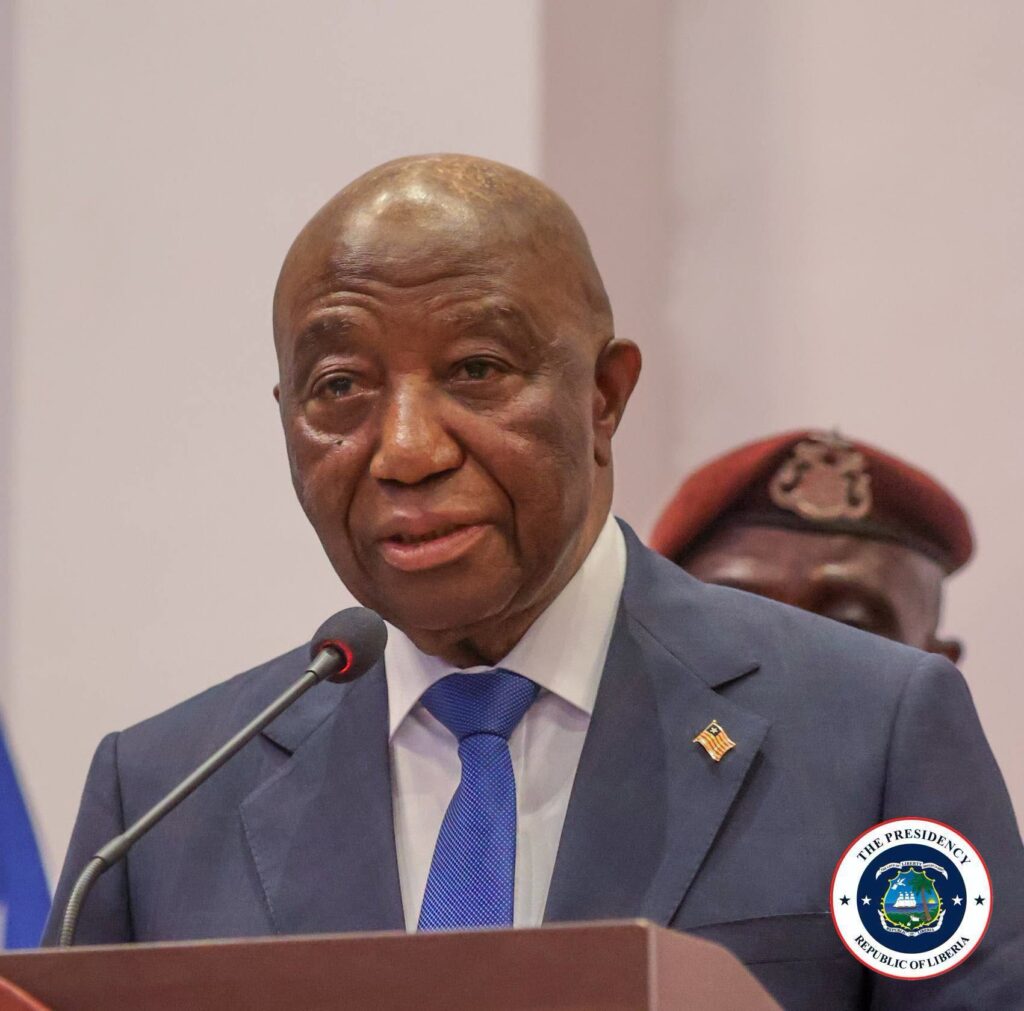
Nearly three years into President Joseph Nyuma Boakai’s six-year administration, only 12 of the 385 development commitments being tracked under the government’s ARREST Agenda for Inclusive Development (AAID) have been fully completed, according to the latest President Meter Report released by governance watchdog NAYMOTE Partners for Democratic Development.
The report, presented Tuesday, October 6, by NAYMOTE Executive Director Eddie Jarwolo, paints a picture of an administration that has launched numerous initiatives but achieved limited completion of its stated development goals.
According to the findings, the government has delivered just 12 interventions, representing 3.1 percent of the 385 commitments monitored between January 2025 and September 2026. Meanwhile, 213 interventions, or 55.3 percent, remain ongoing, while 57 commitments, accounting for 14.8 percent, have yet to begin.
The report also highlighted a major accountability concern, noting that 103 interventions, or 26.8 percent, could not be assessed due to insufficient publicly available evidence to verify progress or implementation.
Taken together, the findings indicate that 160 commitments, roughly 42 percent of those tracked, are either yet to commence or lack enough documentation for independent verification.
NAYMOTE warned that the absence of verifiable evidence raises questions about transparency in reporting progress under the government’s flagship development agenda.
“For citizens, development commitments are meaningful only when their implementation can be clearly demonstrated,” the report suggests, emphasizing the importance of publicly accessible records and measurable outcomes.
Although more than half of the tracked interventions are reportedly underway, NAYMOTE expressed concern about the government’s ability to transition projects from implementation to completion.
The report notes that while significant activity is occurring across several sectors, the low completion rate highlights challenges in execution and delivery.
The findings suggest that achieving tangible results will require stronger project management, accelerated implementation, and improved monitoring mechanisms to ensure that ongoing initiatives translate into measurable benefits for citizens.
The assessment further examined progress across the six strategic pillars of the AAID.
Infrastructure Development recorded the highest activation rate, with 67.3 percent of its interventions either underway or addressed. However, that still leaves nearly one-third of infrastructure commitments without significant progress.
Other pillars recorded the following activation rates: Governance and Anti-Corruption – 63.7 percent, environmental Sustainability – 63.3 percent, rule of law – 60.0 percent, economic transformation – 55.4 percent and Human Capital Development – 53.1 percent
The report identified Human Capital Development, which includes key areas such as education, healthcare, and social services, as the weakest-performing pillar.
Similarly, Economic Transformation, a central component of the administration’s promise of inclusive growth and job creation, ranked second from the bottom.
NAYMOTE noted that the more than 14-point difference between the highest- and lowest-performing pillars reflects uneven implementation across government priorities.
The watchdog also observed that the Governance and Anti-Corruption pillar, despite ranking second overall, remains below expectations for a component designed to strengthen public sector accountability and transparency.
NAYMOTE said the President Meter initiative was established to provide citizens, policymakers, civil society organizations, and development partners with evidence-based assessments of government performance and the fulfillment of campaign and policy commitments.
The monitoring tool is intended to enhance public accountability by tracking implementation progress, identifying delivery gaps, and encouraging greater transparency in governance.
After 21 months of monitoring, the organization says those gaps have become increasingly evident.
The report concludes that the success of the AAID will ultimately depend on the government’s ability to accelerate implementation, complete ongoing projects, improve public reporting, and provide clear timelines for commitments that remain stalled or unverified.
As the Boakai administration approaches the midpoint of its tenure, the findings raise critical questions about whether its ambitious development agenda can move from planning and implementation to the delivery of concrete results that citizens can see and feel in their daily lives.

