

Integrity Watch Liberia has challenged the Government to explain who will shoulder the cost of its proposed US$1.539 billion FY2027 budget, warning that a drive for higher tax revenue must not deepen the financial strain on women, small traders and low-income households.
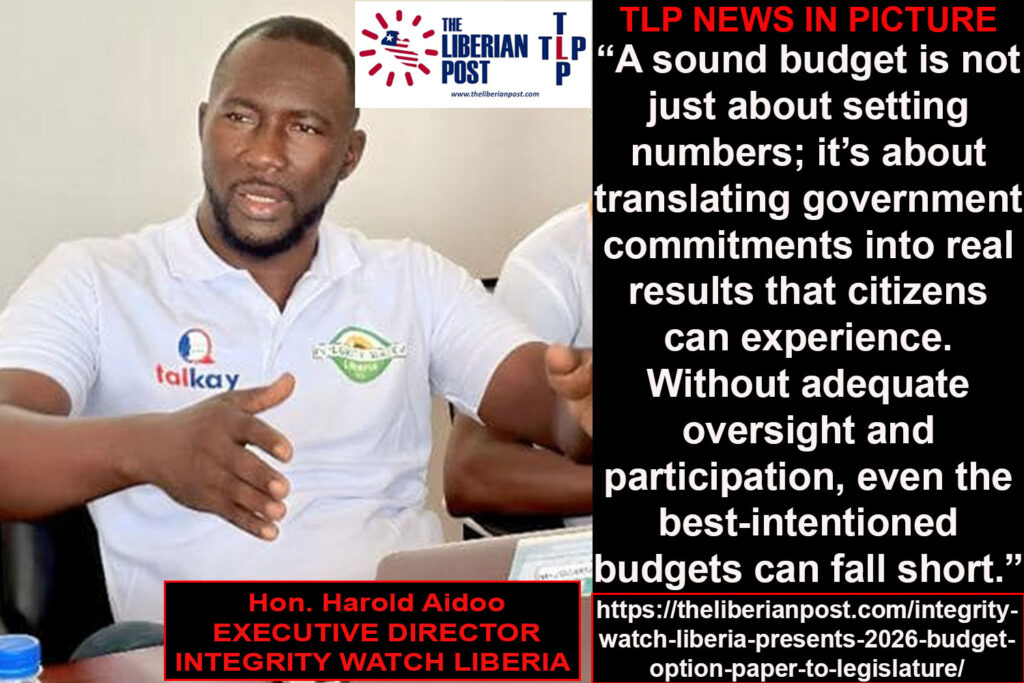
In a press statement delivered by Executive Director Harold Marvin Aidoo, IWL welcomed stronger domestic revenue mobilization but called for closer scrutiny of both sides of the budget: who pays into it, and who benefits from it.
“Our central question is: Who will bear the burden of generating this additional revenue?” the organization asked.
According to its independent gender-responsive assessment, projected tax revenue would rise from approximately US$752.72 million in the FY2026 approved budget to US$1.072 billion in FY2027 — a reported increase of 42.5%. Core domestic revenue is projected at approximately US$1.352 billion, compared with US$1.182 billion in FY2026.
IWL wants the Ministry of Finance and Development Planning and the Liberia Revenue Authority to show whether the additional collections will come from improved compliance among large taxpayers, reduced leakages and tighter management of tax incentives, or from greater pressure on ordinary consumers and small businesses.
Tax reform, but at whose expense?
The statement identifies a transition from Goods and Services Tax to Value Added Tax, a minimum excise on digital financial services, property valuation reforms and stronger electronic invoicing and customs controls among the Government’s proposed revenue measures.
IWL said these reforms could improve efficiency, but their effects on vulnerable taxpayers need to be assessed before implementation. It warned that higher transaction costs and complex compliance procedures could squeeze small traders, while additional digital-services taxation could undermine affordable access to mobile money.
The group acknowledged VAT safeguards, including exemptions for rice and the continued exclusion of petroleum products. But it said the draft budget lacks sufficient publicly identifiable gender- and poverty-disaggregated analysis to establish how the wider reforms would affect different taxpayers.
International trade taxes also drew scrutiny. IWL cited projected collections of approximately US$419.39 million, against US$280.77 million in FY2026 — a reported increase of 49.4%.
The watchdog stressed that this does not necessarily mean import tax rates would rise by the same percentage. It nevertheless called for an explanation of the revenue assumptions and safeguards against additional costs being passed on to consumers and small traders.
Gender funding needs more than a label
IWL acknowledged progress in gender-responsive budgeting: 13 spending entities submitted gender budget statements for FY2027, up from nine in FY2026. But that remains a small share of the 122 entities covered by the proposed budget.
The group said some figures in the consolidated gender statement represent broader programme budgets rather than funding exclusively dedicated to gender equality, making the actual level of gender-focused financing difficult to determine.
The Ministry of Gender, Children and Social Protection would receive approximately US$7.09 million, compared with US$4.06 million in FY2026, according to the assessment. IWL welcomed the increase but noted that the proposed allocation represents only about 0.46% of the national budget.
Its demand is for a clearer distinction between administrative spending and money reaching frontline services, including support for survivors of sexual and gender-based violence, child protection and women’s economic empowerment.
In health and education, IWL sought specific financing and measurable targets for maternal and reproductive care, emergency obstetric services and clinical support for survivors, alongside measures addressing girls’ dropout, adolescent pregnancy, school-related violence, menstrual hygiene and barriers facing learners with disabilities.
It also called for clear targets for women farmers’ access to inputs, extension services, financing, mechanization and markets, and evidence that infrastructure and other public investments create opportunities for marginalized communities.
Lawmakers urged to demand evidence
For the finance ministry and revenue authority, IWL’s recommendations include a public gender and poverty impact assessment, proportionate compliance requirements for micro and small businesses, simplified procedures and taxpayer support.
It urged stronger enforcement of large taxpayers’ obligations, closer scrutiny of incentives and concessions, and action against illicit financial flows. On spending, it called for a phased mandatory gender-budgeting framework, standardized expenditure tagging and quarterly reports showing disbursements, expenditure and beneficiary outcomes.
IWL asked the National Legislature to demand a detailed breakdown of the tax projections and impact assessments before approving major tax reforms. It also called for dedicated gender-responsive budget hearings, scrutiny of priority service allocations and targeted funding adjustments where credible evidence establishes gaps within available fiscal space.
Lawmakers should require transparency on the costs and benefits of tax incentives and regular reporting on what gender-related spending actually delivers, the group said.
“The success of revenue mobilization cannot be measured solely by how much the Government collects,” IWL said. “It must also be measured by who pays, whether the burden is fairly distributed and whether the resources collected improve people’s lives.”

