

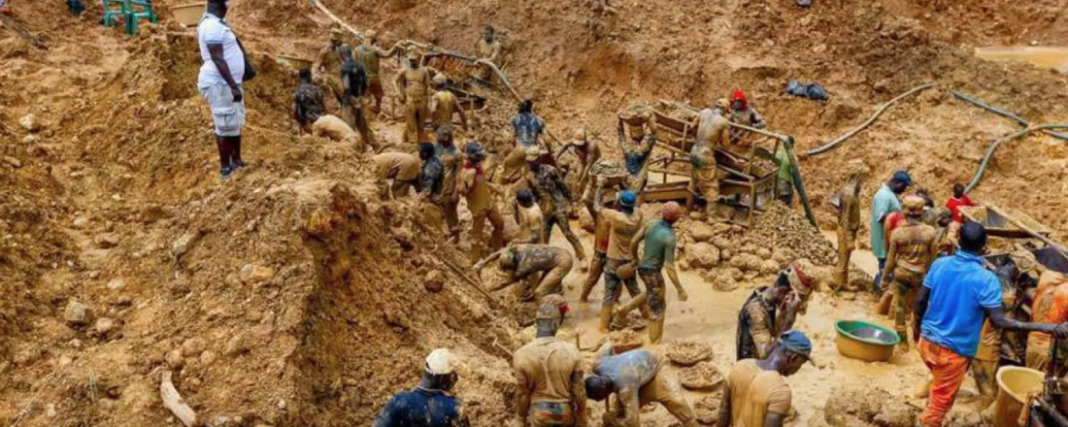
Liberia’s gold boom is drawing renewed scrutiny over allegations that as much as $1.2 billion in precious metal is being smuggled out of the country annually, potentially diverting a substantial share of export earnings from the government and formal financial system.
Col. Abraham Kromah, chairman of the Protect Our Resources Task Force (PORT), said illegal mining and gold-smuggling operations were depriving the state of taxes and other revenue while allegedly attracting financing from international drug cartels.
The claim, made during an interview on Spoon FM, raises questions about how much of Liberia’s expanding gold industry is being captured by the formal economy at a time when the commodity has become one of the country’s most important sources of foreign exchange.
Kromah said gold was being moved out of Liberia without passing through the Liberia Revenue Authority, undermining government oversight and revenue collection. He alleged that PORT had identified individuals financing and facilitating illegal mining operations and warned that those implicated would face prosecution.
The $1.2 billion figure has not been independently verified, and Kromah did not publicly provide supporting documentation or a breakdown of the alleged smuggling flows.
The scale of the allegation, however, is significant against the backdrop of Liberia’s rapidly growing gold exports.
Gold becomes Liberia’s biggest export earner
Gold has emerged as a central pillar of Liberia’s external trade, generating billions of dollars in export receipts over recent years as global prices rose and domestic production expanded.
Liberia’s gold exports generated approximately $1.03 billion in 2024, making the metal the country’s largest export commodity that year, according to trade data.
The World Bank’s Liberia Economic Update reported that gold export earnings increased to approximately $1.3 billion in 2025, up from about $896 million in 2024, contributing significantly to the country’s export expansion.
Total merchandise exports rose to approximately $2.1 billion in 2025 from $1.3 billion the previous year, with gold accounting for about 62% of total export earnings.
Gold’s rising contribution has strengthened Liberia’s foreign-exchange position, helping support the supply of dollars into an economy heavily dependent on imports of fuel, food, machinery and other goods.
The Central Bank of Liberia has also identified higher gold export receipts as a major factor supporting the country’s external-sector performance.
Production is expanding as gold prices climb
Liberia’s gold output has increased alongside the expansion of artisanal, small-scale and industrial mining.
Central Bank data cited in its 2025 annual report put gold production at approximately 461,419 ounces in 2025, up 4.4% from 442,164 ounces in 2024.
The increase comes as gold prices have strengthened internationally, boosting the value of exports and raising the financial incentives for miners, traders and intermediaries operating across the sector.
But the industry’s structure — with production spread among industrial operators, small-scale miners and artisanal producers — presents challenges for authorities seeking to track output, enforce licensing requirements and ensure that gold enters formal export channels.
Illegal production and cross-border trading can weaken the government’s ability to accurately measure production, collect royalties and taxes, and capture foreign-exchange proceeds through the banking system.

