

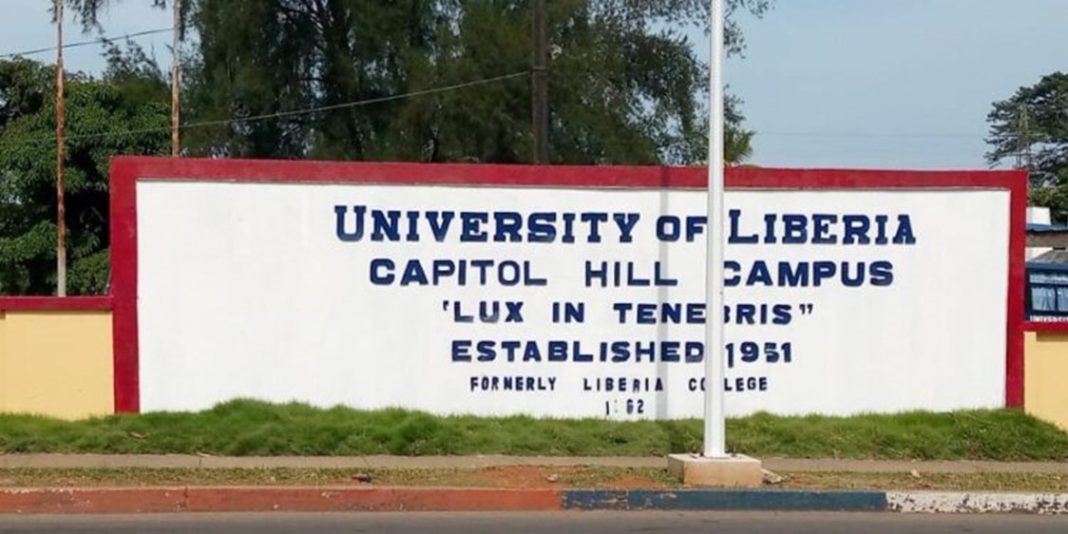
The University of Liberia has reported a wide-scale failure rate in its July 12, 2025, entrance and placement examinations, underscoring both challenges and opportunities for the institution as it pursues broader inclusion and academic reforms.
UL announced that out of 13,130 registered candidates, 9,299 (74.30%) failed the exams, 2,807 (28.32%) passed, 614 (4.68%) were absent, and 410 (3.28%) were disqualified for reasons including incorrect shading of answer sheets. The disparity among genders showed a slightly higher success rate for female candidates: 1,415 females (50.41%) passed compared with 1,392 males (49.59%).
Exam results for the David A. Straz-Sinje Technical and Vocational College in Grand Cape Mount County showed a similar pattern of outcomes. Of 221 registered candidates, 33 (14.93%) were absent while 188 (85.07%) sat the exam. Among them, 25 candidates (13.30%) passed, 85 (45.21%) failed, 74 were required to rewrite, and 4 (2.13%) were disqualified for incorrect shading.
UL President Dr. Layli Maparyan framed the results as both a challenge and an opportunity, noting a notable surge in applications that signals the university’s rising reputation. She clarified that the results reflect outcomes from both the computer-Based and Paper-Based Examinations administered by the Center for Testing and Evaluation (CTE) from July 1–5, 2025, across centers in Montserrado County and Grand Cape Mount County.
In a move toward greater inclusion, Dr. Maparyan highlighted UL’s efforts to improve disability access. She announced that the university’s Resource Center for Disability Services and Support and Alternative Learning (RCDSSAL), in collaboration with Liberia UniPOD, conducted the first-ever entrance exams for visually impaired candidates in July, incorporating Braille and specialized computer software.
The university plans to release these exam results to the press as soon as they are available and noted a weeklong series of disability-awareness workshops conducted across the Capitol Hill, Fendall, and Straz-Sinje campuses.
Further underscoring its strategic ambitions, UL outlined plans to mobilize its Ph.D. and terminal-degree faculty to advance toward becoming a Ph.D.-centric university and to climb into Africa’s Top 300 universities, aligning with the ARREST Agenda for Inclusive Development.
On academic integrity, Dr. Maparyan pledged continued vigilance against fraud and other unlawful practices. An Academic Fraud Committee, established in April, remains active in investigating new cases, while a Transition Team works to reform procedures at the Office of Enrollment Services.
As UL progresses with its reforms and inclusion initiatives, stakeholders are watching closely how the university will translate these challenging examination results into concrete improvements for access, quality, and academic integrity.

