

Hun-Bu Tulay
Cell# 231 777 111 032/886 517 356
Email: ntevoma@gmail.com
“Leaders who learn from Liberia’s history can break its cycles of division; those who act on its truths will unite and liberate their people.”
Hun-Bu Tulay
This profound insight epitomizes the transformative power of engaging critically and constructively with history. Nowhere is this principle more powerfully embodied than in Liberia’s enduring tradition of the National Independence Day Orators, a platform reserved exclusively for the nation’s most eminent intellectuals since 1848.
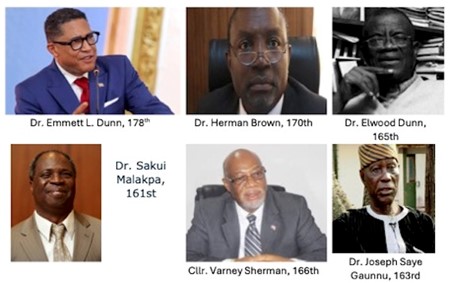
For this purpose of this feature, we would like to focus on the last fifty-three consecutive years (1972–2025), luminaries including Dr. Edward Beyan Kesselly, Dr. Elwood Dunn, Dr. Joseph Saye Gaunnu, Dr. Sakui Malakpa, Cllr. Varney Sherman, Dr. Herman Browne, and culminating most recently in the incisive address by the one hundred seventy-eighth Independence Day’s orator, Rev. Dr, Emmett L. Dunn, have seized this hallowed platform. Their purpose transcends mere commemoration; they consistently deploy it as a catalyst to challenge national complacency, rigorously interrogate the past, boldly reimagine the future, and forcefully redefine Liberia’s national trajectory.
Crucially, Rev. Dr. Dunn, like his predecessors, echoed vital recommendations from past orators’ prescriptions the political elites have persistently failed, or refused to implement. This inescapable pattern forces a disturbing question: Why summon the nation’s sharpest minds to diagnose its ailments and prescribe visionary solutions, only to consign their hard-won wisdom to neglect? The chasm between the orators’ courageous insights and the ruling elites’ inertia renders the tradition not merely ignored, but tragically symbolizes a solemn, eloquent dissent met with resounding official indifference, perpetuating the very cycles the orators strive to break.
The Orator’s Mandate: Courage Over Ceremony
Each orator undertook intensive scholarly research, transforming their address into a state of the nation discourse. Far from ceremonial, this tradition becomes a crucible for intellectual audacity. They interrogate history not to dwell on past failures, but to forge pathways toward justice and renewal.
Dr. Edward Beyan Kesselly: The Catalyst of Critical Reflection
The independence oration delivered by Dr. Edward Beyan Kesselly in 1972 in Sanniquelle, Nimba County set an enduring precedent. His address was revolutionary. With fearless scholarship he:
Challenged Colonial Symbolism:
Called for renaming Monrovia, arguing that honoring U.S. President James Monroe (a slaveowner who supported colonization) perpetuated psychological subjugation.
Critiqued the national motto, “The Love of Liberty Brought Us Here”, as exclusionary. It centered the experience of freed African American settlers while erasing the liberty of Indigenous Africans who already inhabited the land thousands of years before the settlers’ coming.
Questioned the very name “Liberia” (derived from “liberty”), exposing the irony of its founding by colonizers who marginalized native populations.
Faced Elite Backlash:
Kesselly’ s critique threatened the foundational myths underpinning the settler who dominated the True Whig Party (TWP) regime. Political elites and their supporters vilified him, issuing threats and branding him unpatriotic. His courage lay in exposing uncomfortable truths during an era of entrenched hegemony.
Unexpected Vindication:
In a historic validation, President William R. Tolbert (1971–1980) appointed Kesselly as Minister of Information, Cultural Affairs, and Tourism. Later, he was appointed Minister of Post & Telecommunications and Minister of Internal Affairs. Tolbert’s recognition signaled that Kesselly’ s “positive reading” of history, though initially suppressed, resonated with a leader who was open to reform.
Legacy of Intellectual Bravery
Kesselly’ s legacy infused the orator’s role with a mandate for bold truth telling. Subsequent orators, though operating in shifting political climates, continued this tradition:
– Dr. Elwood Dunn (2012): A historian who dissected governance failures and advocated for inclusive nationalism.
– Cllr. Varney Sherman (2013): Addressed post-war reconciliation amid Charles Taylor’s shadow, emphasizing rule of law.
– Dr. Sakui Malakpa (2010): Focused on education reform as the bedrock of national progress.
– Rev. Dr. Emmett L. Dunn (2025): Represents continuity in a nation still grappling with corruption, inequality, drug abuse, youth unemployment, messy education and poor health care systems and identity. Now the question is will President Boakai listen and act? And not be like his predecessors? We will wait to see.
Why Their “Positive Reading” Matters
Illuminating these orators’ impact (Dr. Kesselly, Dr. Elwood Dunn, Dr. Hermen) Browne, Dr. Edward Wilmot Blyden, Didwho Tweh, Garratsen Gibson Jr., Momolu Massaquoi, etc.):
Avoiding Past Wrongs: By dissecting Liberia’s origins, settler supremacy, systemic exclusion they exposed cycles of repression demanding rupture.
Advancing Lives: Their proposals (decolonizing names, inclusive mottos, equitable policies and identifying a common heritage) were blueprints for “structural” improvement. Kesselly’ s call, for instance, foreshadowed later movements to decolonize African toponymy and historiography.
The Cost of Truth: Their reception varied from Tolbert’s embrace to threats from elites proving that “reading positively” is often a radical, contested act.
History as a Compass
The National Orators embody vision: they transformed Independence Day from ritual into reckoning. Kesselly’ s 1972 address remains a beacon, reminding us that nations thrive when leaders confront historical ghosts not with nostalgia, but with the courage to reimagine. As Liberia navigates its future, this lineage of critical patriots from Kesselly to Rev. Dr. Emmett L Dunn stands as testament to the power of history, “read positively”, to illuminate the path toward a more just society.
What President Boakai Must Do Now – Listen to Liberia’s Song
Rev. Dr. Dunn’s wisdom resonates profoundly: “When a stranger enters a town, he must listen to the songs the children sing, for they carry the truth of that place the good and the bad.” President Boakai, you arrived at the head of government as the “stranger” to the entrenched system of power.
The song Liberians are singing now is a chorus of urgent needs and deep-seated problems. Heeding message of this song isn’t just wise governance; it’s the only path to the Rescue Mission’s legacy and Liberia’s true transformation. Here is a detailed expansion of the critical recommendations and the compelling reasons for their immediate implementation.
Corruption: The Enduring Cancer (Since 1822): Corruption as defined by the UN as “the misuse of public power… for private benefit,” has plagued Liberia since independence. Over 53 years, successive administrations have failed to effectively combat it. Tolbert’s efforts were unsuccessful, Sawyer prioritized peace over tackling corruption, and Sirleaf famously termed it a “VAMPIRE” while later admitting her own inadequacy. We saw allegations under President Weah point to corruption across all branches, supported by emerging audits. We are seeing allegation of corruption in the current administration.
Corruption has clearly infiltrated all sectors of the government including the Judiciary. Supreme Court Justices, including Morris, Korkpor, Wolokollie, and Kaba, have acknowledged its presence in forms like bribery, extortion, influence peddling, cronyism, and nepotism (as reported by the New Dawn, May 8, 2024). Development partners share this concern.
While rampant in all branches over the past 18 years, it alleged that corruption is most overt in the Legislature. This raises a critical question: if the branch responsible for oversight is itself corrupt, can the other branches be cleaned? The answer is a resounding “NO”. This failure is starkly illustrated by the Legislature’s refusal to investigate its own members regarding the Western Cluster case, where $14 million owed under a ratified Mineral Development Agreement was waived.
The Song: A weary lament of stolen resources, stunted development, and eroded trust. It is a song about impunity for the powerful while the masses suffer the consequences of graft. The ostentatious behaviors of some officials anger the population.
This flaunting behavior caused the CDC the 2023 election. Mr. president, tell you officials that we do not run government on Facebook That does not do the work to improve the lives of the masses. We saw this in Weah’s Administration. Why continue it?

