

By Festus Poquie
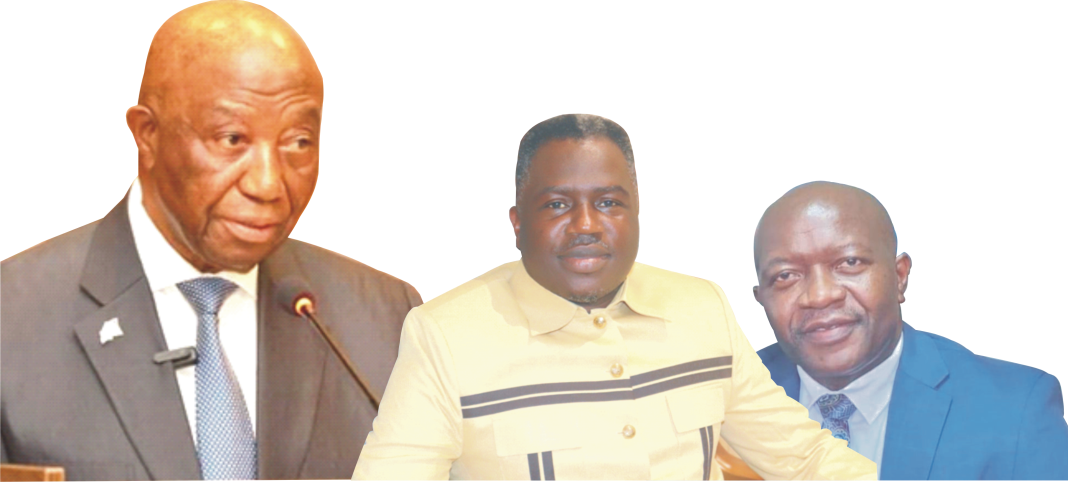
President Joseph Boakai has moved to place Vice‑President Jeremiah Koung at the centre of Liberia’s economic response, effectively sidelining Finance Minister Augustine Kpehe Ngafuan from key operational duties as the government grapples with soaring prices and public concern over the cost of living.
Koung has been convening staff from the Ministry of Finance and Development Planning (MFDP) at his Capitol Building office and was given a 45‑day mandate to “review the economy and achieve price stability.”
With roughly one week remaining in that timeframe, the Vice‑President is expected to report his findings to the President.
The decision seemingly signals a lack of full confidence in the MFDP’s handling of the economy. The ministry, whose remit includes fiscal policy, revenue mobilization and development planning, technically remains headed by Minister Ngafuan on paper — but the practical lead on urgent macroeconomic stabilization now rests with Koung.
The reassignment follows public acknowledgements by President Boakai that his administration has struggled to rein in the rising cost of living. Speaking on Independence Day, July 26, Boakai said that despite “steady progress” in some areas, domestic revenue remained limited, and many households continued to face high prices for essentials including flour and sugar, as well as elevated transport costs.
His comments stood in contrast to a Central Bank of Liberia Monetary Policy Committee assessment issued three days earlier, which reported that inflation moderated to 11.1% in the second quarter from 12.5% in the first quarter, largely due to falling food prices.
The discrepancy between official inflation data and President Boakai’s on‑the‑ground observations prompted him to establish a High‑Level Presidential Ad‑Hoc Committee led by Koung to probe why consumers were not feeling the reported easing.
Policy coordination under scrutiny
The committee’s formation raises questions about the effectiveness of Liberia’s Economic Management Team (EMT), an inter‑ministerial body chaired by the President and including Koung.
Reactivated on August 1, 2024, the EMT is responsible for aligning fiscal and monetary policy, accelerating reforms, and strengthening regulatory oversight, including implementation of the Public Financial Management law under the administration’s ARREST Agenda for Inclusive Growth.
Analysts say the reallocation of responsibilities could reflect concerns about policy coordination and the need for a visible, central figure to drive fast results amid rising public pressure. It may also heighten perceptions of institutional uncertainty if roles are perceived as overlapping or opaque.
Tax reforms and fiscal tightening
Boakai’s administration has pursued a series of tax measures agreed with the International Monetary Fund to shore up public finances amid declining external revenues. Implemented over the past year, these measures — and further items in the 2025 budget law — are already affecting consumers, businesses and foreign investors.
Key fiscal changes include:
An increase in the standard Goods and Services Tax (GST) rate from 10% to 12% for certain goods and services; Reintroduction of a petroleum surcharge of USD 0.20, effective March 21, 2025; Stricter enforcement of a minimum corporate income tax on a quarterly basis; Collection of taxes on imported petroleum products at the import stage to curb under‑declaration and smuggling; Removal of a fuel tax exemption previously granted to a major mining company; Administrative improvements to personal income tax collection.
The reforms mirror fiscal consolidation measures seen in other African economies but carry political risk: similar increases have provoked unrest elsewhere, notably in Kenya, and have drawn scrutiny from civil society and the business community in Liberia.
Business and investor implications
For traders and companies operating in Liberia, the new tax regime and continuing public dissatisfaction with prices create immediate implications for costs, margins and consumer demand. The Freeport of Monrovia — managed by three companies that levy various fees on traders — remains a critical node where import costs and customs processes can further shape price trajectories.
Market watchers will be watching the outcome of Koung’s 45‑day review for any short‑term interventions to ease prices (subsidies, targeted relief or trade measures).
President Boakai, who narrowly won the November 2023 election on promises to tackle the cost‑of‑living crisis and build a middle‑income economy, has shifted policy several times since taking office — notably removing, and later reinstating, a fuel tax.

