

Some of the world’s lowest-income and most aid-dependent nations are paying millions to lobbyists with ties to US President Donald Trump as the country halts foreign assistance, a new Global Witness investigation has found.
Many of these countries are home to one or more armed conflicts and are offering access to valuable natural resources, including minerals or other strategic assets, in exchange for humanitarian or military support.
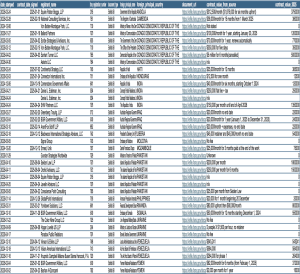
Since the US election in November 2024, 17 of the world’s Least Developed Countries and largest recipients of US aid – Angola, Cambodia, the Democratic Republic of Congo (DRC), Haiti, Honduras, India, Iraq (Kurdistan), Liberia, Moldova, Mozambique, Pakistan, the Philippines, Rwanda, Somalia, Ukraine, Venezuela and Yemen – have signed lobbying contracts with US firms worth more than $21 million in fees paid until end-2025.
What’s more, documents filed with the US Department of Justice reveal that firms with ties to Trump and his inner circle are cashing in.
They have negotiated contracts worth more than $17 million in fees due in 2025 in the six months since Trump was elected, records submitted under the Foreign Agents Registration Act (FARA) show. Liberia lobbying contracts is valued at $540,000
Relative to the size of their economies, $17 million paid by these nations would be equivalent to the US paying out nearly half a billion dollars.
This comes at a time when access to natural resources has become a Trump fixation. This includes minerals like rare earths that are considered critical to US security, whose supply chains are controlled by China.
From threatening to annex mineral-rich Greenland, to waging a trade war and seeking to boost domestic production including by mining the deep seabed, mineral access has become central to Trump’s agenda.
While the revolving door between governments and lobbyists is nothing new, and countries seeking influence over US decisions that could significantly affect them is to be expected, Global Witness is concerned by the wider dynamics that are driving new deals.
“We’re seeing a dramatic cut in aid, combined with an explicit rush for critical minerals, and willingness by the Trump administration to secure deals in exchange for aid or military assistance,” said Emily Stewart, Head of Policy, Transition Minerals at Global Witness.
“These dynamics create a potential situation where dealmaking in Washington is more desperate, less favourable to low-income countries and more open to resource exploitation at the expense of impacted communities.”
Our analysis of lobbying documents reveals that of the 17 countries that have signed lobbying deals, eight are pitching new investment opportunities.
Some of these proposals echo a minerals deal signed in April with Ukraine, which will give the US preferential rights to its mineral and oil and gas reserves in return for support in the war against Russian aggression.
Like Ukraine, nine other countries that have signed new lobbying contracts are resource-rich nations that are home to one or more armed conflicts. This includes the DRC, which is negotiating a minerals-for-security deal with the US.
Monthly fees for lobbying contracts can run up to hundreds of thousands of dollars. To represent Angola, Squire Patton Boggs, a firm with established links to Trump, collects $312,500 per month.
Some firms have commissioned third parties with access to Trump to carry out their contracts.
Seiden Law, which won a deal in April worth $200,000 a month to “promote the exploration and sale of” rare earth and other critical minerals on behalf of Pakistan, outsourced the contract to a firm owned by Trump’s former bodyguard, Keith Schiller.
Global Witness reached out to all the firms named in this report to give them an opportunity to comment on our findings.
Putting America first
Many countries hit by conflict and facing humanitarian crises have historically relied heavily on US aid. But in late January, Trump froze over $60 billion in foreign aid programmes.
The order left millions of vulnerable people without access to critical care, including food, clean water and basic health services.
At the same time, Trump stressed that every dollar of overseas spending must put America first, to make the US safer, stronger or richer.
US aid has often had strings attached. But many of the deals now being proposed, which are detailed below, are explicitly transactional, tying US political, humanitarian or military support to Trump’s “America First” agenda.
-Global Witness

