

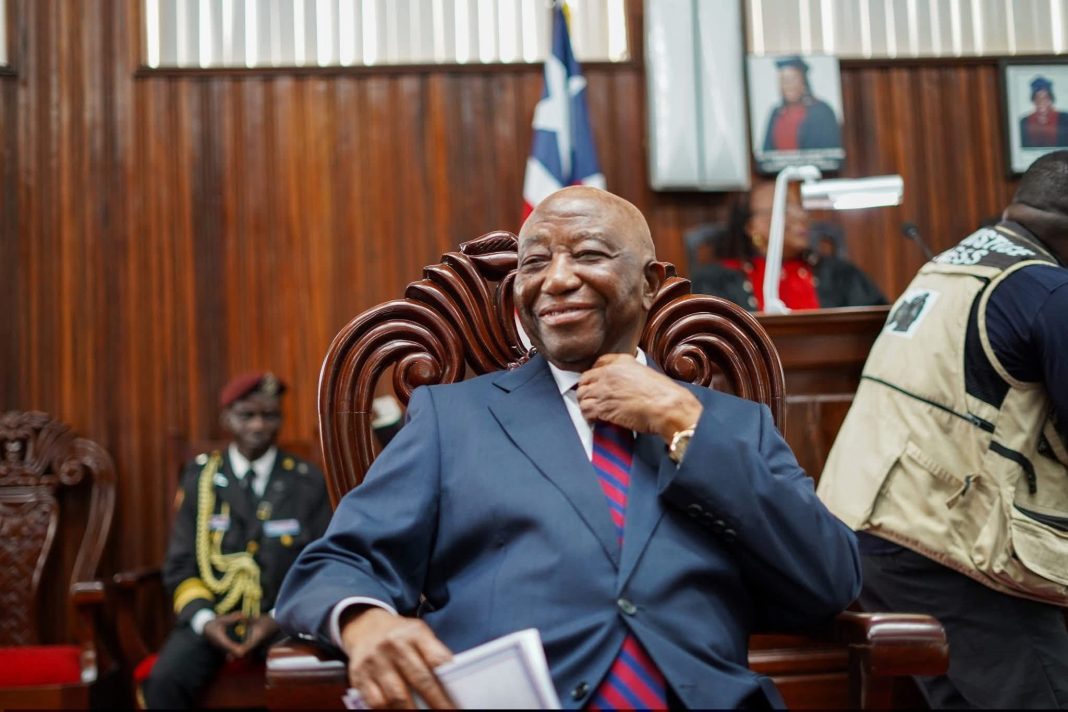
Liberian President Joseph Boakai used a high-profile appearance at the MEDays Forum in Tangiers to set a clear benchmark for incoming foreign investment: deals must deliver equitable revenue sharing, sustainable infrastructure, strong environmental, social and governance (ESG) safeguards, and measurable local benefits.
Boakai framed his expectations around the administration’s ARREST Agenda, which prioritizes local value creation, accountability mechanisms and transparency.
“Under my leadership the country would offer an environment where investment flourishes, grounded in ethics, the rule of law, international best practices, and the strict enforcement of contracts,” he said, urging that Africa’s natural resources be leveraged first to uplift local communities.
Two headline proposals which appear to align with this framework are TotalEnergies’ offshore production-sharing contracts and Ivanhoe Atlantic’s rail-and-port concession.
TotalEnergies signed four offshore production-sharing contracts (PSCs) with Liberia in September 2025 covering about 2,700 square kilometers south of the Liberia Basin.
The company’s plans incorporate enhanced transparency provisions, environmental safeguards and local content commitments designed to avoid past industry pitfalls.
If ratified by the Legislature under the conditions Boakai demands, the accords could restart a petroleum sector that has been largely inactive for more than a decade and generate revenue, jobs and upstream service opportunities for Liberian firms.
Ivanhoe Atlantic is seeking legislative approval for a $1 Billion Concession and Access Agreement (CAA) to rehabilitate and expand the Yekepa–Buchanan rail corridor and associated port facilities.
The project envisages an initial US$64 million phase to restore tracks, upgrade access roads and port infrastructure, enabling 2–5 million tonnes per annum (mtpa) of iron-ore exports. A second phase could entail up to US$888 million in further upgrades to scale capacity toward a potential 30 mtpa total.
Ivanhoe’s bid emphasizes local employment, training and community investment. The company plans to create 500 direct jobs in the initial construction and operational stages, and an estimated 3,000 indirect jobs across ancillary sectors, and a Community Development Fund starting at US$1 million annually and growing to US$5 million after five years.
The CAA also builds on a bilateral implementation agreement between Liberia and Guinea intended to facilitate cross-border trade in line with regional integration goals such as the African Continental Free Trade Area, ECOWAS and the Mano River Union.
The economic upside is clear: renewed oil activity could broaden export receipts and energy-sector investment; rail and port upgrades could unlock mineral export volumes, generate fiscal receipts, and stimulate downstream services. Both projects promise skills transfer and local supplier opportunities if local-content clauses are effectively enforced.
Legislative scrutiny and transparent implementation will be crucial to ensure revenue-sharing mechanisms, community compensation and environmental protections are effectively enforced in collaboration with these companies.
Aberrance to Boakai’s benchmark will ensure that natural resource deals become catalysts for sustained growth.

