

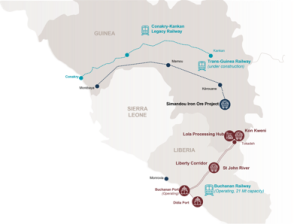
Senior officials of President Joseph Boakai’s administration told a legislative committee they support Ivanhoe Atlantic’s planned access to the Yekepa–Buchanan railway, saying any Concession and Access Agreement (CAA) will be implemented in line with the bilateral Implementation Agreement (IA) between Liberia and Guinea.
At Tuesday hearing of the House Specialized Committee on the 2021 Implementation of the Access Agreement, chaired by Bong County Representative Foday E. Fahnbulleh, Deputy Minister of Justice for Economic Affairs Charles Karmoh, Deputy Minister for Administration at the Ministry of Foreign Affairs Gabriel H. Salee and a representative of the National Investment Commission outlined the government’s position on the cross-border framework.
The officials explained the IA — signed by Liberia and Guinea in 2019 and ratified in 2021 establishes the legal framework for mining operators from Guinea to use Liberian rail and port infrastructure on equal terms.
They told lawmakers that the ongoing review of Ivanhoe Atlantic’s CAA, which would permit the joint venture Societe des Mines de Fer de Guinee (SMFG) to export ore via the Yekepa–Buchanan line, will follow Liberia’s domestic approval processes and remain consistent with the IA’s provisions.
Government representatives provided clarity to the Joint Committee on Investment & Concessions, Judiciary, and Transport on the level of compliance.
They said that the IA preserves each country’s sovereignty and that access requests must be evaluated by the respective national authorities.
The IA sets out procedures for determining operator eligibility and establishes interministerial and monitoring committees (IMMCs) to oversee cooperation and resolve technical issues.
They explained that these committees are intended to monitor implementation and facilitate coordination, not to override national decisions about approval or revocation of access.
If ratified by Liberia’s Legislature, the Ivanhoe Atlantic CAA would implement the access rights defined in the IA rather than create new cross border entitlements, officials said.
They argued the arrangement could expand regional trade, create jobs, and improve infrastructure connectivity in Liberia and Guinea, while setting a precedent for future users of the corridor beyond the mining sector.
Lawmakers on the committee continued to scrutinize legal and technical aspects of the agreement as they consider the CAA’s passage.

