

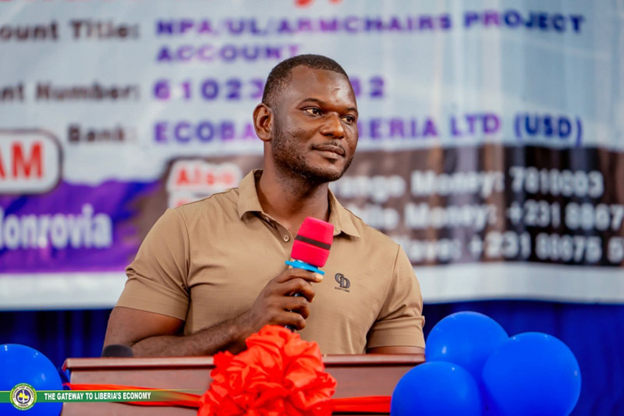
A renewed sense of responsibility is sweeping through Liberia’s education sector as the National Customs Brokers Association of Liberia (NCBAL) pledged support to the University of Liberia (UL), joining national efforts to restore the prestige of the country’s flagship institution of higher learning.
The commitment was announced during a landmark US$1 million fundraising program hosted by the National Port Authority (NPA) under the theme “Coming Together to Revitalize UL.” The event drew leaders from both public and private sectors, signaling a growing consensus that the university’s decline must be reversed if Liberia is to strengthen its human capital base.
NCBAL President James Hinneh framed the initiative not merely as philanthropy but as a strategic investment in Liberia’s economic future. He personally contributed US$500, matched by another US$500 from the association, underscoring the principle of leadership by example. “Education remains the foundation of national development,” Hinneh declared, stressing that improved infrastructure, sanitation, and learning facilities are essential to student performance and national productivity.
Hinneh’s remarks carried weight beyond symbolic support. He linked UL’s revitalization directly to the operational efficiency of Liberia’s trade, logistics, and maritime sectors. The university, he argued, is a pipeline for customs officers, logistics managers, port administrators, and policymakers—professionals whose expertise is indispensable for modernizing trade systems, strengthening revenue collection, and ensuring compliance with international standards.
This framing highlights a critical dimension often overlooked in discussions about higher education: universities are not only centers of learning but also engines of workforce development. By situating UL’s challenges within the broader context of national competitiveness, Hinneh effectively shifted the narrative from charity to necessity. His call for sustained investment in education reflects a recognition that Liberia’s economic growth is inseparable from the quality of its institutions.
The fundraising drive also raises questions about the adequacy of state funding for UL. While private sector contributions are commendable, the reliance on external fundraising underscores persistent gaps in government support. For a university that serves as the country’s premier public institution, the sustainability of such initiatives will depend on whether they complement or substitute for long-term state investment.
Moreover, the event illustrates a growing trend of cross sector collaboration in Liberia. The partnership between NPA, NCBAL, and other stakeholders suggests an emerging model where national institutions and private actors jointly shoulder responsibility for education.
This approach, if institutionalized, could strengthen accountability and diversify funding streams. Yet it also demands vigilance to ensure that private influence does not compromise academic independence or equity in access.
Hinneh’s appeal to stakeholders nationwide reflects a broader call for collective responsibility. “When we support the University of Liberia today, we are building a stronger economy for tomorrow,” he concluded. The statement encapsulates the dual logic of the initiative: education as both a social good and an economic imperative.
The fundraising program marks a significant step toward revitalizing UL, but it also serves as a reminder that the university’s future hinges on consistent, transparent, and strategic investment. For Liberia, the challenge is not only to raise funds but to ensure that they translate into measurable improvements in teaching, research, and student outcomes.

