

By Mohammed Kromah
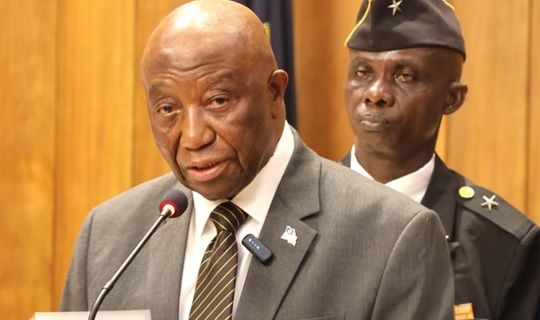
When President Joseph Boakai broke ground on a $20 million Justice Complex, many people clapped. A new building. One location. No more rent. Sounds responsible. But here’s the plain truth: when you’re poor, you don’t spend scarce money on buildings that don’t produce anything. You can’t eat a building. You can’t power a city with a building. You can’t grow an economy with a building. And Liberia is still poor.
Let’s talk simple math. Let’s be generous and say the Justice Complex saves $5 million a year in rent. Over 20 years, that’s $100 million saved. That sounds good—until you understand the dirty secret. The building is not being constructed because it is the best economic option. It is being built for other reasons, and I’ll explain why.
But first, ask the real question: what else could $20 million do in a country that lacks food security, power, and jobs? Let’s slow this down and make it concrete. If Liberia spent $20 million on development today, here is exactly what that money could realistically build using proven technology already operating across Africa.
Power has to come before production. Five million dollars can build five megawatts of solar power—enough to power a full agro-processing complex, keep cold storage running 24 hours a day, eliminate dependence on diesel generators, and stabilize local electricity supply. No fuel imports. No generator noise. No bleeding foreign exchange every night. Just sunlight turned into electricity that works every day.
Once power is secured, production becomes possible. The remaining $15 million can build an integrated agricultural processing complex—not a warehouse, but a full system. That includes cold storage for fish, poultry, vegetables, and rice; rice milling and packaging facilities; cassava and palm oil processing lines; sorting, grading, and packaging equipment; on-site logistics, loading bays, and storage; and basic worker facilities and housing.
This is where crops stop rotting in the bush and start turning into income. This is where farmers stop selling cheap and start selling finished products. This is where food stops being imported and starts being produced.
Here’s how the money actually circulates. Farmers bring crops to the facility. The facility processes them. Finished products are sold to markets, hotels, exporters, and retailers. Importers lose market share. Money stays inside Liberia. Every bag of locally processed rice pays a farmer, a machine operator, a truck driver, a technician, electricity bills, and generates tax revenue. That’s how economies grow—not with buildings, but with circulation.
Conservatively, one $20 million system like this produces about $6 million per year in processing fees and value-added revenue, creates over 1,000 permanent jobs across farming, processing, logistics, and maintenance, processes roughly 30,000 tons of local crops annually, avoids $40–50 million per year in food imports, and provides reliable electricity that does not shut down at night.
Most importantly, that revenue does not disappear. It funds maintenance, expansion, new facilities, and the next phase of development. One project becomes two. Two become four. That is compounding.
Now put that next to the Justice Complex. The Justice Complex produces no food, generates no power, creates no revenue, employs people temporarily, and requires maintenance forever. When the ribbon is cut, the story ends. With the processing system, the ribbon is only the beginning. That is the opportunity cost of this $20 million decision.
So why choose the building? Because buildings are visible. They finish fast. They photograph well. They’re ready before elections. In 18 to 24 months there will be a ribbon cutting—cameras, flags, headlines, “developmental Azeebo.”. That’s how developmental azeebo works.
Processing plants don’t look sexy. Power infrastructure doesn’t fit on a campaign poster. And if a project isn’t fully operational before an election, the credit can disappear. If President Boakai builds a facility that only becomes productive in 2029 or later and he loses the election, his successor cuts the ribbon and takes the praise. That’s not stupidity. That’s political incentives.
The Jimmy Carter lesson explains why leaders avoid long projects. President Jimmy Carter negotiated for 444 days to free American hostages in Iran. They were released minutes after Ronald Reagan was sworn in. Carter did the work. Reagan got the credit.
Carter lost the election. Since then, politicians everywhere learned the same lesson: never start what you can’t finish before voters return to the polls. Liberian presidents are no different. Ellen built ministerial buildings. Weah built parks and patched roads. Boakai is building a Justice Complex. Different leaders. Same system.
Roads and buildings matter, but they are passive infrastructure. They don’t generate revenue, they require maintenance, and their benefits are slow and indirect. Systems like power generation, waste-to-energy, and food processing are active infrastructure. They create revenue, create jobs, and fund the next phase of development. Poor countries can’t afford prestige projects. Rich countries can.
Liberia’s entire recurring infrastructure budget is about $87 million per year. When you only have $87 million to cover power, water, food, roads, health, and schools, spending $20 million on an office building is not a neutral choice. It’s a trade-off. And we’re trading transformation for visibility.
This isn’t about Boakai. President Boakai is acting rationally inside a broken system. President Weah did the same and so did Ma Ellen. The system rewards short-term visibility, ribbon cuttings, and projects that finish before elections. It punishes long-term planning, multi-administration projects, and compounding infrastructure. That’s why we keep getting buildings instead of systems.
Before construction continues, Liberians deserve answers. Where exactly is the $20 million coming from? What infrastructure projects are being delayed or canceled to fund this building? Were revenue-generating alternatives considered? What is the projected economic return compared to other options? These aren’t attacks. They’re basic accountability.
Final truth: Liberia doesn’t lack smart people. It lacks a system that rewards long-term thinking. Development requires leaders willing to plant trees they may never sit under—leaders willing to do the work even if someone else gets the credit. Until then, we’ll keep getting buildings, and Liberians will keep waiting for development.

