

By George K. Werner (former education minister)
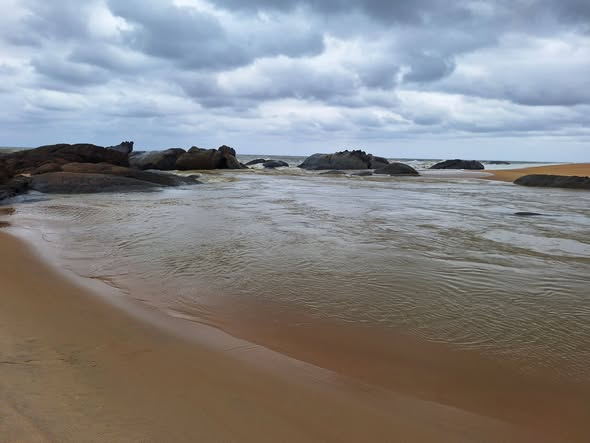
Under the Coalition for Democratic Change administration, something both quiet and consequential unfolded in Grand Cess, a small coastal town in Grand Kru County. It did not begin with politics in the traditional sense. It began with a river—the Nugba (Nigba), an internal river that runs through Barclayville and Topoh before emptying into the Atlantic Ocean. Over time, its waters turned brown—thick with sediment, disturbed by mining activities that had gradually taken hold along its banks.
But the Nugba is not just a river.
Like many rivers across Liberia, it carries meaning beyond water. Along its banks, generations have buried their dead. At its mouth—where the river meets the Atlantic—rituals are performed, sacrifices made for farming seasons, for protection, for continuity. The river is not only an economic lifeline; it is a spiritual one. It holds memory. It holds mystery. It anchors the identity of the town.
To disturb such a river is not simply to pollute water. It is to disrupt a worldview.
For the people of Grand Cess, this was not an abstract environmental issue. It was immediate. Fishermen began to notice unusual activity along the coast—machine boats arriving in a town where such vessels had no natural place. Onboard were foreign miners, many reportedly from Ghana, brought in through arrangements that were not entirely invisible to the community. Excavators followed. Trucks followed. And slowly, the river that sustained livelihoods—and traditions—began to lose its clarity, its fish, and its meaning.
What makes the Grand Cess story particularly powerful is that it was documented in real time—not first through formal reports, but through community voices. Across local Facebook pages and Grand Kru community networks, posts began to surface showing mining equipment operating directly in and around the Nugba River. The message was consistent: the water had changed, fishing grounds were disappearing, and livelihoods were under threat. In post after post, residents described the same reality—machines in the river, foreign miners arriving by boat, and a community watching its lifeline slip away.
And then the women acted.
They organized. They protested. They carried their concerns from Grand Cess to Barclayville. These were not armed actors. They were not backed by institutions. They were unarmed women—mothers, fish processors, farmers—raising their voices in defense of a river that feeds both body and spirit. And for the most part, those voices were ignored by their own government.
But beneath this environmental and cultural story lies a deeper, more uncomfortable truth—one about how local governance itself is structured.
In many of these communities, the system of local leadership selection has become entangled with the political economy of extraction. To make this kind of exploitation possible, local leaders are often chosen—or sustained in their roles—because they align with county and national political interests. City mayors, paramount chiefs, town chiefs: their authority, in some cases, becomes less about representing their people and more about facilitating access—to land, to rivers, to resources.
It is not always formal. It is not always written. But it operates like an understanding—sometimes even a condition. Alignment brings appointment, recognition, or protection. Resistance risks marginalization.
In such a system, community leadership is inverted. Those who should defend the river—its water, its meaning, its sacred spaces—are drawn into the very networks that exploit it. Silence becomes part of the arrangement. And when communities protest, they are not just confronting miners—they are confronting an entire chain of aligned authority.
This is where Grand Cess stops being a local story—and becomes a regional warning.
Because what we are witnessing between Liberia and Guinea today—the tensions, the reported crossings of Guinean soldiers into Liberian territory, the anger among border communities—cannot be fully understood without looking beneath the surface.
Along that northern frontier flows the Makona River—a boundary river, historically recognized as part of the line separating Liberia and Guinea. Unlike the Nugba, which speaks to internal governance failure and cultural disruption, the Makona represents sovereignty, territory, and contested space.
Yet the forces shaping both rivers are connected.
The same political economy that is turning the Nugba brown—elite capture of resources, weak regulation, and local complicity—is also shaping behavior along the Makona corridor. That border region sits atop one of West Africa’s most resource-rich zones, stretching from Nimba through Guinea toward Sierra Leone. Iron ore, gold, and other minerals have attracted major actors such as ArcelorMittal and others alongside a dense web of informal and politically connected operators.
In such a context, boundaries are not just lines—they are assets.
Who controls which side of a river?
Who has access to what lies beneath it?
Who grants permission where maps, history, and interests overlap?
When governance is strong, these questions are resolved through diplomacy and institutions. When it is weak, they spill over—sometimes literally.
What may appear as a security issue—a border crossing, a raised flag, a military presence—often has deeper roots in competition over land and resources. And when political and economic interests intertwine, the line between resource control and territorial assertion becomes dangerously thin.

