

By Varney Kamara
MONROVIA – Years ago, women in Wedjah and Jaedae Districts in Sinoe County processed cassava with their bare hands. Their story has changed for the better. They now use motorized mills, locally called garri machines, to grind their cassava before processing it. The grinders significantly reduce their labor inputs while increasing production, enhancing their businesses and improving their livelihoods.
“Since it was introduced, women’s involvement in business activity in the community has increased. We see more provision shops being built,” says Wratee Boyee, a community leader in Jeadea District.
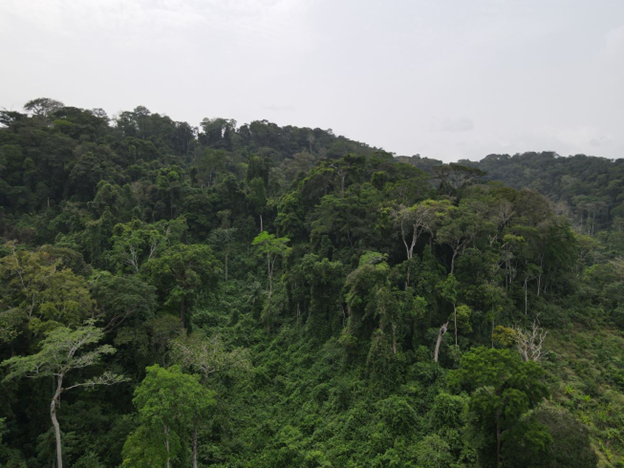
The flourishing cassava businesses are some of the results of a trial of a new conservation method known as payment for stewardship. Launched last July, the program enables communities to receive direct cash benefits and livelihood interventions to help keep their forests standing. Experts say the program shows great potential to improve lives in rural communities, though it is too early to measure its full impact.
The program intends to protect between 300,000 and 500,000 hectares of forest, with a total investment of US$3.4 million by 2030. It is jointly implemented by Integrated Development and Learning (IDL), a Margibi-based NGO, and the Forestry Development Authority (FDA).
“FDA strongly believes that this project will lead to the enhancement of sustainable forest management, forest conservation, including legal compliance and enforcement,” said Myers Tweh Jr., assurance and compliance manager at the FDA. “It will lead to the implementation of reward-based mechanisms that would reduce pressure on the forest.”
Under the trial, Wedjah is protecting 7,131 hectares, and Jaedae 43,543 hectares after meeting payment requirements. Both communities have received a combined payment of US$150,622 at the rate of US$1.50 per hectare yearly, according to payment records. Wedjah got US$21,393 for the two years the trial has been running, while Jaedae secured US$129,229 for the same period. Moreover, local forest guards receive training, a monthly compensation, protective gear, and GPS-programmed gadgets for monitoring.
Both Wedjah and Jaedae are on the buffer with the Sapo National Park, Liberia’s largest protected area, and the Proposed Grand-Kru-River-Gee Protected Area. They host wildlife such as chimpanzees and other species typical of Liberia’s rainforest, the largest remaining in West Africa.
In exchange for cash and the other benefits, Wedjah and Jaedae do not mine, farm, log, or build new homes in their forests. They harvest timber and non-timber products for community use only. They signed an agreement last June.
Environmentalists say the payment for stewardship helps reduce local communities’ dependency on the forest resources and contributes to the fight against climate change. Between 2002 and 2024, Liberia lost 390,000 hectares of primary forest, according to the Global Forest Watch. Agriculture, logging, mining, illicit activities and a recent cocoa boom in the southeast are the contributors, undermining conservation efforts.
Game-changer
Payment for stewardship breaks away from the past, when communities were at the margins of conservation efforts. In contrast, the program places communities at the core of conservation efforts. They protect the forest and decide what to do with the resources.
“We ensured that no one was excluded from the process,” recalls Silas Siakor, the executive director of IDL, “because, when you exclude others, there is a natural tendency for a whole community to go against you.”
“We wanted to do something very simple: we wanted communities to be provided direct incentives to protect their community forests,” adds Siakor.
Overall, the stewardship is intended to develop a community-led benefit-sharing mechanism. Currently, that is the duty of the Benefit Sharing Trust Board, which regulates resources for logging concessions. However, the new program recommends a channel that incorporates mining, agriculture, and climate finance.
Similarly, the payment for the stewardship program readies communities for climate financing, environmentalists say. Liberia is developing a carbon policy framework.
An independent assessment reviewed the new program’s activities and payment performances and found positive behavioral changes among locals.
The most visible success of the scheme comes from the investments in livelihood activities, largely driven by village loan groups that provide savings and low-interest loans to members. IDL works with more than 52 in Sinoe; 20 in Wedjah and Jaedae.
“In 2025 alone, the [village loan scheme] generated more than L$50 million (US$263,000) from their village saving activities, more than what the amount the communities received for keeping their forest standing,” says Silas Siakor.
A section of a farm on the edge of a forest in Jaedae District, Sinoe County, in 2025. The DayLight/Esau Farr
For the cassava processing, four machines have been strategically deployed in Wedjah, replacing the traditional method of grinding the cassava. The investment in livelihood is the primary attraction for women, according to Siakor.
In addition to the machines, Wedjah received three motorbikes to improve women’s access to the market and secure better prices for their garri.
“We see that women are forming more financial clubs in the community, the movement of goods and services has increased, and businesses are also flourishing,” Lasting Kadee, a community leader in Wedjah, said in an interview with The DayLight. “We want to give it out to them 100 percent for this program. It is really helping our people.”
Additional feedback
Despite the success stories, the independent assessment found the payment for stewardship to be “moderately strong” in that it was too early to grade the overall impact. The review took place six months into the program, needing more than to conduct a full-scale assessment. This, too, was compounded by bad weather and terrible road networks.
However, the assessment was conclusive regarding the challenges associated with the payment for stewardship. It found that the youth and elderly townspeople disagreed on how potential land disputes could be settled.
Also, it found that townspeople in Wedjah and Jaedae faced difficulty meeting and agreeing on projects due to long distances between communities. Townsfolk said they did not afford transportation to attend meetings, the assessment revealed.
“We saw that planning for the project was a difficult thing to do because you cannot get everybody in one location at the same time,” says Saah David, an environmentalist who led the assessment. “Nevertheless, based on our interactions with the different actors, I think it is a game-changing initiative with a lot of potential.”
David’s report recommends that youth participation, coordination, and improvement in communication and compliance safeguards would address challenges. It also recommends improvement in performance requirements and governance safeguards to meet the program’s challenges.
To meet these challenges, IDL wants to engage communities and support local forest bodies for long-term success.
“We intend to organize more discussions around these issues,” says Siakor. “The idea is to generate additional feedback from the different stakeholders, so that we can derive effective solutions to those issues that have been identified.”

