

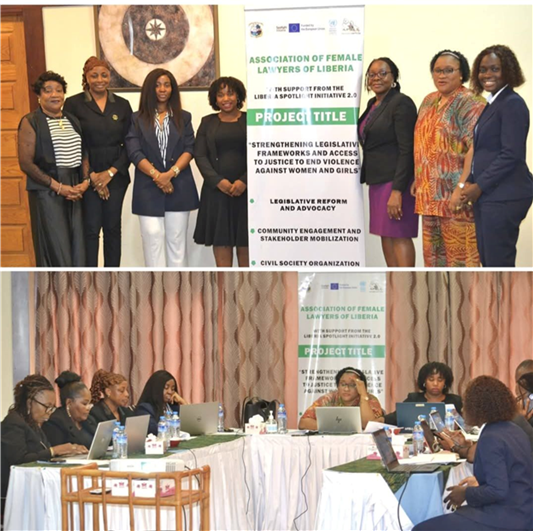
In a decisive stride toward advancing gender justice and strengthening legal protections, the Association of Female Lawyers of Liberia (AFELL), in partnership with national institutions and with technical support from UN Women Liberia, has concluded a two-day high-level legal review session in Monrovia.
The landmark gathering brought together legal professionals, policymakers, civil society leaders, and women’s rights advocates to confront Liberia’s legal gaps and chart reforms aimed at safeguarding women and girls.
The review, held in the capital, convened representatives from the Liberian National Bar Association, the Ministry of Gender, Children and Social Protection, human rights defenders, and legal scholars. Their mission: to scrutinize Liberia’s statutes and recommend reforms responsive to modern realities.
Over two days of intense deliberations, participants examined legislation on gender equality, domestic violence, sexual offenses, inheritance rights, child protection, and access to justice. Discussions underscored the urgent need to modernize laws to address emerging forms of gender-based violence, including cyber harassment and online exploitation. Stakeholders pressed for stronger enforcement mechanisms, improved survivor access to justice, and alignment of Liberia’s statutes with international human rights standards.
While acknowledging progress through reforms such as the 2006 Rape Law and the Domestic Violence Act of 2019, participants warned that implementation gaps, underreporting, and limited legal aid continue to undermine justice. “Strong laws are essential, but they must also be implemented effectively and reach every woman and girl, including those in rural communities,” one participant stressed.
Globally, UN Women reports that nearly one in three women experiences physical or sexual violence in her lifetime. In sub-Saharan Africa, weak enforcement and stigma remain formidable barriers. Liberia’s postwar recovery has seen notable milestones, including the election of Ellen Johnson Sirleaf in 2005 as Africa’s first female president. Yet activists argue that grassroots legal empowerment remains unfinished business.
The Monrovia session concluded with renewed commitments from all participating institutions to pursue practical reforms and collaborative action. Organizers emphasized that recommendations from the meeting will inform advocacy campaigns, legislative proposals, capacity building programs, and survivor centered interventions under Spotlight Initiative 2.0 — a global UNEU partnership to eliminate violence against women and girls.
The second phase of the Spotlight Initiative aims to deepen impact through stronger institutions, prevention strategies, and accountability systems. For Liberia, this means embedding gender justice into the nation’s democratic and developmental journey.
Stakeholders agreed that legal reform is not merely about changing statutes but about transforming lives. As Liberia continues to rebuild, experts insist that equal protection under the law for women and girls is central to sustainable peace, economic growth, and national progress.
The Monrovia review session thus stands as a milestone in Liberia’s broader struggle to build a justice system rooted in dignity, equality, and opportunity for all citizens — a bold reminder that the fight for gender justice is inseparable from the nation’s future.

