

By Festus Poquie
On a hot Friday that folded into Monrovia’s damp night, fifteen strangers in a narrow room did something that ricocheted beyond the Temple of Justice.
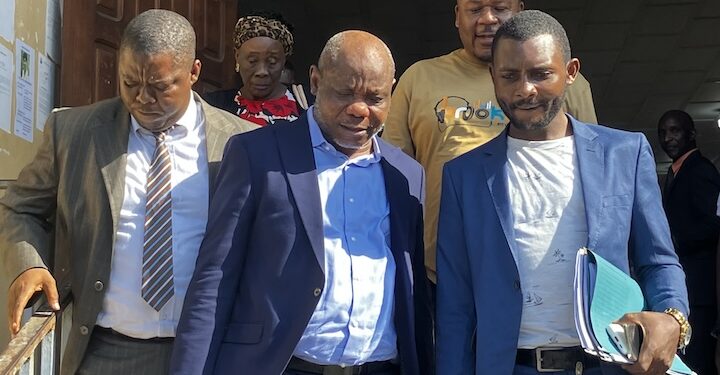
They rendered a unanimous verdict for Samuel D. Tweah, the lanky, plain‑spoken man who had run Liberia’s purse strings from 2018 to 2024.
Not guilty, on every count. Economic sabotage, criminal conspiracy, theft of public funds, money‑laundering—each charge fell away, one by one, beneath the weight of a jury’s simple, collective decision.
For nearly two years the trial had been a spectacle and a scalpel, excising a public controversy and exposing the seams of legal argument, institutional practice, and political animus that stitched it together.
The courtroom scenes—ritualized, small, precise—had the intimacy of a parish confession.
In April, the lead defense counsel, Cllr. Arthur Tamba Johnson, moved with the economy of someone who understands that questions are a lawyer’s tools.
Across from him sat Baba Borkai, introduced as the prosecution’s principal witness and a senior investigator with the Liberia Anti‑Corruption Commission.
There were other defendants, too: a former solicitor general, a national security advisor, and two figures from the Financial Intelligence Agency.
By the end of the first wweek, three of the five men were convicted on some charges, two were entirely cleared—Tweah and the former FIA comptroller. Two others were left in legal limbo with hung counts.
Tweah’s defense was, in public, almost doctrinal: a dense, statute‑based narrative that placed his acts within the National Security Reform and Intelligence Act and the Public Financial Management framework.
He answered questions on the stand for eight days and did so by drawing a line from the dry language of law to the messy exigencies of governance: transfers to operational accounts of security agencies, procedures for national‑security audits, and the practices of the Central Bank of Liberia.
Prosecutors, at various turns, indicated they would counter with financial and legal experts. They never did. Without that rebuttal, the minister’s account remained largely unchallenged in open court—an absence that would prove as consequential as any witness.
It is always useful, in moments like this, to look at what was not proved as much as what was. The prosecution began by alleging an “elaborate scheme” to divert roughly US$6.2 million through accounts associated with national security agencies and accused the men of using coded channels and the opacity of national security to cloak misappropriation. But when the focus shifted—forced by evidentiary gaps and the questions of the defense—toward accounting for operational spending, the prosecutors’ case lost its clarity.
Lead investigator Borkai conceded he had not pursued forensic accounting for the disbursed funds; he had concentrated instead on which agencies received money. In turn, a juror’s question about whether membership in joint security was limited to entities listed in statute prompted testimony that undercut the prosecution’s premise: that formal admission by the justice ministry was the sole route to participation. Small missteps, answered badly, compounded into a larger erosion of the state’s narrative.
Outside the courtroom, reactions were electric in their variety. Supporters of the ruling Unity Party—who had hoped the trial would be a public rectification of perceived Weah‑era excesses—were stunned into an argument over the next move: retrial, new charges, legal maneuvers.
Emmanuel Azango, a state oil company vice president, went on Facebook to demand that courts “carefully review and possibly set aside the jury’s verdict,” questioning the coherence of acquitting the former finance minister while finding others guilty of conspiracy.
Tweah, by contrast, offered absolution and gratitude. “A jury of my peers has set me free of all charges! To God Almighty be this GLORY!” he wrote; elsewhere he accused political opponents and journalists of circulating “garbage” that had damaged him and others.
There is a particular cruelty to losing a case you have publicly framed as moral clarity. For Tweah’s political enemies—the officials and zealots who made him a target—the verdict is less a factual reversal than an emotional one: a missed opportunity to put behind bars the man they called the most feared enemy. They had imagined, and perhaps believed, that a conviction would not only punish an individual but also serve as a catharsis for a country long wearied by graft. Instead they were left with the raw, human residue of disappointment: loud, public, and immediate.
The trial’s procedural history reads like a chronicle of a system testing itself. Motions, recusals, wavering jurisdictional rulings, and an eventual grant by the Supreme Court to reargue a contested opinion about whether the Finance Minister was explicitly named in the National Security Council—these judicial volleys signaled the constitutional stakes.
Defense lawyers argued that Section 3(b) of the NSRI lists the Minister of Finance among the council’s members; the initial opinion, they said, had overlooked that text. The high court accepted a petition for reargument after defense counsel discovered what they described as a “grave and material error.”
The question at the center—how national security authority intersects with criminal liability—has implications far beyond one trial. It will shape how future cases handle classified materials, presidential auditing authority, and the delicate boundary between executive prerogative and criminal accountability.
Politics looms over every paragraph of this story. President Joseph Boakai—who campaigned on a promise to tackle corruption—watched this case as an early test of that pledge.
Liberia’s economy, anchored in iron ore and rubber exports, has been frustrated by grafts old and new: a 28/100 on Transparency International’s 2025 Corruption Perceptions Index, and a national conversation about how to harness wealth for governance rather than patronage.
The trial, for many, was a referendum of sorts: on the effectiveness of post‑Weah accountability, on the capacity of prosecutors to build sophisticated financial cases, and on the judiciary’s ability to navigate statutes, evidence, and political expectation without becoming an instrument of either.
The legal theater also displayed the practical limits of prosecutorial strategy. Instead of mounting an evidentiary assault on Tweah’s statutory explanations, the prosecution narrowed its focus to investigative methodology and membership questions—lines of attack that, in the absence of financial experts and detailed operational accounting, left crucial gaps.
What remains, after the verdict, is not neat. Two defendants were fully acquitted; two others were convicted on some counts; one remains under the cloud of a hung verdict.
Political operatives who had staked reputations on conviction are rearranging strategy; Tweah is proclaiming vindication and attempting to turn public grief into a sermon of forgiveness.
Liberia, meanwhile, is left with a moment that is both triumph and warning: the triumph of a man cleared by jurors, and a warning that the machinery of public accountability—its witnesses, its experts, its forensic reach—must be built if future cases are to resolve the country’s endemic questions about money, power, and secrecy.
In the town’s cafes and along the market roads, people repeated the verdict’s basic facts and then moved quickly to the larger question: what this means for governance. The answer, as always, depended on where you sat.
For some it was proof of a justice system that can resist political pressure; for others it was proof that power knows how to defend itself.
For Tweah, now walking free of criminal guilt, it is a political reprieve and a personal vindication. For his enemies, the pain is momentary and raw: a public chorus of disappointment that may yet seek solace in appeals, fresh indictments, or the slow arithmetic of future elections.

