

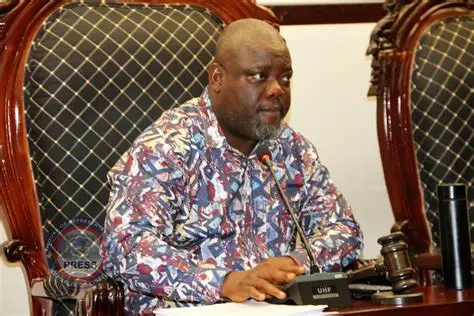
By George K. Werner (former education minister)
When I listened to Francis Sakila Nyumalin Sr. on OK FM this week, I was struck not simply by what he said, but by what his remarks revealed about the deeper political transition quietly unfolding in Lofa County. Beneath the frustration, criticism, and lingering tension was something larger: the unmistakable anxiety of an older political order confronting a newer and far more aggressive political reality. What appears publicly as a rivalry between Nyumalin and Thomas P. Fallah is increasingly becoming a struggle over who will inherit the political future of Lofa after the generation of Joseph Boakai.
There are counties in Liberia that participate in politics, and then there are counties that shape the direction of national politics itself. Lofa has long belonged to the latter category. Bordering both Guinea and Sierra Leone, and shaped by migration, trade, religion, war, ethnicity, and agriculture, the county occupies a unique place in Liberia’s political imagination. From the era of President William Tubman through the rise of the Unity Party under former President Ellen Johnson Sirleaf, Lofa has consistently played an outsized role in shaping national coalitions and political direction.
Today, however, another political transition is unfolding quietly but intensely within the county. What appears on the surface to be a rivalry involving Thomas Fallah, Francis Nyumalin, and the lingering influence of Clarence Massaquoi is, in reality, part of a much deeper struggle over the future architecture of Liberian politics itself.
And increasingly, another important figure quietly sits at the center of that evolving equation: President Boakai.
That reality matters because Boakai is not merely Liberia’s sitting president. He is also a son of Lofa County whose political roots and long-standing county relationships naturally place him within the emotional and political tensions unfolding there. Francis Nyumalin has historically been viewed as politically and socially close to Boakai’s broader political orbit. In earlier political calculations, many observers would likely have assumed that such proximity would reinforce Nyumalin’s long-term standing within the county’s establishment.
But politics is rarely static.
Increasingly, there are perceptions within Liberian political circles that Thomas Fallah has strategically positioned himself close to President Boakai in ways that have unsettled parts of the older county establishment. In counties like Lofa, perceived proximity to executive influence matters enormously. It shapes legitimacy, access, appointments, confidence within local structures, and long-term political calculations.
Yet Fallah’s political repositioning has not been universally accepted.
He emerged nationally through the Coalition for Democratic Change and became one of the party’s most visible and aggressive political mobilizers. For years, he was identified closely with the political style and machinery of former President George Weah and the CDC establishment. But following internal tensions and his eventual fallout with sections of the CDC leadership, Fallah increasingly began repositioning himself politically outside the traditional CDC structure.
That transition remains politically sensitive.
Within sections of the Unity Party establishment — including among some longtime Boakai loyalists — there are still lingering questions about Fallah’s long-term political intentions and ideological consistency. Some remain uncertain whether his growing alignment with Boakai represents a genuine political evolution or a strategic repositioning by an ambitious politician seeking relevance within a changing national political landscape.
And among those who reportedly remain cautious are political actors aligned with Francis Nyumalin and sections of the older Lofa establishment.
Part of that distrust is historical. The 2023 elections left deep political and emotional scars within the county. Part of it is also structural. Older Unity Party figures built their political identities over years of opposition politics against the CDC, often enduring political isolation, state pressure, and electoral defeats during the Weah years. For some of them, the rapid emergence of a former CDC heavyweight within Boakai’s broader orbit naturally creates discomfort and suspicion.
But another part of the unease is strategic.
Because many political observers increasingly believe that Fallah is not merely trying to join an existing political structure. He appears to be trying to build one.
What makes the evolving political tension in Lofa even more consequential is the generational dimension beneath it.
Both President Boakai and Francis Nyumalin largely belong to the same political generation — one shaped by older systems of coalition-building, county negotiations, elite consensus, institutional loyalty, and gradual political ascension. Their political instincts were formed in an era when influence flowed through party structures, seniority, personal relationships, and long-established county networks.
Thomas Fallah represents something different.
He belongs to a newer political generation that understands visibility, emotional connection, constant grassroots engagement, populist responsiveness, financial mobilization, and narrative control in ways that older political actors sometimes underestimate. While Boakai and Nyumalin emerged from the politics of structure and hierarchy, Fallah increasingly thrives in the politics of movement, personality, and direct public accessibility.
And increasingly, there is a growing perception that Fallah is positioning himself not merely as another politician within Lofa, but as a future broker of Lofa politics itself.
Historically, every dominant Liberian county eventually produces political brokers — figures capable of mediating alliances, influencing appointments, mobilizing votes, settling disputes, shaping presidential coalitions, and determining which local actors rise or fall politically. In different periods, counties produced elders, senators, war-era figures, party financiers, or establishment politicians who quietly performed that role.
In Lofa, the emerging perception within some political circles is that Fallah is attempting to inherit that position before the older political generation fully exits the stage.
His strategy appears multidimensional: build grassroots loyalty among youth and marginalized communities; cultivate younger intellectual defenders capable of shaping public narratives; maintain access to financial resources; deepen strategic proximity to executive power; and gradually position himself as the unavoidable political center of gravity within the county.
The emergence of NIMBO — the National Independent Movement for Boakai — has added another layer to that evolving political strategy. While publicly framed as a pro-Boakai political movement, many political observers increasingly interpret it as part of a broader effort by Fallah to build an independent political machinery capable of surviving beyond traditional party structures. His association with NIMBO has further reinforced perceptions that he is attempting to transcend the old CDC-versus-UP divide and position himself within a broader national coalition aligned around Boakai’s presidency.
That ambition naturally creates unease among older political actors.
Because succession struggles in Liberian politics are rarely announced openly. They unfold quietly through shifting alliances, county appointments, grassroots mobilization, radio debates, youth recruitment, symbolic gestures, and proximity to presidential authority. What appears publicly as disagreement between politicians is often, underneath, a deeper negotiation over who will control the future political machinery of an entire county.
And in that sense, the Fallah–Nyumalin rivalry may ultimately be less about the past than about the future — specifically, about who becomes the next dominant architect of Lofa’s political direction after the Boakai generation.
For decades, political authority in counties like Lofa rested on relatively stable foundations. Elders, political families, traditional leaders, county elites, and party structures largely determined political direction. Influence flowed through negotiated alliances, educational standing, ethnicity, seniority, and long-standing relationships. Politics was often managed quietly through accommodation and consensus.
That older political order is now under immense pressure.
Across Liberia, a younger and more impatient generation is reshaping politics from below. Economic frustration, unemployment, migration, social media, weak institutions, and declining trust have fundamentally altered how political legitimacy is earned. Increasingly, voters reward politicians who appear physically present, emotionally accessible, financially responsive, and constantly visible. In many communities, citizens no longer trust institutions; they trust personalities.
Few Liberian politicians appear to understand that changing political reality better than Thomas Fallah.
Originally known for his political influence in Montserrado County through the CDC, Fallah built his political identity through relentless grassroots engagement, direct interaction with ordinary communities, populist messaging, and constant visibility. His victory over Francis Nyumalin in Lofa County District #1 during the 2023 legislative elections represented more than the defeat of an incumbent. It signaled that traditional political control in Lofa was no longer guaranteed.
But the rivalry between Fallah and Nyumalin did not unfold quietly.
During the 2023 presidential and legislative elections, Lofa became one of the most politically tense counties in Liberia. Clashes between supporters of the CDC and the Unity Party in Foya District reportedly left at least two people dead and several others injured, drawing national and international concern.
The confrontation carried larger symbolic meaning because the local legislative battle mirrored the national presidential struggle itself. Fallah had become one of the most visible CDC political figures in the county and an important ally of former President George Weah. Nyumalin, meanwhile, stood firmly within the Unity Party structure aligned with Joseph Boakai.
Both sides blamed each other for the violence.
CDC figures alleged that Unity Party supporters attacked Fallah’s compound and provoked confrontations. Unity Party officials countered that their supporters were peacefully mobilizing when clashes allegedly began near Fallah’s area of influence. No definitive independent conclusion fully settled the competing political narratives. But politically, the damage had already been done.
The violence hardened loyalties and deepened mistrust.
Within sections of the Unity Party establishment in Lofa, Fallah increasingly came to be viewed not merely as an outsider entering county politics, but as a disruptive populist figure willing to challenge the county’s older hierarchy directly. Within CDC circles and among Fallah’s supporters, however, the violence reinforced the narrative that entrenched county political networks were unwilling to accept the emergence of a new political force capable of threatening long-standing arrangements.
That period also appears to have marked an important turning point in Fallah’s political evolution.
Before 2023, he was widely viewed primarily as a Montserrado-based CDC politician with roots in Lofa. After the elections — and especially following the post-election political transition that brought Boakai to power — Fallah increasingly began repositioning himself beyond narrow party identity. He appears to have recognized that controlling the future political direction of Lofa may eventually require transcending rigid CDC-versus-UP divisions and instead becoming the county’s central political broker regardless of party alignment.
And perhaps that is what now worries parts of the older political establishment most.
Because if Fallah succeeds in maintaining grassroots dominance, cultivating younger intellectual defenders, building cross-party relationships, and deepening proximity to executive power, he may eventually emerge not simply as another county politician, but as one of the most strategically positioned political actors in Liberia’s next political era.
What is unfolding quietly in Lofa today may therefore be far bigger than a local political rivalry.
It may be the beginning of a generational transfer of political power.

