

At aged 14, Martha Bridges* was being raped every weekend by an older nephew in her aunt’s house. She didn’t know she had fallen pregnant until she visited a clinic in Paynesville, a Monrovia suburb, confused by the extreme cramps she was suffering.
When she was told, her terrified reaction was to ask the nurse to “take it out!”. But abortions in Liberia are illegal except under specific conditions: doctors need to certify there is a medical necessity, or there is official documentation proving the pregnancy was the result of rape or incest.
That was a bar way too high for Bridges. She came from a struggling, single-parent home and felt beholden to her aunt who treated her like a daughter. Knotty familial, gendered, and economic reasons stopped her from reporting her nephew. So, like many other desperate Liberian women, she took the nurse’s advice and sought a local remedy.
These typically range from the use of powerful herbs to induce contractions, lengths of wire and sharpened sticks to pierce the womb, or the insertion of a glass bottle designed to break internally – obviously methods that are highly dangerous. “That night I thought I was going to die,” said Bridges. “The bleeding wouldn’t stop.”
Seven years on, she still suffers from complications including an embarrassing vaginal discharge and painful periods. But she at least survived. A young neighbourhood friend who used a mixture of herbs and glass – known colloquially as “RPG” – didn’t.
As contraceptive access is limited in Liberia, more than half of all pregnancies are unintended, with 35% ending in abortion – mainly self-induced. It’s one reason Liberia has among the world’s highest maternal mortality rates. Even then, the official figures underestimate the problem: medical staff typically diagnose haemorrhage or sepsis as a cause of death, concealing the real impact of botched abortions.
Blocked reforms
The response by the government was the introduction in 2020 of a Public Health Bill that includes provisions that would allow doctors to perform abortions at up to 18 weeks of pregnancy, and the promotion of comprehensive sex education (CSE).
It contains several other long-overdue reforms – from improving disease surveillance, to updating mental health laws – but it’s the progressive measures outlined in chapter 48 on sexual and reproductive health rights that have ensnared it in controversy.
Backed by women’s rights groups, the UN, key government ministries, and Liberia’s Inter-Religious Council, the bill made it through the lower house in 2022. But a coalition of conservative politicians – supported by the Catholic Church and US pro-life political leaders – are stalling its passage through the senate, where it needs two-thirds of the votes to pass.
Into this culture war debate has stepped the fundamentalist Church of Jesus Christ of Latter-Day Saints (LDS), better known as the Mormons, headquartered in Utah in the US.
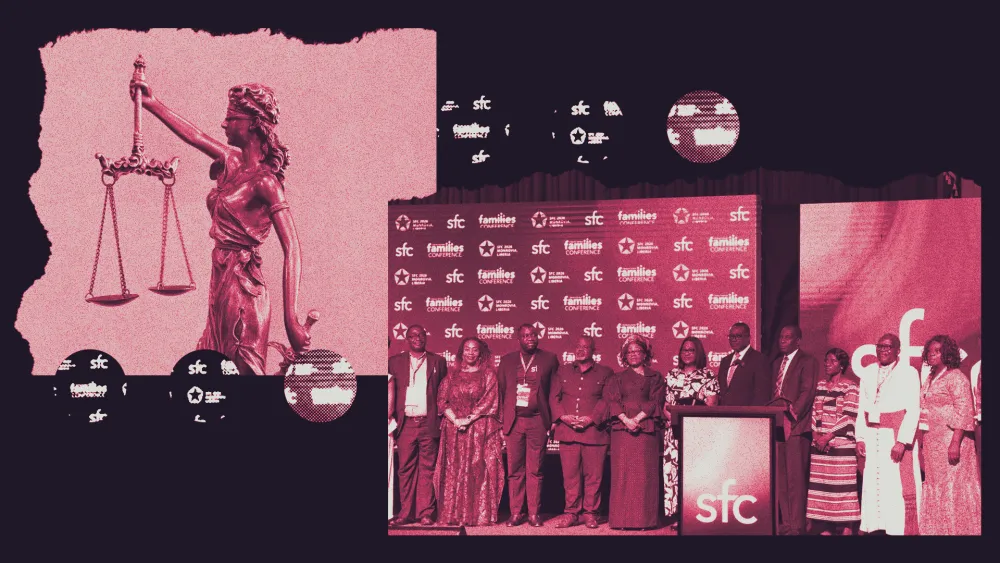
They held a Strengthening Families Conference (SCF) in Monrovia on 19-20 June, attended overwhelmingly by church members, who sat through platitudes on the family “as the bedrock of society”, and the importance of ethics, integrity, and setting the right example for your children.
The audience lapped it up. “The gospel can change a family,” said Anthony Silo, 19, in a white shirt, tan chinos, and a name tag that identified him as a church official. Even though he was raised by a single mother, he believes the ideal is that “women bear the primary responsibility for the welfare of the children, while men are there to provide”.
Yet a nuclear family bears little resemblance to the reality of much of Liberian society, still traumatised by two civil wars that lasted a combined total of 14 years, an Ebola outbreak, and profound multidimensional poverty that affects more than half of the population.
Today, an estimated 40% of Liberians still suffer from PTSD and other anxiety disorders. Households are ideally places of caring and support, but the world over, they can also be far darker arenas of violence and abuse.
“We have a young population and a lot of unwanted pregnancies,” said Bendu Tonia Kamara of the Community Health Care Initiative. “We say you need to be able to decide when to have children, that young people need to have information around sex and know how to protect themselves.”
Elder Adeyinka Ojediran, one of a triumvirate of LDS leaders in West Africa, believes “there is a divine definition of the family”. But he accepts that as a result of the societal upheavals Liberia has faced, “those traditional patterns have been disrupted. We place no blame but come with compassion,” he told The New Humanitarian. “Families that have been wounded can be mended.”
How the US Christian right built an interfaith coalition against LGBTQ rights in Africa
An alliance between Christian, Muslim, and even traditional religious institutions has formed under the secular banner of “family values”.
Family values “as a smokescreen”
The LDS, reportedly one of the world’s wealthiest religions, has grown exponentially in Africa. It overcame a tricky history, officially branding black people as cursed until a “revelation” in 1978 allowed the ordination of black priests. African membership has since surged to more than 660,000, with a presence in over 30 countries, helped along by missionary work, a focus on local leadership, and youth scholarships.
Monrovia is the eighth SFC, an annual event that swings through West African capitals, extolling LDS’s vision for society. Rights groups fret over the church’s ideological impact, and the appeal conservative religion can have for vote-hungry politicians – especially when backed by the resources the LDS can offer.
The day before the opening of the conference, First Lady Kartumu Yarta Boakai broke ground on a new 100-bed maternity hospital being built with LDS funding. She didn’t attend the SFC, and neither did senior government officials, including Foreign Minister Sara Nyanti, who reportedly has links to the church’s leadership.
“They are using family values as a smokescreen, and people are chasing that money.”
Yet Aminata Kamara-Sneh, a reproductive rights expert with the Swedish Association for Sexuality Education, is concerned nonetheless. “Liberia is very low-income, it’s cheap to get political influence here,” she said. “They are using family values as a smokescreen, and people are chasing that money.”
Civil society leaders worry the church and allied US-based right-wing movements will empower pushback on the Public Health bill; encourage the parliamentarians working on draft anti-LGBTQ legislation; and provide tacit support to traditionalist lawmakers holding up a separate bill that prohibits child marriages and bans outright female genital mutilation (rather than the current conditional freeze).
However, senior LDS officials insist their agenda is solely spiritual. “Everything we do is in accordance with scriptural mandates,” said Jeffrey Adams, legal counsel for the West Africa region. “We don’t take political positions, but it’s important to take a moral stance.”
The last speaker of the two-day event was Greg Slator, co-founder of Family Watch International (FWI), a controversial, conservative, US-based Christian lobby group that campaigns against LGBTQ rights, sex education, and women’s reproductive health.
There was excitement in the auditorium when he tore into what he described as the “CSE agenda” – promiscuity, the sidelining of parental rights, and the “false doctrine that we are sexual beings from birth”. His clinching argument was that “studies show” sex education does not reduce unwanted pregnancies or sexual diseases, and that “chastity is more fulfilling than physical sex and less damaging”.
However, the meta study he cited was co-sponsored by FWI, and Slator, in an interview with The New Humanitarian – interrupted by conference attendees warmly congratulating him – acknowledged the World Health Organization among others had reached the opposite conclusion on CSE.
Bridges said she had a message for Slator and the conference. “They talk about abstinence but they have the wrong mindset,” she explained. “Abortion is not wrong, but we need the government to make it safe. If that had been available to me, I wouldn’t be experiencing what I’m experiencing today.”
A broader assault on rights
Rights groups see the conference as part of a broader global political assault against policy approaches once regarded as mainstream. They point to the dismantling of USAID by President Donald Trump, and the damage that has been done to core reproductive health programmes and LGBTQ care and treatment initiatives.
The US had previously provided roughly $70 million a year to support maternal clinics, HIV and malaria treatment, community health workers, and disease surveillance systems. Most of that funding stopped suddenly in early 2025, replaced by a “Health Compact” offering around $25 million a year over the next five years, with the Liberian government expected to make up the shortfall.
“It’s the worst transition I’ve ever seen,” said Naomi Tulay-Solanke, founder of the Community Health Care Initiative. “Ninety percent of Liberia’s health budget is funded by partners [who are also cutting back on financing], where does the government get that money from overnight?”
For the Public Health Bill to pass there has been speculation the abortion and sex education provisions may have to be sacrificed. But Lela Dolo, a doctor and public health activist working with teen girls, is not giving up hope. She believes a lot more work can be done with lawmakers to understand the value of the bill, and the coming elections in 2029 could provide leverage.
“Yes it’s going to take a long time,” she said. “But you can’t stop abortions. It’s just the young people who can’t afford [to do it safely] that are suffering. We need to make people understand that it’s their daughters that are at risk.”
*Her name has been changed to protect her privacy.
By Tina Mehnpaine
An award-winning Liberian journalist covering public health, the environment, and climate change
Edited by Eric Reidy/The New Humanitarian

