

Analysis By Sherman C. Seequeh
Political power is rarely confined to constitutions, official titles or organizational charts. The real centres of influence often lie elsewhere—in private conversations, trusted relationships and the small circle of advisers whose opinions carry greater weight than formal institutions. Every presidency develops such an inner sanctum, and George Weah’s administration was no exception. While public debate fixated on who occupied the country’s highest constitutional offices, seasoned observers argued that the more consequential story lay behind closed doors, where a handful of confidants enjoyed unusual proximity to the President.
Today, as several of those once regarded as pillars of Weah’s political household increasingly appear within President Joseph Boakai’s orbit, an old debate is being revived with renewed urgency. The question is no longer who formally held office during the CDC years, but who truly exercised influence—and whether that influential network is quietly dissolving.
A NARRATIVE THAT NEVER FULLY HELD
Throughout the Weah presidency, one of the most persistent accusations advanced by political opponents was that the administration had become dominated by the President’s southeastern kinsmen. The argument gained traction because Weah hailed from Grand Kru County, while House Speaker Bhofal Chambers and Senate Pro Tempore Albert Chie also came from the southeast. To critics, the three offices symbolized a regional concentration of authority.
Yet the argument overlooked an important constitutional distinction. Neither Chambers nor Chie was appointed by President Weah. Both first secured their seats through popular election before being elevated by fellow legislators to lead their respective chambers—just as Weah’s own presidency was the outcome of a national democratic vote. Elections, unlike appointments, reflect the independent choices of voters and legislative colleagues rather than unilateral presidential preference. For many constitutional scholars, citing those three offices as evidence of regional favoritism was never entirely persuasive.
THE DIFFERENCE BETWEEN OFFICE AND INFLUENCE
If the southeastern-domination critique failed to withstand constitutional scrutiny, a less discussed reality deserves greater attention. Power inside every presidency exists on two levels. One is institutional, visible through ministers, agency heads and constitutional officers. The other is personal—exercised by those who enjoy unusual access to the President’s confidence, shape conversations before decisions are made, and often influence policy without holding the most prominent public offices. Liberia’s political history has repeatedly demonstrated that those closest to the presidency often determine who gains access, whose counsel is heard, which appointments advance and how crises are managed. This informal structure of influence, many observers contend, tells a more revealing story about the Weah years than the debate over constitutional offices ever did.
INSIDE WEAH’S TRUSTED CIRCLE
Rather than being defined by holders of constitutional offices, Weah’s political nucleus was widely perceived to include several influential personalities from Lofa County whose proximity to the President became increasingly evident across his six-year administration.
Among the most frequently mentioned was Finda Bundoo, the Executive Mansion’s Chief of Protocol. Though her official duties centred on state protocol, she was widely regarded as one of the few officials with regular personal access to the President—proximity that earned her considerable influence and, among CDC loyalists, the affectionate title of “Rescue Mother.”
Standing in that same category of intimate confidants was Pepsi K. Yeke, the former Executive Director of the Liberia Agency for Community Empowerment (LACE). Like Bundoo, Yeke was widely regarded as an inner-circle confidant and unapologetic defender of the former President—a loyalist whose closeness to Weah was never seriously disputed within political circles and whose standing derived less from the office he held than from the trust he enjoyed.
Representative Thomas Fallah similarly emerged as one of Weah’s most trusted confidants. His rise from humble beginnings to a three-term legislator—with strong backing from Weah and the CDC—was cited by supporters as evidence of the President’s confidence, and within the Legislature he was viewed as one of the administration’s most dependable defenders. Senator Joseph Kpator Jallah of Lofa County became another influential ally after winning election with significant CDC support in 2023.
Within the Executive itself, few careers illustrated presidential confidence more vividly than that of Dee-Maxwell Saah Kemayah, Sr. Under Weah, Kemayah rose in rapid succession—first as Deputy Minister of Foreign Affairs for Administration, then as Ambassador Extraordinary and Plenipotentiary and Liberia’s Permanent Representative to the United Nations, and ultimately as Minister of Foreign Affairs. That ascent to the summit of the nation’s diplomacy, accomplished within a single administration, was read by many observers as unmistakable evidence of his place within the President’s circle of trust.
Outside the Legislature, Jefferson Tamba Koijee—first as Mayor of Monrovia, later as Secretary General of the CDC—evolved into one of Weah’s most visible and uncompromising lieutenants, often serving as the administration’s most aggressive public defender. Alongside him stood Janga Augustus Kowo, who served as CDC Secretary General before ascending to the party’s national chairmanship, further strengthening what many described as a formidable Lofa presence within Weah’s immediate political environment.
Whether every important decision passed through this network is impossible to verify. What remains difficult to dispute is that few political actors appeared closer to George Weah during his presidency—and informal networks of that kind rarely survive unchanged after power changes hands. And Lofa had a domino effect.
THE GREAT POLITICAL CONTRADICTION
Few subjects generate greater public discomfort in Liberia than tribal and regional politics. Politicians denounce them from campaign platforms. Civil society condemns them as threats to national cohesion. Religious leaders preach against them, while academics urge Liberians to embrace merit and national identity over ethnic affiliation. Yet every election tells a more complicated story. Across Liberia, family ties, county identity, ethnic affinity and regional loyalty continue to shape political calculations, influence candidate selection, mobilize campaign resources and, in many instances, determine voting behavior. Parties matter. Ideas matter. Performance matters. But identity remains one of the most enduring currencies in Liberian politics—a reality many politicians privately acknowledge even while publicly denying it.
Political scientists call the phenomenon identity politics, and it is neither uniquely Liberian nor exclusively African. In the United States, election-night analyses routinely dissect the Black vote, the Hispanic vote, the evangelical vote and the youth vote; in Europe, analysts examine religious constituencies and regional strongholds. These voting patterns are treated as measurable political realities rather than moral failures. Liberia’s version simply revolves around county of origin, ethnicity, family networks and regional solidarity. Political parties provide the vehicle. Identity often supplies the fuel.
Ironically, many of the same politicians who condemn tribalism quietly organize their operations around precisely those social realities. County associations become campaign structures. Traditional leaders become mobilizers. Funerals, homecomings and development associations evolve into electoral networks, while cabinet compositions are assessed according to perceived regional balance. This is not always a wish to promote division; it reflects an understanding that political trust in Liberia frequently develops through familiar social networks before expanding into broader national support. The contradiction is unmistakable: Liberians often reject tribal politics in principle while practicing identity politics in reality.
THE SOUTHEASTERN PROPOSITION
It was against this backdrop that, according to several former officials and political insiders, an important conversation repeatedly unfolded during the Weah presidency. As Weah settled into office, a number of southeastern professionals, technocrats and intellectuals reportedly grew concerned about the influence of non-southeastern actors within the President’s circle of trust. Their concern was not simply representation; it was political durability. Every successful presidency, they reportedly argued, requires a dependable political fortress capable of surviving beyond the tenure of power itself. Friendships forged through political opportunity could change with circumstances; relationships rooted in shared regional identity and longstanding social bonds were generally more resilient.
Their message to the President was straightforward: build a stronger political citadel among those whose historical, emotional and political destinies are permanently tied to your own. They urged neither exclusion of others nor regionally driven appointments—only that his innermost nucleus include a sufficiently strong base within the region that had produced him politically.
Those familiar with the period say Weah never publicly embraced or rejected the recommendation. He listened. He acknowledged the conversations. But he appeared content with relationships cultivated over decades of political struggle. To many within his circle, loyalty had been earned through years of personal sacrifice rather than geography; political confidence, in Weah’s calculation, seemed to depend more on trust than on birthplace. There was no dramatic restructuring of his political household. Whether that reflected sound judgment or a missed strategic opportunity has since become a matter of growing debate.
POWER IS THE GREATEST MAGNET
One of the oldest observations in political science is that proximity to power shapes political behavior. When governments change, relationships are tested, alliances evolve, and few politicians willingly isolate themselves from the prevailing centre of national influence—particularly in systems where access to government determines access to development, appointments and political relevance. Liberia has witnessed this after every democratic transition.
The movement is rarely announced through dramatic declarations or formal defections. It unfolds quietly: a public appearance here, a shared platform there, a warm embrace at a funeral, words of praise once considered politically unthinkable. Individually, such moments may appear insignificant. Collectively, they often reveal the early stages of realignment long before party memberships officially change. Formal defections, when they eventually occur, are frequently mere confirmations of relationships already obvious to observers.
When Joseph Nyuma Boakai defeated incumbent President Weah in the 2023 runoff, Liberia experienced more than a routine transfer of executive authority. The country’s political centre of gravity shifted. For the first time in six years, access to state power and executive influence no longer resided with the CDC but with the Unity Party. It is within that historical context, observers say, that the developments now unfolding around several influential Lofa politicians should be viewed.
THE FALLAH FACTOR
Among the earliest names to attract attention was Representative Thomas Fallah, long regarded as one of the former President’s most dependable allies in the House of Representatives. In recent months, however, observers have noted increasingly cordial interactions between Representative Fallah and the Boakai administration. Neither Fallah nor the Unity Party has announced any formal alliance. But political relationships, analysts note, are often measured less by official declarations than by patterns of public engagement—and it is those patterns that are drawing increasing scrutiny.
NIMBO AND THE POLITICS OF SYMBOLISM
Political symbolism often speaks louder than official statements. That reality became particularly evident at the launch of Representative Thomas Fallah’s NIMBO initiative in Foya, Lofa County. Community development initiatives are common across Liberia, but the political significance of this event extended beyond its stated objectives. Prominently seen participating was Senator Joseph Kpator Jallah—whose election had enjoyed strong support from Weah and the CDC.
To casual observers, it was a county gathering celebrating local development. To experienced analysts, it demonstrated that figures once firmly identified with Weah’s political network were increasingly comfortable sharing public platforms amid a changing national landscape. Whether that comfort reflected friendship, pragmatism or evolving political calculation became a matter of growing public discussion.
BOAKAI’S QUIET ADVANTAGE
President Boakai enters this evolving equation with one significant advantage that has received relatively little attention: he, too, is a son of Lofa County. Shared county identity does not automatically determine loyalty, nor guarantee political migration. Yet students of Liberian politics recognize that common regional identity creates opportunities for dialogue that may not exist elsewhere.
County identity provides familiarity; shared history builds trust; engagement becomes easier. It is precisely this dynamic that leads some observers to suggest Boakai may be uniquely positioned to cultivate or re-cultivate relationships with influential Lofa politicians regardless of their previous affiliations.
The significance of these developments extends beyond individual careers. The larger question confronting the CDC is institutional. Parties rarely weaken because they lose elections alone; they weaken when influential organizers, financiers, strategists and trusted intermediaries begin quietly repositioning themselves toward emerging centres of power.
That process is seldom dramatic, but over time it can fundamentally reshape a political organization. If the movement now observed among some influential Lofa politicians continues, analysts believe the CDC could face something more profound than electoral defeat: the gradual erosion of the network that once constituted the informal backbone of George Weah’s political operation.
WHEN GRIEF BECOMES POLITICAL
Even as observers debated these public appearances, another event unexpectedly intensified the conversation. It occurred neither in the Executive Mansion nor on the floor of the Legislature, but at a funeral.
In Liberia, funerals are more than moments of mourning. They are social gatherings, cultural reunions and, often, quiet political observatories—revealing who comes when the cameras are absent, who stands beside a family in its darkest hour, and who chooses not to appear at all. In a country where personal relationships shape political alliances, attendance at a funeral can carry symbolism greater than attendance at a rally.
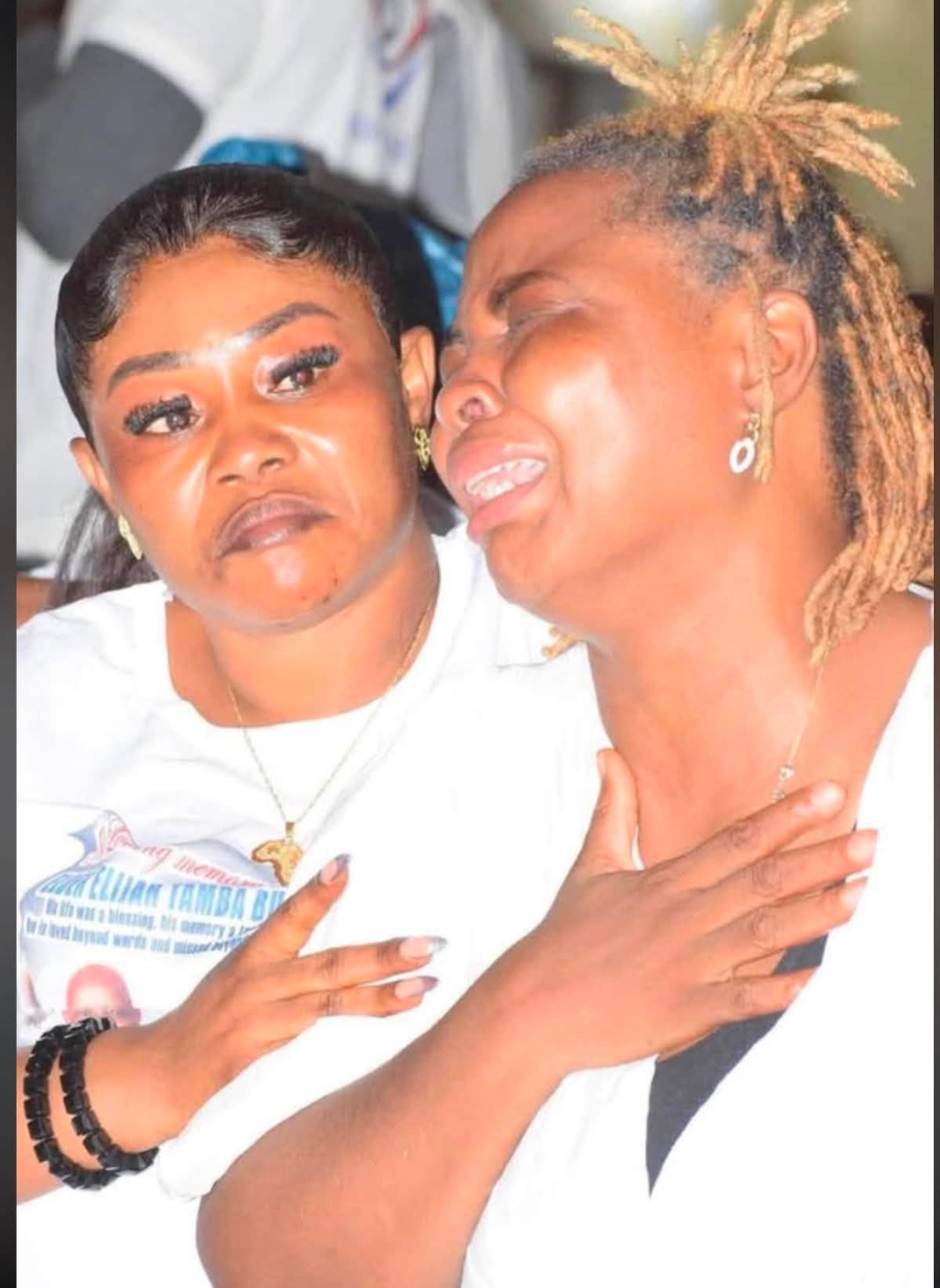
It is therefore unsurprising that the solemn farewell to the late father of former Chief of Protocol Finda Bundoo evolved into one of the most discussed political moments of post-election Liberia—not because of political speeches, but because of one grieving daughter’s heartfelt words and what many believed they revealed.
As mourners gathered, Bundoo took the microphone to acknowledge those who had stood with her family. Her remarks were deeply personal; at times she struggled to contain her tears. Among those she singled out for special appreciation was Representative Fallah, and she extended gratitude to members of the Boakai administration for standing with her family through its most difficult period.
What attracted immediate attention, however, was not simply whom she thanked. It was her apparent disappointment that others from whom she had expected similar solidarity were nowhere to be seen. Though she named no one, her remarks quickly became the subject of political interpretation across Monrovia and beyond.
Her words carried such weight because of who she is. For years, Finda Bundoo symbolized loyalty to George Weah; her influence extended well beyond protocol, and perception of that influence—accurate or not—shaped political reality.
There is an unwritten rule in politics: people remember who stood beside them when they had little to gain. Expressions of gratitude in moments of grief carry greater credibility than statements at rallies or conventions. Observers therefore viewed her tribute through two lenses. The first was humanitarian—a grieving daughter thanking those who comforted her family. The second was political—a revelation of where meaningful relationships presently exist. Neither interpretation excludes the other; both may be true simultaneously. Yet politics rarely permits emotionally charged public statements to remain free from political reading.
Whether Miss Bundoo eventually alters her political affiliation is ultimately a matter for her alone; there is no public evidence that she has done so. She announced no departure from the CDC and pledged no allegiance to the Unity Party. But experienced observers argue that symbolism often precedes political decisions: relationships become visible before migration becomes official, and public warmth frequently appears before formal realignment.
Whether that process is unfolding in Bundoo’s case is impossible to determine with certainty. What cannot be disputed is that her remarks changed the conversation. Time—not speculation—will determine which interpretation proves correct.
EVERY PRESIDENCY LEAVES A LESSON
Every Liberian presidency eventually becomes a political classroom. Time strips away the passions of elections, leaving history to ask what lessons future leaders should learn. Liberian history offers remarkably consistent patterns here: presidents inherit loyalists, cultivate allies and inspire extraordinary devotion while occupying the Executive Mansion—yet almost every administration discovers that political loyalty is tested only after power has changed hands.
Tubman experienced it. Doe experienced it. Taylor, Sirleaf and now Weah have each, in different ways, witnessed the evolution of alliances once they were no longer the country’s principal centre of authority. This is neither unusual nor uniquely Liberian. It is politics.
One of the central arguments of this feature is that personal friendship and political durability are not always identical. Weah built his closest circle around individuals in whom he had deep personal confidence—many of whom had stood beside him through difficult struggles. There is nothing inherently wrong with such leadership; every president depends upon trusted confidants.
The harder question concerns what happens after power changes hands. Does personal trust automatically translate into enduring political solidarity? History suggests the answer is more complicated. Political friendships are genuine. Political interests are also real. Sometimes they coincide. Sometimes they diverge.
Did President Weah underestimate the importance of building a more durable political fortress? Were the southeastern professionals who reportedly urged a different strategy correct? Or are the relationships now developing around President Boakai simply the normal evolution of politics after a change of government?
Reasonable people may answer differently, and many would reject the proposition as encouraging regional politics while others defend it as sound strategy. What cannot be denied is that observers are asking these questions with increasing frequency—some now arguing that the proverbial chickens are coming home to roost, and that calculations made during the Weah presidency are being tested in the harsher light of opposition politics.
Whether that judgment proves accurate will depend not on speculation but on the decisions individual political actors make between now and 2029.
THE FINAL WORD
Ultimately, this story is larger than George Weah and larger than Joseph Boakai. It is about the enduring nature of political power in Liberia. Every president must decide how to balance personal loyalty with political sustainability, friendship with institutional strength, and immediate convenience with long-term resilience. Those choices rarely attract attention while power remains secure; they become visible only after power has moved elsewhere. Presidents do not truly discover the strength of their political foundations while occupying the Executive Mansion. They discover it only after they have left.
The friendships that survive defeat become history’s measure of genuine loyalty; the alliances that dissolve become its measure of political convenience. For George Weah, as for every Liberian president before him, that final judgment will not be written by speeches, campaign slogans or political speculation. It will be written by time.

