

By Ian Yhap (former managing director, Liberia Electricity Corporation)
I waited several weeks for a response to my letter. Thirty-four days after writing to President Charles Ghankay Taylor about what I called “The CAED Dilemma,” I wrote to him again.
The first letter had been about a proposed agreement that I believed could lock Liberia into the wrong energy strategy for the foreseeable future. The second letter was different. This time, I wanted to talk directly to the president–if he were open to it.
Not in Cabinet or through his ministers or advisers. Certainly not in a room where everyone felt no reservation to interrupt me before I could finish explaining myself–my diction tended to be slow and careful when I attempted to maintain precision and accuracy in discussing technical matters to a general audience. I was aware that my communication style could be even more laborious when such technical matters pertained to matters of national import.
I wanted to sit down with President Taylor, one on one. And there was a reason why.
Before going further, let me briefly retrace how I had gotten to this point. It had begun almost a year earlier when, quite by accident, I discovered that senior LEC management was negotiating with CAED for what appeared to be a long-term arrangement for Liberia’s electricity sector, while Ron Quist and I were pursuing the very different course laid out in the Master Energy Recovery and Development Plan.
I challenged the CAED arrangement and eventually left Liberia. In November 1998, President Taylor brought me back and appointed me Managing Director of LEC. Then, in March 1999, I was unexpectedly summoned to a Cabinet meeting where the President asked why CAED should not be considered.
When I answered that what CAED offered was inconsistent with the aspirations contained in the Ministry of Planning-approved Master Energy Recovery and Development Plan, the room erupted and the meeting ended abruptly. Still uncertain about where matters stood, on April 27, 1999, I put my concerns directly to the President in writing. That became my first Letter to Ghankay: “The CAED Dilemma.”
After sending that letter, I spent some time nursing my wounds and pondering what to do next. The CAED affair, the Cabinet confrontation and finally having to put my objections directly before the President had taken a physical and psychological toll on me. But what followed was, in some ways, more difficult to deal with than an argument.
There was complete silence with respect to my first letter. I remained in limbo. I didn’t know if the Energy Plan had been formally abandoned by the executive as the principal guide to fashioning the recovery and development of Liberia’s power sector.
Neither did I know if CAED had been abandoned. I appeared to have been shut out of the loop. The president had not relieved me of my position as MD of the LEC, and I was getting no advice from anyone to change direction–not even through informal backdoor channels.
On the contrary, now politically, government officials and friends of the president appeared to avoid me like a plague. In a small country like Liberia, and an even smaller society like Monrovia, that can feel very isolating and lonely. A large part of my personal motivation has always been the inclusion, warmth, and acceptance I have felt from my fellow Liberians. These were tough days.
So as the days moved on, I remained Managing Director of the Liberia Electricity Corporation, and LEC still had much work to do. This left me in a strange place. I felt trapped in the waiting room of my own office.
I had been appointed by President Taylor to manage the national electricity corporation, but I was no longer certain if he had confidence in me or whether the energy strategy I was trying to implement was still the strategy of the government that had appointed me. The larger questions about future aspirations would have to wait. The daily problems of the LEC could not.
The LEC that I was trying to manage was generating virtually no revenue. Nearly one hundred percent of the prewar generation, transmission, distribution and tariff-collection infrastructure had been destroyed, damaged, abandoned or looted. And, as I had pointed out in my first letter, LEC had not even been included in the 1999 national budget.
This was particularly troubling because electricity was not just another service awaiting restoration. It was a prerequisite for almost every serious effort at economic recovery and development. Yet the institution charged with restoring it had been given no financial foundation from which to begin.
Businesses needed electricity, hospitals needed it, water systems needed it, government needed it, industry needed it, and any serious investor considering Liberia would certainly need it. With no realistic prospect of financing all of this from LEC’s own resources, I was compelled to look elsewhere for funding. Given the circumstances, my ambitions must have bordered on the delusional.
International organizations were spending substantial amounts of money on postwar relief and reconstruction in Liberia. I tried to persuade a few that some of their energy-related interventions should be coordinated through LEC or, at the very least, made consistent with the Master Energy Recovery and Development Plan. My reasoning was straightforward.
If millions of dollars were going to be spent helping Liberia anyway, why not design those interventions so that when the emergency ended, Liberia would have something permanent upon which to build further?
I was not asking donors simply to give LEC money. I was asking that their assistance fit within a Liberian national strategy. That proved surprisingly difficult. The more I tried to synchronize some of their assistance with our long-term ambitions, the more distant and less transparent the process sometimes seemed to become. There was an attitude that I and my staff sometimes encountered that I found particularly condescending, not only to us, but by extension to LEC and the country itself. Sometimes it was expressed almost as bluntly as this:
Who are you to tell us what assistance to give you? You are already suffering. We are offering help. You have no right to tell us how to spend our money.
Such an attitude seemed to fly in the face of what I understood to be one of the most basic tenets of development: assistance should be fashioned, as much as possible, around the requirements and priorities of the recipient, rather than primarily around the preferences of the donor. Looking back, my expectations may have been somewhat naive about the realities of geopolitics.
Liberia desperately needed assistance. I knew that better than most. But needing help did not mean that Liberia should surrender its responsibility to decide what kind of country should remain after the helpers had gone home. That point struck me as non-negotiable.
One particular experience with a proposed European Union grant frustrated me enormously. An early EU project concept for Liberia’s energy sector contemplated a 20-megawatt heavy fuel oil generating plant. This aligned almost exactly with the first phase of the Master Energy Plan. To me, it could have been a breakthrough.
One of our greatest short-term challenges was finding the capital required to restore substantial generating capacity to Monrovia. If the EU provided the generating plant as a grant, an enormous part of that financing burden would disappear.
We could then concentrate our efforts on attracting funding for the distribution system, metering and commercial operations necessary not only to deliver the electricity, but to collect revenue to operate and maintain the plant. Generation without the means to distribute, meter and collect for the electricity would not give us a sustainable utility.
The grant could also have fundamentally changed the CAED discussion. I could have gone to President Taylor and said, in effect: Mr. President, we have the plant. With all due respect, get rid of CAED, please. Let us work with the EU grant instead.
But the substantive support I had hoped for did not materialize. Instead, the direction shifted toward interventions that I regarded as temporary and unlikely to leave Liberia with the infrastructure upon which a permanent electricity system could be rebuilt.
My impression at the time was increasingly that the more LEC insisted that assistance should fit within a national strategy, the less attractive LEC seemed to become as a partner. That troubled me.
The Liberia Water and Sewer Corporation offered a visible example of what concerned me.
The water sector received considerable donor assistance. Large metal overhead tanks appeared around Monrovia. Trucks transported water from boreholes and discharged it into those tanks. People came with buckets, pans and other containers, collected water and toted it home. As emergency relief, it provided water and that was good. But I kept asking a different question: What would remain when the project ended?
The tanks were not connected to neighborhood piping systems carrying water into homes. The trucks belonged to the intervention. Even the contractors operating the transportation were not local. When the intervention ended, the trucks disappeared. The tanks remained but there was no functioning distribution infrastructure around them, no permanent transport system inherited from the project, and little local capacity created to continue what the intervention had been doing. People still needed water.
To me, this illustrated the distinction between delivering a service today and rebuilding the institution that must deliver that service tomorrow.
Liberia needed relief but Liberia also needed reconstruction. The two were not automatically the same thing. I was determined, as much as circumstances allowed me, not to let electricity follow the same path.
There was another battle taking place almost literally over the remains of the country. By then it had become common knowledge that the Voice of America was not returning to its former facilities at Careysburg, Brewerville and along the Roberts International Airport highway. Those facilities contained substantial materials that potentially could be useful to LEC. There were towers and other equipment that could be reused. Some materials could help us repair substations and reconstruct portions of the transmission and distribution system.
There were also generators at LIMINCO, the former LAMCO operations, that we believed could potentially be used to provide electricity to parts of Monrovia.
When we looked at abandoned infrastructure, we were asking: What can we salvage to rebuild the electricity system? But other people were looking at the same infrastructure and asking a different question: What can we sell? I would add under my breath ‘so we can chop. Man got to chop.’
LEC found itself competing with scrap dealers, some apparently supported by powerful interests, who saw immediate cash where we saw pieces of a future electricity system.
A tower had two entirely different values depending upon who was looking at it. To a scrap dealer, it was metal. To LEC, it might be part of tomorrow’s transmission system. It was another manifestation of the problem that had begun to haunt me since returning to Liberia: the needs of now versus the requirements of tomorrow.
Unfortunately, the scavenging problem was not confined to people outside LEC. Some of our own employees were removing surviving transmission and distribution materials and using them on private contracts, including contracts arising from some of the same donor-funded projects taking place around the country. I could not permit that. Whatever remained of LEC belonged to the corporation and ultimately to Liberia. If we were serious about reconstructing the system, we had to protect those assets.
So I clamped down. That did not make me popular. But there was an uncomfortable human reality behind the problem. Most of those LEC workers had not been paid for more than a year. Many were leftovers from the prewar corporation. They had survived the war and watched the institution in which they had worked collapse around them.
They had families. They had bills. They had to eat. And I was asking them to come to work for an institution that could not pay them. I could understand the desperation that might cause an employee to look at an abandoned roll of conductor or a piece of equipment and see a way to feed his family. But I was the Managing Director. Understanding why it happened did not give me the authority to allow it to happen.
So there I was, trying to prevent desperately unpaid employees from cannibalizing the remains of a corporation that did not have enough money to pay them. There were days when managing LEC seemed less like running an electricity company and more like guarding the skeleton of one.
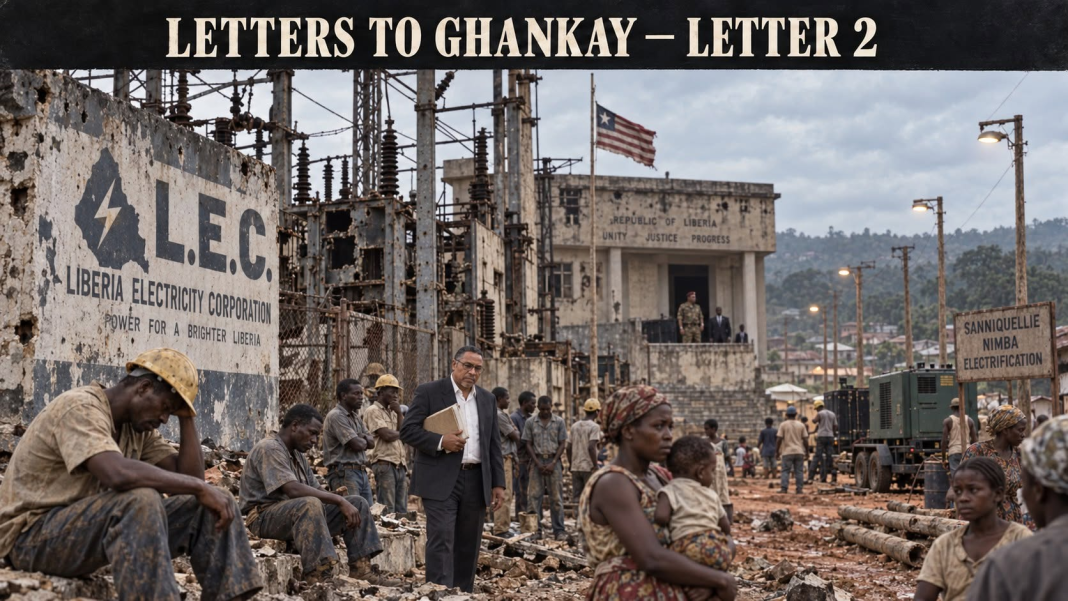
While all of this was happening, President Taylor had decided that the 1999 July 26 Independence Day celebrations would be held in Sanniquellie, Nimba County and as expected, LEC was given the assignment of providing electricity.
We prepared an estimate for generation and a basic distribution system, including street lighting. Sanniquellie was a small city. We were not pretending that $250,000 would completely electrify it. But we could provide power to a meaningful portion of the city for the celebrations and, more importantly to me, leave behind the beginnings of a system that could subsequently be expanded. If we were going to spend money for July 26, I wanted something useful to remain in Sanniquellie on July 27.
Our budget was approximately $250,000. The Ministry of Finance was supposed to provide the funds. I understood that the money had been allocated. There was only one problem. I could not get it. May was ending and June was approaching. July 26 was not moving to a later date. Equipment had to be obtained.
Materials had to be transported to Nimba. Generation had to be installed. Distribution lines had to be erected. Streetlights had to go up. The system had to be tested. All of that required time and money. The irony was that LEC had not been important enough to appear in the 1999 national budget, but LEC was important enough to be expected to electrify Sanniquellie for the national Independence Day celebration.
It was becoming desperate.
There was something else troubling me.
I had heard one of President Taylor’s financial advisers say several times, including in the President’s presence and also in social settings: “Liberia is not bankable.” I found the expression deeply disturbing. Certainly Liberia was in terrible condition and nobody needed to explain that to me. Every morning I went to an electricity corporation producing virtually no revenue, with devastated infrastructure and employees who had not been paid for more than a year. I knew Liberia’s condition probably better than anyone else.
But there was a difference between saying that Liberia was presently a difficult environment in which to attract financing and allowing “Liberia is not bankable” to become the country’s economic epitaph. To Ron Quist and me, the entire Master Energy Recovery and Development Plan was an argument against that conclusion. We believed the electricity sector could be made bankable. That was the point.
The $2.5 million I had secured from Taiwan was nowhere near enough to rebuild LEC. Everybody knew that. That was why we proposed using it as seed capital to leverage the larger financing required for generation and distribution.
The regional interconnection concept followed the same logic. Liberia’s domestic electricity market was small. But connect Liberia to Côte d’Ivoire and eventually to the larger West African electricity network, and the economic equation begins to change. In the short and medium term, Liberia could import lower-cost electricity. In the longer term, development of Liberia’s considerable hydroelectric potential could allow power to move in the other direction.
Suddenly, a hydroelectric project in Liberia would not have to depend exclusively upon Liberia’s small domestic market. Its potential market could extend beyond our borders. That was part of what we meant by making the sector bankable. Liberia might have been broke. That did not necessarily mean Liberia had nothing of value to finance.
So when I repeatedly heard someone close to the President saying that Liberia was “not bankable,” I began to wonder about something larger. What was President Taylor hearing when people like Ron Quist and me were not in the room? And believe me, most of the time we did not have access to that room.
That question brought me straight back to my experience in the Cabinet. The President had asked why CAED should not be considered. I had attempted to answer. I barely got started. When I said that what CAED offered was inconsistent with the aspirations embodied in the Master Energy Recovery and Development Plan, the room erupted. Instead of discussing whether CAED fitted Liberia’s national energy strategy, the atmosphere quickly became one in which it appeared that I was somehow challenging the President himself.
The meeting ended abruptly and then the silence followed. But the President had not fired me. He had not relieved me of responsibility. He had not instructed me to abandon the Energy Plan. He had not told me what was happening with CAED. I was still the Managing Director and every morning the problems were waiting for me: donors, scrap dealers, abandoned equipment, unpaid employees, no national budget, Nimba ’99. And somewhere behind all of it remained the unanswered question: What exactly did President Taylor want me to do?
I did not want to attempt that conversation in Cabinet again. I wanted Taylor alone. Not because I believed everyone around him was necessarily acting against Liberia’s interests. People had different priorities, different assessments of what was possible, and different pressures upon them.
But I had already learned that in a crowded political room, a technical disagreement could very quickly become something else. I wanted to remove the room. I wanted to know what Charles Taylor himself thought.
Did he still believe in the Master Energy Recovery and Development Plan? Was CAED now his preferred direction? Did he want me to continue seeking financing for our plan? Did he believe Liberia was “not bankable”? And perhaps most importantly: Did he still have confidence in me to do the job for which he had brought me back to Liberia?
Those were questions I could not answer from his silence. I needed to sit across from him and ask.
So, on May 31, 1999, I wrote President Charles Ghankay Taylor again. This time I was not principally writing about CAED. I was writing about the increasingly difficult environment in which I was being asked to manage LEC.
The first letter had essentially said: Mr. President, do not sign this agreement. The second was asking something much simpler, but perhaps much more important: Mr. President, can we talk? Not through your advisers or ministers or in a cabinet meeting. Just you and the man you have appointed to manage the Liberia Electricity Corporation. I called it an:
EXCLUSIVE TÊTE-À-TÊTE
I wanted an opportunity to explain what was happening at LEC, what I believed was happening around us, what was happening to the Energy Plan, and what I believed Liberia was in danger of losing. I also needed to know whether the President and his Managing Director were still trying to get to the same place, because by then, the issue was becoming larger than CAED. It was becoming a question of whether anyone could realistically be expected to rebuild LEC under the conditions in which I was being asked to manage it.
And I was beginning to understand something else. You can appoint someone Managing Director, you can give him responsibility, and you can hold him accountable for results. But unless responsibility is accompanied by resources, authority, access and some reasonable understanding of the direction in which the government wants him to go, the title itself means very little. I wanted to find out whether President Taylor understood that, and whether he was prepared to do something about it.
What happened after I sent that request is important. For a long time, I remembered the story as though the private meeting I requested simply never happened. That is not quite correct. A meeting did take place. It was not the tête-à-tête I had requested, and it did not happen in the manner I had hoped.
But President Taylor and I did meet. And before we continue this story, I want to reconstruct that meeting as carefully as I can, because after twenty-seven years I do not want to fill the spaces in my memory with things that merely sound right. The contemporaneous document comes first. What follows is the actual letter I sent to President Charles Ghankay Taylor on May 31, 1999.
It was written then, not twenty-seven years later. It records what was occupying my mind while the events were still unfolding and before I knew where any of this would eventually lead.
LETTER TWO
REQUEST FOR AN EXCLUSIVE TÊTE-À-TÊTE
May 31, 1999

