

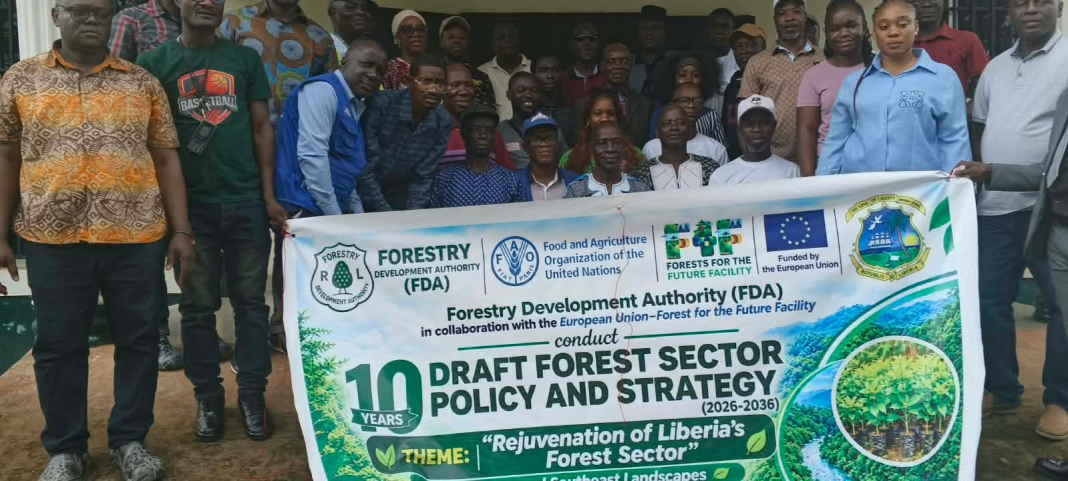
The Forestry Development Authority (FDA), in collaboration with national and international partners, has concluded a one-day regional validation workshop on the draft Forest Sector Policy and Strategy (2026–2036). The exercise, held in Zwedru, marks a critical step toward shaping Liberia’s forestry governance for the next decade.
The new framework replaces the outdated 2006 policy and aligns with the ARREST Agenda’s environmental sustainability goals. It seeks to strengthen natural resource management, safeguard biodiversity, and enhance climate resilience while simultaneously driving economic growth and improving livelihoods.
Presenting the workshop overview, Joseph G. Dolopaye, Manager of FDA’s Strategic Planning Unit, emphasized the importance of inclusive participation. “The goal is to ensure local communities, traditional leaders, civil society, women, and youth have a direct voice in shaping resource access and governance,” Dolopaye said. He noted that consensus-building among forest-dependent populations, private entities, and government agencies will be vital for transparency and accountability.
Decontee King-Sackie, Forest Governance Facilitator with the Food and Agriculture Organization (FAO), outlined the four pillars of the new policy: sector governance, production and forest-based industries, management of protected forests, and buffer zone management. “The policy is built on measurable targets to ensure accountability over the next ten years,” she explained.
The workshop featured breakout sessions where participants reviewed the strategy, aligned regional priorities, and presented recommendations for final inclusion. Stakeholders agreed that the validation process provides an opportunity to refine and endorse a shared vision for sustainable forestry.
Following this step, technical teams will prepare an action plan with specific activities and timelines to guide implementation.
The event brought together traditional chiefs, community leaders, civil society groups, local government officials, youth and women’s representatives, and officials from line ministries and agencies. Their collective input is expected to strengthen Liberia’s commitment to participatory conservation and long-term forest management.

