

By Festus Poquie
Liberian lawyer and politician Charlyne M. Brumskine said the Liberty Party helped her secure a seat on the Economic Community of West African States’ regional court, raising questions about political influence in the selection process.
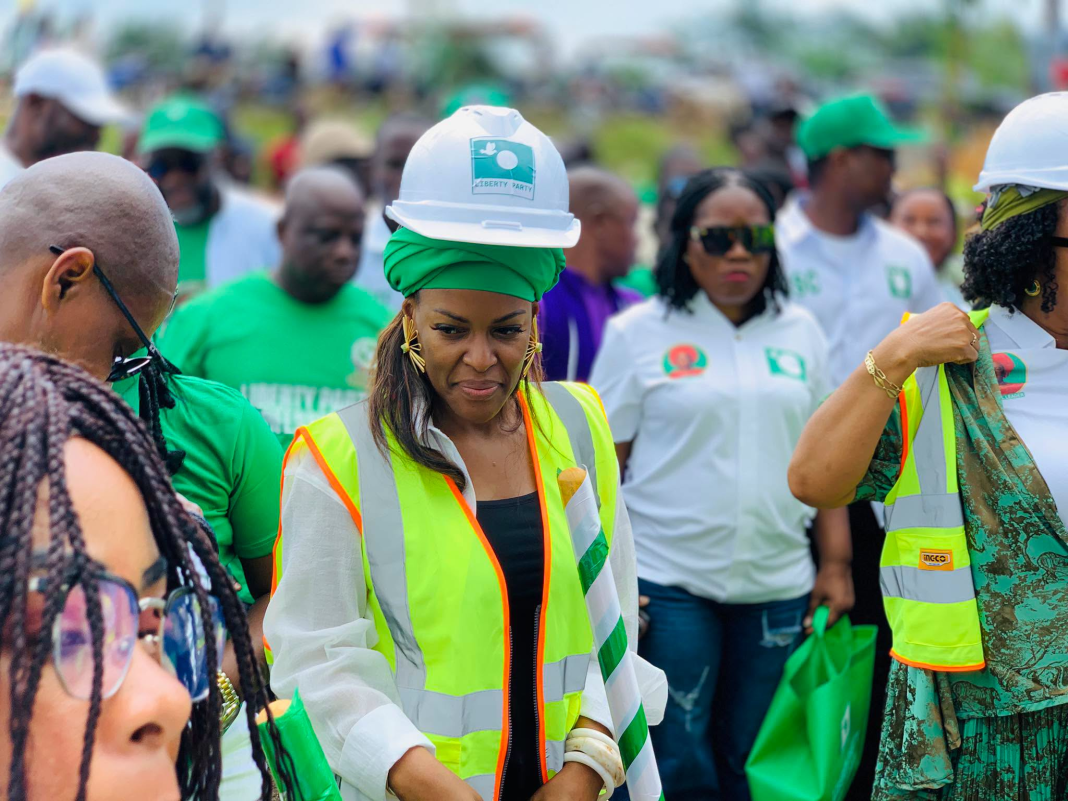
Brumskine, who was appointed in July to serve as Liberia’s judge on the ECOWAS Community Court of Justice for the 2026-2030 term, made the remarks at a Liberty Party gathering in Buchanan, Grand Bassa County, over the weekend.
“It was for Liberty Party coming together and reconciling that was able to help me to get this position,” Brumskine told party supporters. “It’s for you all. I’m representing you.”
She also thanked Nyonblee Karnga-Lawrence, the Senate president pro tempore and political leader of the Liberty Party, calling her “Mama” and urging her to continue the legacy of Brumskine’s late father, Charles Walker Brumskine, who founded the party.
“On behalf of my mother, on behalf of Cllr. Charles Walker Brumskine, this is your time, this is your season,” she said.
“Carry on the legacy. Liberty Party will govern this country one day.”
Brumskine’s comments appear to link her appointment to political ties with Liberty Party, a coalition partner of President Joseph Boakai’s Unity Party-led alliance.
According to the ECOWAS Court website, judges must be people of high moral character who either possess qualifications for appointment to the highest judicial office in their home countries or are recognized experts in international law.
The court also says candidates must have at least 20 years of professional experience. Judges are shortlisted and interviewed by the Community Judicial Council before being recommended to the ECOWAS Authority of Heads of State and Government for appointment.
ECOWAS formally approved Brumskine as one of five judges for the 2026-2030 term in July. She is the first Liberian woman to serve on the regional court.
The appointment marks a significant departure from the judicial backgrounds of some of Liberia’s previous representatives on the court.
Yussif D. Kaba, who joined the ECOWAS Court in 2017, had served in several judicial positions in Liberia, including as a circuit judge, interim chief justice of an Ad hoc Supreme Court and was later appointed an associate justice of Liberia’s Supreme Court in 2019.
Kaba began serving as a relieving judge in 1998, became a resident circuit judge in 2009 and later served as vice president of the ECOWAS Court.
Wilkins Micah Wright, another former Liberian member of the regional court, had served as an associate justice of Liberia’s Supreme Court and Solicitor General or chief prosecutor before his ECOWAS appointment.
Brumskine’s own professional record is more mixed than a comparison based solely on Supreme Court service would suggest.
She passed the Liberia Supreme Court Bar examination in 2022 as its valedictorian and was subsequently admitted as a counsellor that year.
She had, however, been admitted to the New York State Bar in 2003, according to the Ellen Johnson Sirleaf Presidential Center for Women and Development. She has also worked as a corporate lawyer and law professor.
The contrast between Brumskine’s career and those of some previous Liberian ECOWAS judges has nevertheless prompted renewed scrutiny of how Liberia selects nominees for international judicial positions, particularly given the court’s stated requirement for extensive professional legal experience and judicial or international-law expertise.
Brumskine, the daughter of the late Liberty Party founder, has been active in Liberian politics and served as a vice-presidential candidate in the 2023 election cycle.
The ECOWAS Community Court of Justice was created under a 1991 protocol and began operating in 2001. Its composition was reduced from seven judges to five, while terms were changed to four years and made non-renewable under subsequent amendments.

