

By Sherman C. Seequeh
Their lamentations to the lawmakers on the $1.5 billion budget (Hypothetical)
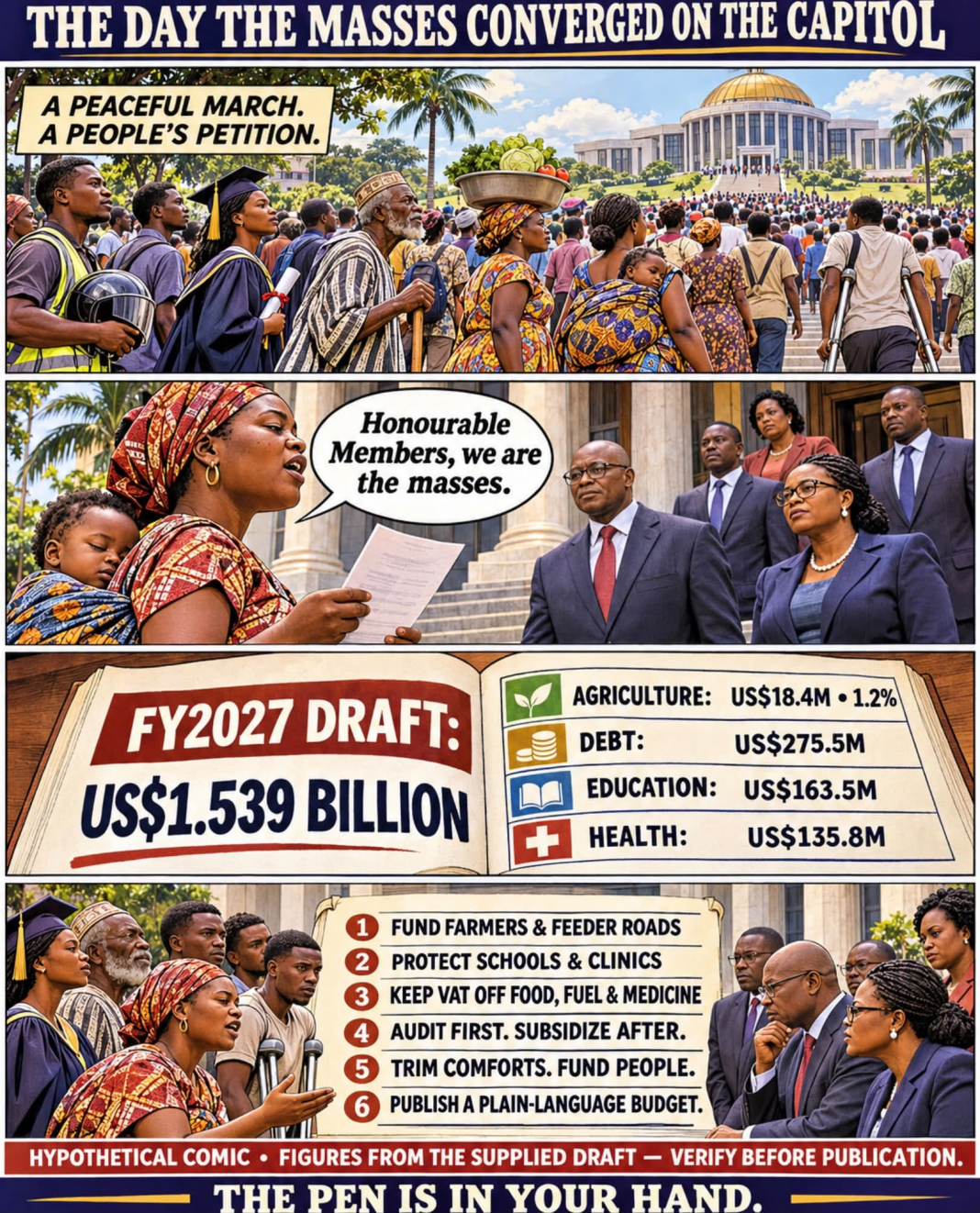
It begins, as these things always begin in Liberia, with the sun.
By seven o’clock the tar on Capitol Hill is already soft underfoot, and the heat stands over Monrovia like a lid on a pot. The hawkers are setting out their trays. The traffic grinds and blares at the foot of the rise. An ordinary Tuesday, by every sign. And then, out of the ordinary morning — out of Waterside and Red Light and West Point, out of Clara Town and New Kru Town and the swamp-edge places the budget never troubles to name — they begin to come.
They come on foot, mostly, because the fare is the first thing the poor surrender. A slow river of ordinary people, wending up the long grey slope toward the white dome of the Capitol, where the laws are made that they will live under and were never asked about.
At the head of it, almost without meaning to be, walk the women. Mothers with their babies lashed to their backs in faded lappa, the infants sleeping clean through it all, one small fist curled against the morning. The sweat runs and they do not wipe it. They have carried heavier things than heat up harder hills than this.
Behind them come the old. An old man feels the road ahead with a walking stick rubbed smooth by the years, his trousers belted high, his eyes fixed on the dome as a pilgrim fixes on a shrine. An old ma follows, her headtie the one bright and defiant colour in the whole grey procession, her lips moving — whether in prayer or in a song from the war time, no one near her can tell.
Then come the young, who should be the country’s strength and are instead its open wound. The graduate in his one good shirt, a brown certificate rolled in his fist like a baton he has nowhere to pass. The pen-pen riders, who have left their machines in a long silver row at the bottom of the hill and walked up bare-headed, helmets under their arms, their trade stilled for a morning so their grievance can be heard.
And among them, unbearable to look at and impossible to look away from, the ones this nation has half-buried while they still draw breath — the drug victims, the boys the streets swallowed, hollow in the cheek, trembling in the hand, scratching at a torment under the skin. One of them was a schoolboy three dry seasons ago. His mother is somewhere in this same crowd, further back, and cannot bring herself to look at him, and cannot stop.
There is a man on one leg and two crutches — the war’s old signature, swinging himself up the hill a yard at a time. There is a blind man with a boy’s thin shoulder for his eyes. There are the market women with their basins empty on their heads, because a basin that carries nothing to sell carries a message instead. No placards of insult. No burning tires. No stones in any fist. They have brought only themselves — which is the one thing the big men have never learned how to answer.
At the gate the guards shift their weight and finger their straps and do not know what to do, because there is no drill for this, no order ever written for the hour when the whole governed world simply walks up quietly to the house of its governors and stands there in the sun, breathing, waiting. A thousand faces, and more climbing the hill behind them, all turned up toward the cool stone balconies above — the balconies from which, on other mornings, power looks down at the small ant-traffic of the poor and sees nothing it must answer to.
And then the thing nobody had thought to expect. The great doors of the Capitol open. And the lawmakers come down. Down the wide marble steps, they come — the ones who are always watched walking up them in dark glasses and darker cars. The President Pro Tempore. The Speaker.
The chairmen of the committees. Down they come, out of the cool and the carpet, into the raw white light, onto the same hot ground where the market woman’s bare feet are planted. For once in the long quarrel between this people and its rulers, the stage turns the other way: not the masses summoned up to power, cap in hand — but power walking down, at last, to the masses.
A hush falls so complete you can hear the baby stir on its mother’s back, and a pen-pen rider’s helmet knock once against his hip.
Out of the front of the crowd a woman steps forward. A market woman. There is a baby asleep on her back and a single sheet of paper, folded small and soft from much handling, in her hand. She is not a big woman. Her voice, when it comes, is not a big voice. But the whole hill leans in to catch it, and the men on the steps go still.
She unfolds the paper. She looks up once, at the row of powerful faces above her, and down once, at the words a schoolteacher wrote out for her the night before. And she begins to read.
“Honourable Members,” she reads. “We are the masses…”
TO: The Joint Legislative Committee on Ways, Means, Finance and Budget, National Legislature of Liberia
THRU: The President Pro Tempore of the Liberian Senate, and The Speaker of the House of Representatives — Capitol Hill, Monrovia
FROM: The Masses of the Republic of Liberia
DATE: November 2026
RE: Our humble—and unpaid—petition on the Draft National Budget, FY2027
Honourable Members of the Joint Committee,
We are the masses. Permit us, first, to say who is writing, for we are seldom allowed to speak for ourselves.
We are the ones you fight for at election time, and curse in the heat of your own quarrels. We are the name on every banner and the reason given for every war. When the big men want power, it is our hunger they point to. When the self-appointed liberator picks up his gun, it is in our name that he fires it.
When one warring faction meets another in the bush, it is over our bodies that they fight to the death — and it is our villages that burn while they share the spoils in the city. We have been fought for, preached to, counted, and mourned. We have rarely been fed.
We are the farmer in Tarjuowon and the fisherman at Robertsport. We are the market woman at Red Light whose small-small profit no longer buys the week’s rice. We are the pen-pen rider, the ma in the clinic line, the boy with a certificate and no job leaning on his wheelbarrow. We cannot all read — so this letter was read to many of us, under the mango tree, before our marks were set to it. But we can count. On an empty stomach, a person counts very well.
And so we have counted the budget your brothers in the Executive have prepared over our heads — all US$1,538,916,274 of it, nearly US$1.54 billion. They have given it a sweet name: “A Growing Budget for Bigger Impact.” Forgive us, Honourable Members, but we have learned to fear sweet names. In our experience, the bigger the impact they promise from the hill, the smaller our portion of it in the village.
They tell us the economy is growing. We believe them; we have watched the iron ore leave through the port in long, heavy trains. But growth that machines dig out of the ground is not food in a child’s bowl. Most of us are farmers.
And for the farmer — the backbone, they call us at every rally — this budget sets aside just US$18.4 million: 1.2%. One dollar out of every eighty, for the work that feeds the whole nation. A backbone budgeted at one and two-tenths of a percent.
We have grown hungry standing on our own fertile land, and then watched them borrow to import the very rice we could have grown.
Speaking of borrowing: they will spend US$275.5 million next year paying off old debts — more than the US$163.5 million they will spend to teach every child in Liberia, and more than double the US$135.8 million they will spend to keep us alive in the clinics. We did not eat those loans. We never saw some of the roads they were borrowed to build. But we will pay. We always pay. The creditor is served before the classroom, the classroom before the clinic, and we come last of all — as usual.
Then we are told there is a new tax coming, dressed up in new letters — VAT. They swear on their comfortable chairs that it will not touch our rice or our kerosene. We hold our little receipts, Honourable Members, and we wait to see. We have heard such swearing before.
And here is the part that would be funny, if our stomachs left us the strength to laugh. Seventeen of their twenty big government companies could not even bring their account books on time this year — and still the hand reached into the public purse for US$47.4 million to keep those companies running, US$28 million of it for the light company alone, while our towns sit in darkness. If the market woman kept her books that way, she would be sleeping in Monrovia Central Prison by Friday evening. But there is one law for her, and another for them.
Meanwhile there is US$3 million for the Lone Star, and another US$1 million to make the Executive Mansion beautiful again. We do not begrudge the nation its pride or its flag. We only ask that a hungry house be fed before its sitting-room is painted. That is not economics. That is the common sense our grandmothers had.
AND NOW, HONOURABLE MEMBERS, LET US SAY THE HARD THING.
We are not fooled. We have watched this ritual all our lives, and our fathers watched it before us. The Executive writes the budget; the Legislature stamps it; and the two branches that the Constitution set to watch each other sit down instead and eat from the same bowl, over our portion. Two friends sharing one spoon do not weigh each other’s hand.
How many budgets have passed through these very committee rooms unread? How many times has the people’s money been quietly shared in the cool of these chambers, the thick allocations settled among friends, and only the thin water of it handed down to us and called “impact”?
We have seen this House find money swiftly — for its own sitting allowances, its own comforts, its own travels — while the farmer’s 1.2% sits there on the page, year after year, like a wound nobody will dress. When the hand that writes the law and the hand that spends it belong to the same handshake, the poor man’s name is never in the letter.
We know the dance beyond these walls, too. Every few years the drums beat, and the big men come down from the hill to us with soft hands and softer promises.
They eat our kola, they dance our dance, they weep at our funerals and swear they are one of us. Then the counting ends, the long cars climb back up the hill, and we do not see them again until the next drum. This budget is that same old dance — only written down. It balances beautifully on their paper. It balances on nothing in our kitchen.
And yet we write to you — and not to them. We write to you with our eyes open, knowing this House’s record, because the Constitution has given us no other door, and because a seat can be redeemed even after it has been abused. You are the People’s Branch. You are the one chamber in this whole Government that we, the small people, were told was built for us. The Executive has sent you their draft.
But you are not their clerks, and this is not their law to make. The pen is in your hand now, Honourable Members, and in yours alone, to change a single line of it before it becomes the law of this Republic. That window will shut soon, and it will not open again this year.
So we beg you — we, who have no lobbyist but our own worn feet, and no envelope to slide across any table — do not, this one time, simply pass what the men on the hill have handed you. Break the ritual. Amend it for us. We ask a few plain things:
- Feed us first. Lift agriculture far above that shameful 1.2%, and send the increase to seed, to simple tools, and to the small feeder roads that carry our harvest to market.
- Serve the school and the clinic before the creditor. Put a limit on what this nation spends chasing old debts, and protect the little lines that keep our children in school and medicine on the shelf.
- Keep the new tax off our basket. Do not let VAT touch our food, our fuel, or our medicine, and leave the petty trader out of its net entirely.
- No public money for a company that will not open its books. Let every subsidy wait upon an honest, audited account. No report, no money.
- Trim the comforts of the big men — and your own — and give the saving to the people. Move it into one open fund we can actually watch: farms, mothers, school feeding.
- Show us the budget in words we can read. A citizens’ budget, in plain language, and real hearings in our own counties, so we can follow our own money.
A WORD ABOUT THE CHAIR YOU SIT IN.
They tell us this budget is balanced. We are small people, but we have read our Bibles, and we know there is an older balance than theirs — an unseen one, in which kingdoms and their stewards are weighed. Belshazzar’s feast was balanced too, and the wine was sweet, the night the fingers of a hand came out and wrote upon the wall: weighed in the balances, and found wanting. The king who could not read it did not live to see the morning.
Honourable Members, walk the quiet halls of this same Capitol and read the old nameplates. Look at the portraits on the wall. Men sat in your very chairs — Pro Tempores, Speakers, chairmen of this same committee — who were certain the drums would never change their tune for them. They too received the Executive’s budgets and stamped them.
They too heard the people’s cry at the door and turned up the music inside. And where are they now? Some the ballot swept away in a single morning. Some time quietly carried off. And some met the harder reckonings that this land still does not speak of above a whisper. The chairs remained. The people remained. Only the occupants changed.
The seat you sit in is not yours. It is only lent to you, for a short season, by us. One day — sooner than you believe, for it always comes sooner than they believe — you too will rise from it and walk out these doors, and another will warm it, and this letter, or one just like it, will be read again under some other mango tree. The only question history leaves open is which kind of occupant you were: the one who read the writing on the wall — or the one it was written against.
And hear our last words not as a threat — we have no army, only our hunger — but as a memory this land already paid for in blood. We are a patient people; God above knows how patient.
But the hard sentence of our history reads the same in every chapter: when the masses are fought over but never fed, when they are counted but never heard, that is the very hour the drummer and the gunman find their recruits among us. You know this truth. You buried it with us, grave by grave, for fourteen years. Do not let a tidy, well-balanced budget become the quiet first page of another untidy season.
We are not asking you to perform a miracle. We are asking you to remember whose branch you are, to read the writing on your own wall, and to use the pen while it is still in your hand.
Respectfully, and with the little patience we have left,
THE MASSES OF THE REPUBLIC OF LIBERIA
–the farmer, the fisherman, the market woman, the pen-pen rider, the ma in the clinic line, and the child still waiting for a teacher.

