

By Sherman C. Seequeh
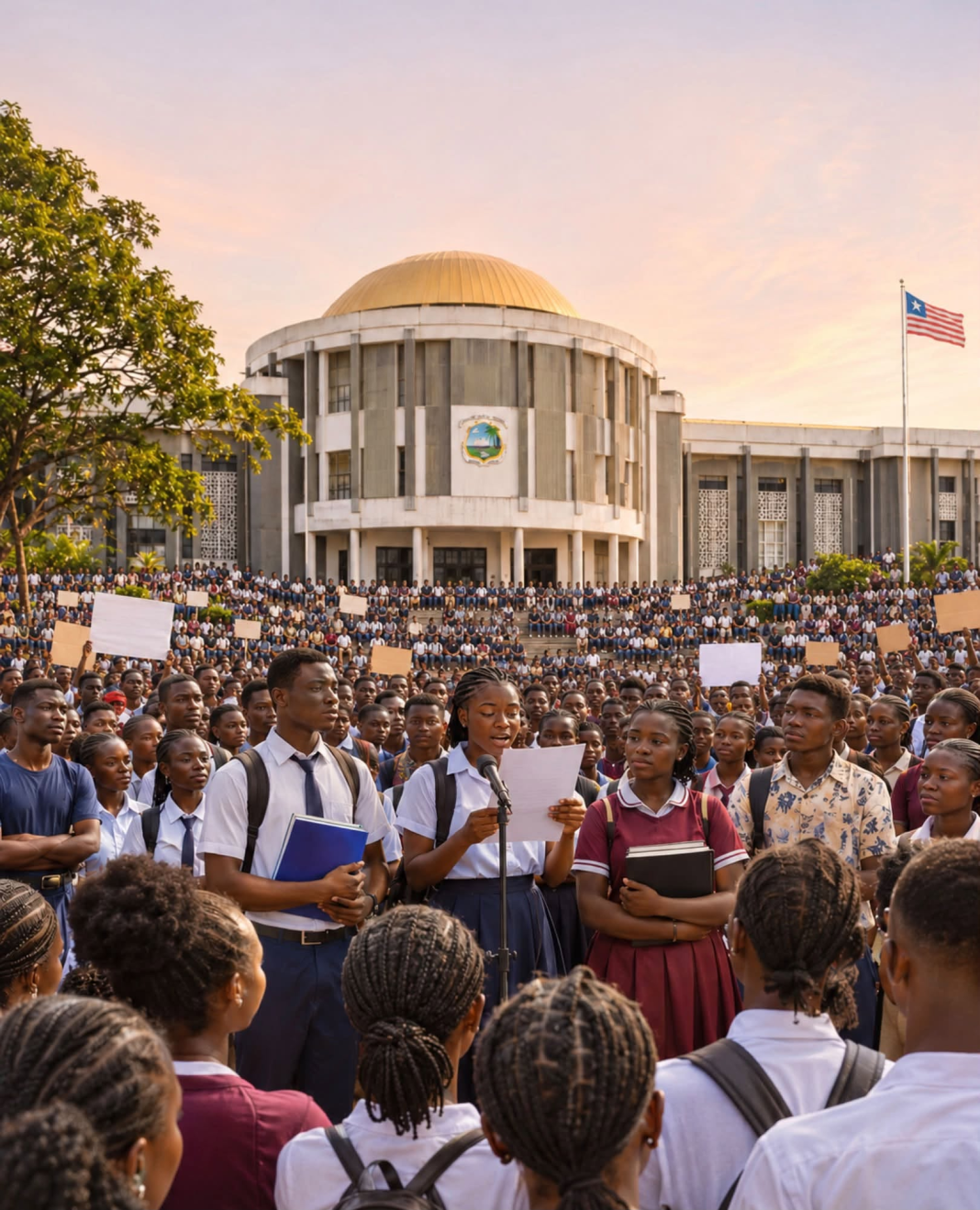
A petition read aloud by a student leader before a mass of students assembled at the Legislature on Capitol Hill, calling on the people’s deputies to raise the budget for education.
Only yesterday, it was their mothers and fathers who had filled this hill — the masses, with their own cry and their own folded petition.
The Capitol had scarcely swept the dust of that crowd from its steps. And then, this morning, they came again — but younger. In their thousands, in white shirts and worn uniforms, from the public schools and the university, massing on Capitol Hill under the noon sun. They carried no stones — only exercise books, and one folded petition. The guards did not know what to do with a crowd that only wanted to read. At last a young woman climbed the step, unfolded the paper, and the great crowd behind her went quiet. She began to read.
Honourable Speaker. Honourable President Pro Tempore. People’s Deputies of this Republic. We greet you.
You have hardly caught your breath. Only yesterday the masses — our mothers, our fathers, our aunties from the market — stood on this same ground and read you their own petition on this budget. Today it is the turn of their children. Hear us too.
We are the students of Liberia. We are the ones you call “the future” – “the precious jewels” – at every graduation, in every speech, whenever the cameras are rolling. We have walked here today to ask you one simple question, and to lay before you one simple petition. If we are truly the future — then why are we funded last?
We have read your budget, Honourable Deputies. All US$1.54 billion of it. And we did the small arithmetic you yourselves taught us — in the very classrooms you underfund.
You have set aside US$163 million to educate every child in this country — one dollar out of every ten. And in the same budget, you will spend US$275 million to service old debts. Put those two numbers side by side, and grieve with us: this nation will pay more to its foreign creditors next year than it will pay to teach all of its children. The lender is served before the learner. The interest is treated as sacred; the child is told to wait.
And here, People’s Deputies, is the part that cut us deepest.
We studied the pages where you record what offices have already spent. And we found office after office that spent past the very budget you gave them — before the year was even finished — and then, instead of being stopped, were handed more for next year. The office of the Presidency spent past its ceiling, and was lifted by a third. The security agency overspent by a fifth, and was rewarded with a fifth more. Even this House — your own House, the people’s House — spent seven million dollars above its own budget. So the money was there. You found it, mid-year, whenever you wanted it. You found it for kitchens, and special projects, and travel. But when we asked for desks, for chalk, for a roof that does not rain on our books, suddenly the cupboard was bare.
Let us tell you what your US$163 million looks like, from where we are sitting.
It looks like a girl doing her homework under a streetlight, because there is no current in her house. It looks like sixty children in a classroom built for thirty, three to a bench, one torn textbook shared between them. It looks like a teacher who has not been paid a regular and a living wage, standing in front of us anyway, out of love and not out of salary. It looks like a laboratory with no equipment, a library with no books, a university where we fight one another for a seat in the one good lecture hall. That is what ten percent buys. That is what “the future” is worth, in this budget.
And do not tell us that ten percent is enough, Honourable Deputies — because the world has already fixed the mark, and Liberia put its own name to it. Under the Education 2030 agreement that the nations of the earth adopted at Incheon, every government pledged to spend at least 15 to 20 percent of its national budget on education — or 4 to 6 percent of its whole economy. This draft gives us 10.6 percent of the budget, and barely 3.8 percent of our GDP. We are beneath both lines — beneath the very floor we ourselves signed. And across this continent, only nine countries out of forty-nine have ever reached the twenty percent they promised their children.
Honourable Deputies, do not let Liberia be counted forever among the nations that promised the child, and paid the creditor, and fill the president’s luncheon sumptuously.
And this is not the failure of one bad year. It is the story of our whole lives. Government after government has stood where you stand and promised us free and compulsory education — in the commencement speech, in the campaign song, in the fine policy paper that nobody ever funds. We have heard the word “priority” spoken over education so many times that it has worn thin and lost its meaning. Priority in the mouth; last place in the budget. That has been the Liberian habit for as long as any of us has been alive. Only one historically giant move – when the last government implemented a free tuition policy for public universities and colleges.
Our teachers taught for years on “volunteer” rolls — unpaid, year upon year, waiting for a payroll that was always coming and never came. We have sat under mango trees and in leaking zinc shacks and called them schools. And we have not forgotten the year this nation hung its head before the whole world — the year a whole crop of our young people sat the university entrance, and a pass could barely be found among the thousands of them. That was not the children failing the nation, Honourable Deputies. That was the nation, year upon year, failing its children. The lip service is old. The classrooms are still empty. We have come to say: enough.
And hear this bitter thing. Even the body that sets our examinations — the one that decides whether years of our sweat will count for anything — even it ran short of money this year. So we sat our papers in fear, wondering if the fees would be found. Is that the future you keep promising us from the podium?
And yet we did not walk all this way only to cry. We came because we know the money is there. This year, for the first time in the entire history of this Republic, Liberia collected more than one billion dollars of its own revenue. A billion dollars, Honourable Deputies! Surely, out of such a harvest, a bigger portion can be made to reach the classroom.
You keep telling us you will carry Liberia to middle income by the end of this decade. Then hear us well, because we are the ones you are counting on to carry it: no nation in the history of the world has ever climbed into the middle class on the backs of an ignorant generation. You cannot build a rich country with poor minds. Education is not a cost you suffer. It is the one investment that pays a whole nation back.
And remember what this very land already knows in its bones. An idle, hopeless, unschooled young person is the dry wood that caught fire for fourteen years. You have seen, with your own eyes, what becomes of a generation that is abandoned. Educate us, and you build the nation’s surest defense.
Abandon us, and you plant, with your own hands, the trouble of tomorrow.
So here is our petition, People’s Deputies, stated plainly, so no one can say they did not hear it:
- Raise the budget for education — not by crumbs, but by a share that matches your speeches.
- Pay the teacher a wage he can live on, and post trained teachers to the villages, not only to the city.
- Put books in the libraries, and equipment in the laboratories.
- Fund the rural school, the school feeding that keeps a hungry child learning, and the scholarships that let a poor child rise.
- And find the money where it is being wasted. Take it from the offices that overspent and were rewarded. Take it from the kitchen, and give it to the classroom.
Honourable Deputies, you hold the pen. We hold only our books, our hope, and our patience — and our patience, like our school fees, is running short. Do not send us home today with another fine speech about the future. Fund the future. Write it into the budget, in a figure we can see with our own eyes.
We thank you for hearing us. And we want you to know: we are watching what you will do with this budget. History will remember it. And so will our generation — whether, on this day, the people’s deputies chose the creditor, or the child.
And one last word, Honourable Deputies, before we fold this paper and go home. Yesterday, the masses. Today, the students. Then ask yourselves, quietly, who climbs this hill tomorrow. Perhaps the sick, from the clinics that have no medicine. The day after, the farmers you handed one percent. Then the market women, the pen-pen riders, the unpaid widows of soldiers — one group after another, the people this budget funds last are learning the road to this House. We are not a mob. We are a line — a long, patient, growing line. Do not wait until the hill is full to hear us.
Signed, in white shirts and with open books,
THE STUDENTS OF LIBERIA.

