

By Esau J. Farr, Sr.
Residents of Tartuken in River Gee County are raising alarm over a massive water-filled mining site left behind by a gold mining company, warning that the abandoned pits now pose a serious threat to lives and livelihoods in the community.
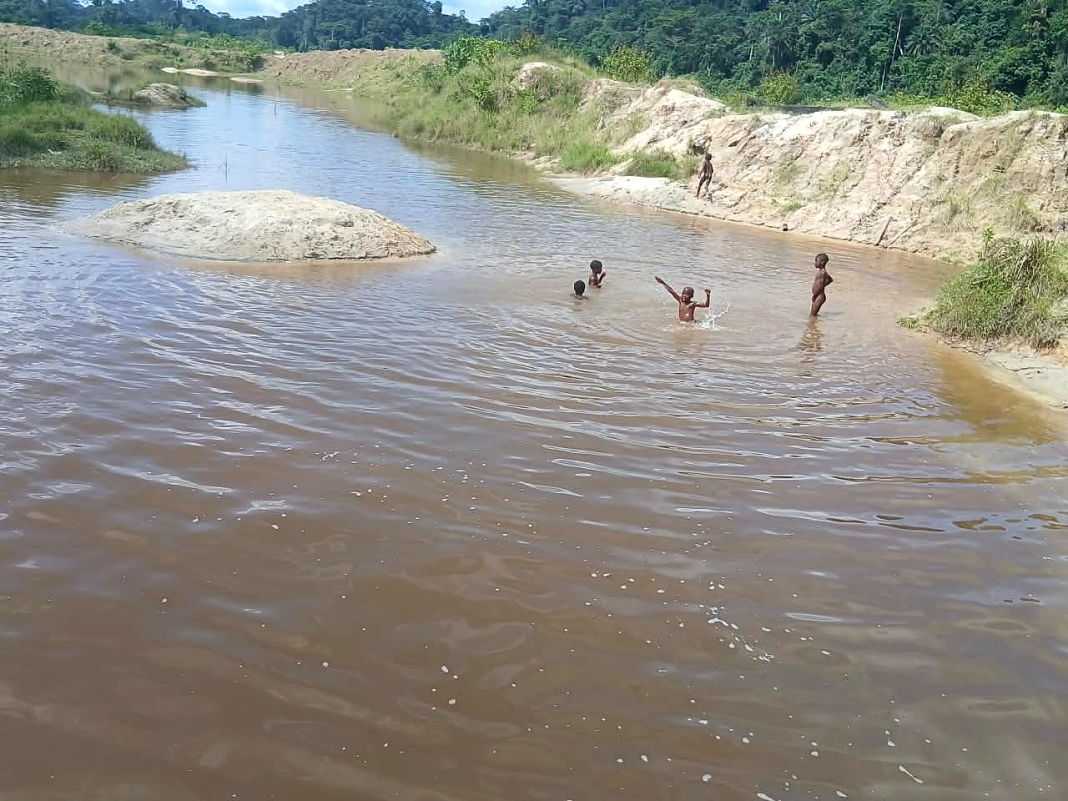
On a recent Saturday afternoon, six children were seen swimming in one of the large pits on the outskirts of the town before a concerned relative rushed in to drive them away.
“What are you doing there?” the woman shouted. “Didn’t we tell you not to swim in this water? Do you want your mothers to wear black?”
The water body, now referred to by residents as a “river,” is the legacy of mining operations carried out by Gee Mining Resources Limited, a company that residents and authorities accuse of violating environmental and mining regulations.
According to community members, the company obtained a Class B, or medium-scale, mining license shortly after its establishment and began extracting gold in the area. During operations, it diverted a nearby creek into an open field and excavated large pits, dramatically altering the landscape.
When the company suspended operations nearly two years later, residents say it left without fully reclaiming the site, contrary to legal requirements.
The result is a series of deep, water-filled excavations located only a short distance from homes and farms. Some residents have reportedly had to swim across portions of the pits to access their farmland.
“The way the place is opened is not correct. It is a threat to us,” said Lawrence Dweh, a classroom teacher in Tartuken. “It could bring trouble to the town in the future. We are fearing for the lives of our children and ourselves.”
The town’s chief elder, Paul Kity, echoed those concerns.
“We don’t want death trouble here,” Kity said.
The fears are not unfounded. Across Liberia, abandoned mining pits have been linked to drowning deaths, particularly among children and small-scale miners. Residents worry that Tartuken could face a similar tragedy if the hazards are not addressed.
Yet responsibility for the dangerous site remains disputed.
Sylvester Shaw, liaison officer for Gee Mining, acknowledged that the pits pose a risk but argued that community leaders prevented the company from refilling them. According to Shaw, residents opposed reclamation because they intended to continue mining the area themselves.
Community elders confirmed the claim, revealing that they had been earning about LD$5,000 (US$30) weekly from informal gold-sifting activities in the abandoned pits.
“We told them not to close those holes so we could put our machines there and get small money,” Kity admitted.
However, acknowledging the growing danger to residents, he said the pits should now be closed.
“I think the way it is happening there, let them close the pits,” Kity told The DayLight.
Despite the community’s position, legal experts note that reclamation remains the responsibility of the mining company. Liberia’s Minerals and Mining Law of 2000 and the Environmental Protection and Management Law require mining operators to restore disturbed land after operations cease.
Government officials say Gee Mining failed to meet that obligation.
David Sayon, a Ministry of Mines and Energy representative in the region, said the company violated the law by both abandoning unreclaimed pits and diverting a natural watercourse.
“Diverting the water is dangerous for lives and living things in the water,” Sayon said in a telephone interview. “That was the first crime they committed, and it is not good for our people.”
The Environmental Protection Agency (EPA) has also vowed to pursue the matter.
Johnson Nowon, head of the EPA in River Gee County, said a report detailing the company’s alleged violations has been forwarded to the agency’s headquarters in Monrovia.
“When they leave the place, they are not leaving the country,” Nowon said. “Wherever they go, we will trace them and bring them back to reclaim the land.”
Gee Mining owner Nelson Worjolo said he is willing to return to Tartuken and complete restoration work. He defended the diversion of the creek, saying it was intended to provide cleaner water for downstream communities.
Beyond the environmental concerns, investigations have uncovered additional compliance issues. A DayLight investigation using satellite imagery found that portions of Gee Mining’s operations extended at least one kilometer beyond its licensed concession area, despite permit restrictions prohibiting activities outside approved boundaries.
Questions have also emerged over the company’s legal relationship with the host community. Although Gee Mining carried out the mining operations, the required memorandum of understanding (MoU) with Tartuken was signed by RAC Incorporated, a company owned by miner Randy Scott, who has faced scrutiny over other mining operations across Liberia.
Investigators found that RAC signed the agreement in July 2024, before Gee Mining was established.

