

A Scholarly Article
Prepared for academic and public-policy discussion
Abstract
This article examines the relationship among the balance of power, the balance of terror, and weapons proliferation through the lens of classical and structural realism. It argues that states pursue security in an international system without a central authority capable of reliably protecting them. Consequently, governments build military capabilities, form alliances, seek strategic advantage, and sometimes acquire increasingly destructive weapons. Nuclear deterrence can discourage direct aggression by making the costs of war unacceptable, yet it also creates risks of miscalculation, escalation, arms racing, and catastrophic humanitarian consequences.
The article distinguishes nuclear proliferation from the wider spread of conventional arms, small arms, missiles, cyber capabilities, and dual-use technologies. It considers the role of international law and institutions, including the United Nations Charter, the Treaty on the Non-Proliferation of Nuclear Weapons (NPT), and the Arms Trade Treaty (ATT).
It then applies these debates to Liberia and West Africa, emphasizing responsible arms management, regional cooperation, maritime security, accountable institutions, and human security. The central conclusion is that a stable international order requires more than military equilibrium: it requires credible deterrence accompanied by diplomacy, transparency, arms control, and sustained investment in peace and development.
Keywords: realism; balance of power; nuclear deterrence; balance of terror; weapons proliferation; arms control; Liberia; international security.
Introduction
International politics is shaped by the continuing tension between the desire of states to preserve peace and their determination to protect national interests. Governments operate in an international environment where no single world authority possesses an uncontested monopoly on legitimate force. Even though the United Nations and other institutions provide rules, forums, and mechanisms for cooperation, states ultimately remain responsible for their own security. This condition is central to realist theories of international relations.
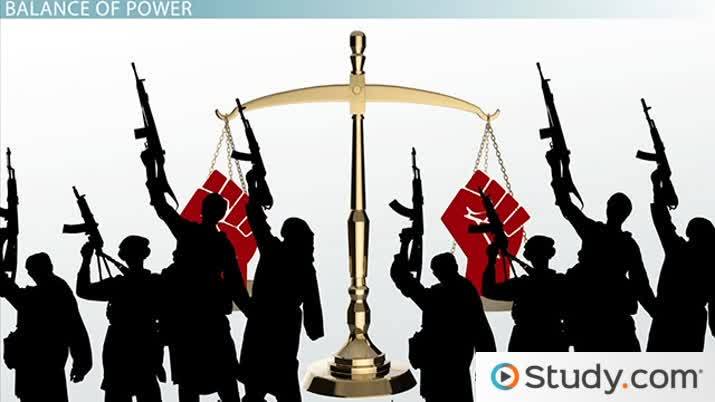
The balance of power describes a distribution of capabilities in which no state or coalition is able to dominate all others without facing resistance. States may balance against a threatening power by strengthening their own armed forces, forming alliances, increasing diplomatic partnerships, or developing economic and technological capabilities. The objective is not necessarily equality in every category of power. Rather, it is to prevent a decisive concentration of power that could endanger the independence and survival of other states (Waltz, 1979).
The phrase balance of terror is commonly associated with the nuclear age. It describes a strategic condition in which opposing nuclear-armed states possess the ability to inflict unacceptable destruction on one another. The prospect of retaliation may discourage either side from launching a first strike. Yet the same condition leaves humanity exposed to accidents, false warnings, unauthorized use, escalation, and political misjudgment. Nuclear deterrence can therefore produce restraint while preserving an extraordinary level of danger.
Weapons proliferation complicates this strategic environment. It includes the spread of nuclear, chemical, biological, radiological, and conventional weapons, as well as the technologies, expertise, materials, and delivery systems that support them. Proliferation may occur vertically, when an existing weapons possessor expands or modernizes its arsenal, or horizontally, when additional states or non-state actors obtain capabilities. The uncontrolled movement of conventional weapons and small arms can also destabilize societies even where nuclear weapons are absent.
This article advances three propositions. First, realist competition helps explain why states pursue military capabilities even when arms accumulation creates insecurity for others. Second, deterrence can reduce the likelihood of deliberate attack but cannot eliminate the risk of war. Third, rules, verification, diplomacy, and regional cooperation can reduce the dangers of proliferation without requiring states to ignore legitimate security concerns.
Theoretical Framework: Classical and Structural Realism
Classical realism, associated with Hans J. Morgenthau, emphasizes the struggle for power rooted in political life and human nature. It treats national interest, prudence, and the limits of political action as essential considerations. Structural realism, particularly Kenneth Waltz’s neorealism, places greater emphasis on the structure of the international system. Because the system is anarchic—not necessarily chaotic, but lacking a central governing authority—states must consider how their capabilities compare with those of others.
For structural realists, survival is the primary goal and power is an important means of securing it. A state may increase its military strength not because it intends to attack another state, but because it fears vulnerability. However, its neighbors may interpret the same buildup as threatening and respond with their own military expansion. This security dilemma can generate arms competition even when no government initially seeks war (Waltz, 1979; Jervis, 1978).
Balance of Power as a Strategy of International Stability
The balance of power is both a description of international arrangements and a strategy pursued by states. In a multipolar system, several major powers possess significant capabilities; in a bipolar system, two principal powers dominate the strategic landscape; and in a unipolar system, one state enjoys a substantial preponderance. Each configuration creates different incentives, risks, and opportunities for diplomacy.
Balancing can be internal or external. Internal balancing occurs when a state develops its own military, economic, industrial, technological, and intelligence capabilities. External balancing occurs when it builds alliances or security partnerships. States may also pursue limited accommodation with a stronger power, sometimes described as bandwagoning, when resistance appears too costly or when alignment offers political or economic benefits.
A balance of power does not automatically produce peace. It may deter aggression by making victory uncertain or prohibitively expensive. Yet it can also create crises when states misread one another’s intentions, fear that the balance is shifting, or believe that a temporary advantage will disappear. Alliances can strengthen deterrence, but they can also widen the geographical scope of a conflict. A crisis involving one state may draw in partners whose commitments and interests are not identical.
The realist perspective therefore encourages policymakers to assess capabilities, intentions, geography, alliance commitments, and strategic credibility. It also warns against assuming that declarations of peaceful intent are sufficient. At the same time, prudent realism does not require endless militarization. A state that diverts too much of its national resources into armaments may weaken the economic and social foundations of its own power. National resilience depends on education, public health, infrastructure, effective institutions, economic productivity, and public trust.
The Balance of Terror and Nuclear Deterrence
Nuclear weapons transformed the meaning of military superiority. Conventional wars may devastate armies, cities, and economies, but nuclear weapons can inflict destruction on a scale that threatens the survival of states and the lives of millions of people. The strategic concept of deterrence rests on the belief that an adversary can be persuaded not to attack because the expected costs of retaliation exceed any possible gain.
Thomas C. Schelling’s work on coercion and strategy explains how threats, commitments, communication, and uncertainty influence bargaining between adversaries. Deterrence differs from compellence: deterrence seeks to prevent an action, while compellence seeks to make another actor change its behavior. A credible deterrent generally requires capability, communication, and a belief that the threatened response could occur. A weapon that cannot survive an attack, cannot be controlled, or is not believed by an adversary may fail to deter.
The Cold War confrontation between the United States and the Soviet Union is the most prominent historical example of a nuclear balance of terror. Both superpowers developed large arsenals and delivery systems. The possibility of devastating retaliation contributed to caution during periods of crisis, including the Cuban Missile Crisis of 1962. Nevertheless, the absence of direct superpower nuclear war should not be interpreted as proof that deterrence is fail-safe. The world experienced dangerous confrontations, technical errors, proxy wars, and repeated arms competitions.
Deterrence depends on rational judgment, reliable command-and-control systems, accurate information, and political leaders who understand the consequences of escalation. These assumptions may be weakened by domestic instability, compressed decision-making time, cyber interference, misinformation, unauthorized actions, or leaders who miscalculate an opponent’s resolve. The balance of terror is therefore a condition of mutual vulnerability, not a guarantee of safety.
Weapons Proliferation: Forms, Drivers, and Consequences
Weapons proliferation is not limited to the acquisition of nuclear bombs. It includes the spread of chemical and biological weapons, ballistic and cruise missiles, armed drones, advanced conventional systems, small arms and light weapons, and relevant dual-use materials and technologies. Dual-use technologies can support legitimate civilian activities while also having potential military applications. This creates difficult policy questions for export controls, scientific cooperation, and verification.
States may pursue weapons for several reasons: fear of external attack, regional rivalry, alliance uncertainty, status and prestige, domestic political legitimacy, technological ambition, or a desire to reduce dependence on foreign suppliers. Some governments view strategic weapons as insurance against regime change or coercion. Others believe that advanced military capabilities will improve their bargaining position. These motivations are consistent with realist expectations, although leaders and institutions can interpret threats differently.
Proliferation can have destabilizing effects. It may encourage neighboring states to acquire similar capabilities, intensify arms races, increase the risk of accidental or unauthorized use, and weaken confidence in international agreements. Conventional weapons can fuel civil conflict, organized crime, terrorism, and political violence when transferred to unauthorized users or diverted from state stockpiles. Poor recordkeeping, insecure depots, corruption, weak border controls, and inadequate end-user verification create opportunities for diversion.
It is important to distinguish legal arms transfers from illicit trafficking. States have legitimate rights to maintain armed forces and acquire equipment for lawful self-defence. However, transfers should be subject to national law, international obligations, risk assessment, licensing, and effective end-use controls. The Arms Trade Treaty seeks to establish common standards for international transfers of conventional arms and to prevent or eradicate illicit trade and diversion. Its effectiveness depends on implementation, transparency, and enforcement.
International Law and Institutions: Restraining Competition
Realism explains why states are concerned with power, but it does not mean that law and institutions are irrelevant. International rules can reduce uncertainty, create expectations, facilitate communication, and raise the political and legal costs of irresponsible conduct. Institutions are often most effective when they address practical interests shared by states, including avoiding accidental war, preventing diversion, and maintaining predictable trade.
The United Nations Charter establishes the foundation of the contemporary collective-security system. Article 2(3) requires members to settle disputes by peaceful means, while Article 2(4) prohibits the threat or use of force against the territorial integrity or political independence of any state, subject to the Charter’s legal framework. Article 51 recognizes the inherent right of individual or collective self-defence if an armed attack occurs. These principles seek to reconcile sovereign security with the collective interest in peace (United Nations, 1945).
The Treaty on the Non-Proliferation of Nuclear Weapons, opened for signature in 1968 and in force since 1970, is built around three mutually reinforcing pillars: non-proliferation, peaceful uses of nuclear energy, and disarmament. Articles I and II contain commitments against the transfer or acquisition of nuclear weapons by treaty parties; Article III provides for safeguards; and Article IV recognizes the right to peaceful nuclear energy in conformity with the treaty. The NPT’s legitimacy depends in part on progress across all three pillars, not only on restricting additional states from acquiring nuclear weapons.
The International Atomic Energy Agency (IAEA) plays a central verification role through safeguards agreements. Verification does not eliminate every risk, but it can increase confidence that declared nuclear material and activities remain within peaceful purposes. The Arms Trade Treaty complements this framework by addressing conventional arms transfers. These instruments illustrate that security and regulation need not be opposites: effective controls can help states pursue legitimate defence while reducing the risks of diversion and escalation.
Contemporary Strategic Competition and the Risk of Miscalculation
The current international environment is characterized by renewed major-power competition, regional conflicts, technological change, and uncertainty about the future of arms control. Strategic competition now extends beyond nuclear weapons to missile defence, hypersonic systems, autonomous platforms, cyber operations, space capabilities, artificial intelligence, and the protection of critical infrastructure. These technologies can affect warning times, command systems, intelligence assessments, and the perceived vulnerability of national forces.
The war in Ukraine has renewed attention to nuclear signaling, alliance cohesion, conventional deterrence, and the risk that a regional conflict could produce wider confrontation. Tensions in the Middle East demonstrate how regional rivalries, missile capabilities, external security guarantees, and nuclear concerns can interact. In the Indo-Pacific, strategic competition involving the United States and China intersects with questions of maritime access, Taiwan, alliance commitments, and military modernization. These examples should not be treated as identical; each has its own history, legal context, and political drivers.
A realist analysis asks how each actor interprets the distribution of power and whether it believes the existing order protects its interests. Yet the same analysis must recognize that perceptions can be inaccurate. Military exercises may be interpreted as preparation for attack; defensive deployments may appear offensive; and public threats may reduce leaders’ room for compromise. Crisis communication, military-to-military contacts, hotlines, incident-prevention arrangements, and transparent doctrine can reduce the danger of accidental escalation.
The spread of cyber capabilities adds another layer of uncertainty. Cyber operations may target communications, energy infrastructure, financial systems, or military command networks. Attribution can be difficult, and states may disagree about whether an incident constitutes an armed attack. Where cyber operations affect nuclear command-and-control or early-warning systems, the danger is particularly serious. Resilience, clear rules, secure networks, and responsible state behavior are essential.
The Security Dilemma: When Defence Produces Insecurity
The security dilemma occurs when one state’s measures to improve its security make other states feel less secure. Because intentions are difficult to verify, governments often judge one another by observable capabilities. A state that increases troop levels, deploys missiles, purchases aircraft, or strengthens naval forces may describe these measures as defensive. Its neighbors may nevertheless interpret them as preparation for coercion or attack.
The dilemma can become self-reinforcing. State A expands its military because it fears State B. State B interprets the expansion as a threat and responds with its own buildup. State A then cites B’s response as evidence that its original concern was justified. Without communication or confidence-building measures, both states may spend more on weapons while becoming less secure.
The dilemma is not inevitable. Geography, transparency, defensive force posture, arms-control agreements, verification, and shared economic interests can reduce uncertainty. States can notify one another of major exercises, exchange information about military doctrines, establish rules for encounters at sea and in the air, and create mechanisms to investigate incidents. Such measures do not remove strategic competition, but they can prevent routine competition from becoming a crisis.
A mature realist policy should therefore distinguish between necessary defence and destabilizing accumulation. It should consider not only the number of weapons but also their purpose, deployment, readiness, survivability, command arrangements, and effect on the calculations of others. Strategic stability is not simply a numerical balance; it is a condition in which states have strong reasons to avoid war and sufficient communication to manage disputes.
Liberia and West Africa: A Regional Security Application
The debate over the balance of power and weapons proliferation is not confined to nuclear-armed states. For Liberia and its West African neighbors, the most immediate security challenges are more likely to involve small arms and light weapons, cross-border trafficking, maritime insecurity, organized crime, illicit resource flows, terrorism in parts of the wider Sahel, and the vulnerability of state institutions. These challenges can undermine public safety even when no state in the region seeks strategic dominance.
Liberia’s experience of prolonged civil conflict demonstrates how the circulation of weapons, weak institutions, political exclusion, and regional instability can combine to produce severe human suffering. The country’s post-war peace is a national achievement that requires continued protection through professional security institutions, accountable governance, economic opportunity, and public confidence. The lesson is not that Liberia should pursue an arms race. Rather, it should build the institutional capacity to prevent weapons diversion, enforce the law fairly, and cooperate with regional partners.
A realist perspective recognizes that every state has a responsibility to protect its territory, people, borders, maritime approaches, and national interests. For Liberia, this includes effective coastal surveillance, port security, maritime domain awareness, secure management of government weapons, border coordination, and capable law-enforcement institutions. These priorities should be pursued in accordance with national law, human rights standards, and international obligations.
Regional cooperation is especially important because criminal and trafficking networks do not respect national borders. Information-sharing among customs services, police, immigration authorities, coast guards, intelligence agencies, and prosecutors can improve early warning and investigations.
The Economic Community of West African States (ECOWAS) provides a regional framework for cooperation, including its Convention on Small Arms and Light Weapons, Their Ammunition and Other Related Materials. Implementation requires practical national measures: licensing, marking, recordkeeping, tracing, stockpile security, border controls, and destruction or safe disposal of surplus and obsolete weapons.
Liberia’s ratification of the Arms Trade Treaty in 2015 is a significant international commitment. The treaty’s purpose is to regulate international trade in conventional arms and prevent illicit trade and diversion.
Liberia can strengthen implementation through clear inter-agency responsibilities, trained licensing personnel, reliable import and export records, end-user documentation, risk assessment, and parliamentary and public oversight where appropriate. These steps help prevent legitimate arms procurement from becoming a channel for criminal supply.
The Importance of Professional Security Institutions
Security institutions are central to translating national policy into public safety. Professional police, border agencies, customs authorities, coast guards, intelligence services, and armed forces require clear mandates, competent leadership, adequate training, lawful procedures, and independent accountability. Institutional weakness can turn weapons into sources of insecurity, particularly when firearms are poorly inventoried, stored, transported, or supervised.
Training should include the legal basis for the use of force, human rights, firearms safety, evidence preservation, incident reporting, leadership, anti-corruption standards, and the prevention of unauthorized access to weapons. Operational effectiveness must be measured not only by equipment or force size but also by public trust, lawful conduct, accurate intelligence, and the ability to protect civilians.
For a post-conflict state, security-sector reform must also address the relationship between security and development. Roads, education, employment, health services, and fair access to justice reduce the conditions that armed groups and criminal networks may exploit. The legitimacy of the state is itself a security asset. A government that protects citizens impartially strengthens national cohesion and resilience.
Maritime Security, Trade, and Strategic Geography
Maritime security is an important dimension of national power and economic survival. Liberia’s coastline and ports connect the country to regional and global commerce. The security of shipping lanes, ports, offshore resources, fisheries, and coastal communities affects revenue, food security, employment, and national sovereignty. Threats may include illegal, unreported and unregulated fishing, smuggling, trafficking, piracy and armed robbery at sea, pollution, and unlawful exploitation of maritime resources.
From a realist perspective, maritime capabilities protect national interests and preserve freedom of lawful commerce. Yet maritime security is not achieved by naval or coast-guard assets alone. It requires coordination among port authorities, customs, immigration, fisheries agencies, police, maritime regulators, and regional partners. Reliable vessel information, port facility security, communications, surveillance, search-and-rescue capacity, and effective prosecution are all part of a credible maritime posture.
Weapons proliferation can intersect with maritime security when vessels or cargo routes are used to move illicit arms, ammunition, or dual-use materials. Risk-based cargo inspection, intelligence-led targeting, cooperation with flag states, and adherence to international maritime law can reduce these risks. Such controls should be designed to facilitate lawful trade rather than create unnecessary barriers to commerce.
Policy Recommendations
First, Liberia and other West African states should strengthen national coordination on arms control. A clearly designated lead authority, supported by police, customs, immigration, defence, intelligence, justice, and maritime agencies, can improve licensing, recordkeeping, tracing, and reporting.
Second, governments should improve physical security and accountability for state-owned weapons and ammunition. Regular inventories, secure storage, controlled access, documented transfers, incident reporting, and independent audits reduce loss and diversion. Weapons management should be treated as a continuing governance responsibility rather than a one-time administrative exercise.
Third, states should strengthen border and maritime cooperation. Joint training, lawful information-sharing, interoperable communications, and coordinated investigations can disrupt trafficking networks while protecting legitimate movement of people and goods.
Fourth, governments should invest in professional education for security personnel. Instruction should combine operational competence with constitutional law, human rights, ethics, community relations, and accountability. A disciplined security service must be capable, impartial, and trusted.
Fifth, major powers should preserve channels for crisis communication and arms-control dialogue. Even where comprehensive disarmament is politically difficult, agreements on notification, verification, incident prevention, and limits on destabilizing deployments can reduce risk.
Sixth, nuclear-armed states should take practical steps to reduce the possibility of accidental or unauthorized use. These include resilient command-and-control systems, secure communications, responsible doctrine, careful handling of warning information, and meaningful dialogue about strategic risks.
Seventh, international institutions should apply non-proliferation rules consistently and fairly. The legitimacy of the NPT depends on all parties taking their obligations seriously, including the commitments concerning peaceful uses and disarmament. Selective enforcement and unequal treatment can weaken confidence in the regime.
Eighth, security spending should be balanced with investment in human development. Education, employment, infrastructure, public health, and access to justice are not alternatives to security; they are foundations of durable national resilience.
Critical Assessment: The Limits of Realism
Realism offers a powerful explanation of why states compete, why alliances form, and why military capabilities matter. It reminds policymakers that good intentions cannot substitute for credible institutions and that security decisions must account for uncertainty. Its emphasis on survival and national interest is especially useful when analyzing rivalries among major powers.
However, realism has limitations. It may understate the influence of domestic politics, ideology, economic interdependence, international law, and transnational civil society. It can also risk treating arms accumulation as inevitable, even when diplomacy and institutions have successfully reduced specific threats. Not every state responds to insecurity by seeking more weapons; some pursue neutrality, regional integration, confidence-building, or legal commitments.
The balance of terror also raises a profound moral and humanitarian question. A strategy that relies on the threat of mass destruction may deter certain forms of aggression, but it cannot make nuclear weapons safe. The humanitarian consequences of nuclear use would extend beyond combatants and national borders. Environmental damage, displacement, economic collapse, and long-term health consequences would challenge the capacity of states and international organizations to respond.
The most defensible approach is therefore not to reject realism but to place it in dialogue with legal, institutional, and humanitarian perspectives. Responsible statecraft requires an understanding of power and a recognition of the limits of force. It requires military readiness without militarism, deterrence without reckless threats, and arms control without ignoring legitimate security concerns.
Conclusion
The balance of power, balance of terror, and weapons proliferation are closely connected features of international security. Realist theory explains how states seek to preserve their independence in an anarchic international system by building capabilities, forming alliances, and responding to perceived threats. Nuclear deterrence may discourage direct conflict between nuclear-armed adversaries, but the balance of terror remains fragile because it depends on sound judgment, reliable systems, and the avoidance of miscalculation.
Weapons proliferation creates risks at both global and regional levels. Nuclear expansion can intensify strategic rivalry and increase the consequences of crisis. The uncontrolled movement of conventional weapons and small arms can fuel criminal violence, political instability, and conflict. International law and institutions—including the UN Charter, the NPT, IAEA safeguards, and the Arms Trade Treaty—provide essential mechanisms for restraint, verification, and responsible conduct.
For Liberia and West Africa, the central priority is not to imitate the military competition of major powers. It is to strengthen sovereign capacity through accountable security institutions, effective arms management, maritime and border cooperation, regional diplomacy, and investment in human development. Liberia’s post-conflict peace should be protected through professionalism, justice, and public trust.
Ultimately, a sustainable balance of power must be more than a balance of weapons. It must be a balance supported by diplomacy, law, mutual restraint, and shared responsibility. The objective of national security should be to protect human life and preserve the conditions for development—not to make the threat of destruction the permanent foundation of international order.
Final Reflections and Practical Implications
A realist perspective should encourage sober assessment rather than fatalism. States cannot ignore the distribution of power, but they can shape how competition is managed. They can choose whether military modernization is transparent or destabilizing, whether arms transfers are controlled or careless, and whether regional disputes are addressed through dialogue or allowed to deepen into confrontation.
For Liberia, practical action begins with institutional discipline. Every firearm and item of ammunition held by a public security institution should be subject to lawful authorization, accurate records, secure storage, and traceable movement. Agencies should cooperate in investigating illicit transfers and should share information through appropriate legal channels. Training institutions should prepare personnel to understand both the strategic environment and the constitutional limits of their authority.
At the international level, the major powers carry special responsibilities because their decisions can affect global stability. Strategic dialogue should continue even during periods of severe political disagreement. Risk-reduction measures are not signs of weakness; they are instruments of responsible competition. Arms control is most durable when it is reciprocal, verifiable, and connected to the security concerns of the parties.
The global community should also resist the idea that peace can be secured by weapons alone. Strong institutions, economic opportunity, accountable governance, education, and respect for human dignity contribute directly to national and international security. The best measure of a security policy is not simply the military power it accumulates, but the lives it protects and the peace it helps sustain.
Author Profile
Apostle Dr. Tarpeh Lasanah U-sayee, Jr. is a Liberian criminal justice professor, law-enforcement educator, and security and firearms instructor. He has served in law-enforcement training and instruction, including work associated with the Executive Protection Service Training and Firearms Division and criminal justice education. His professional training includes the Louisiana State Police Academy and other police training institutions.
He holds a Doctor of Ministry (D.Min.) in Church Growth from T-Net International/Teleo University, a Master of Divinity, a Master of Arts in Foreign Service Leadership (International Relations), and undergraduate degrees in Sociology and Criminal Justice. His doctoral dissertation examined ministry multiplication and the advancement of the Great Commission in District 11, Montserrado County, Liberia.
His academic and professional interests include criminal justice administration, law-enforcement professionalism, firearms safety and instruction, security-sector development, maritime security, international relations, peacebuilding, and public safety. He advocates discipline, justice, accountability, national unity, and the protection of human life as foundations for sustainable peace and development in Liberia and across Africa.
Suggested citation: U-sayee, Tarpeh Lasanah. “Balance of Power, Balance of Terror, and Weapons Proliferation on the World Stage: A Realist Perspective.” Scholarly article, November 2026.
References
Brodie, Bernard, ed. The Absolute Weapon: Atomic Power and World Order. New York: Harcourt, Brace, 1946.
Freedman, Lawrence. “General Deterrence and the Balance of Power.” Review of International Studies 15, Special Issue 2 (1989): 199–210. https://doi.org/10.1017/S0260210500113002.
Jervis, Robert. “Cooperation Under the Security Dilemma.” World Politics 30, no. 2 (1978): 167–214. https://doi.org/10.2307/2009958.
Morgenthau, Hans J. Politics Among Nations: The Struggle for Power and Peace. 5th ed. New York: Alfred A. Knopf, 1978.
Schelling, Thomas C. Arms and Influence. New Haven, CT: Yale University Press, 1966.
United Nations. Charter of the United Nations. 1945. https://www.un.org/en/about-us/un-charter/full-text.
United Nations. Treaty on the Non-Proliferation of Nuclear Weapons. Opened for signature July 1, 1968; entered into force March 5, 1970. https://www.un.org/en/conf/npt/2015/text.shtml.
United Nations. Arms Trade Treaty. Adopted April 2, 2013; entered into force December 24, 2014. https://www.thearmstradetreaty.org/treaty-status.
United Nations Treaty Collection. “Arms Trade Treaty: Status of Participation—Liberia.” Treaty registration no. 52373. https://treaties.un.org/.
Waltz, Kenneth N. Theory of International Politics. Reading, MA: Addison-Wesley, 1979.
Payne, Keith B. “Realism, Idealism, Deterrence, and Disarmament.” Strategic Studies Quarterly 13, no. 3 (2019): 7–37.
International Atomic Energy Agency. IAEA Safeguards Glossary. 2022 ed. Vienna: IAEA, 2022.
United Nations Office for Disarmament Affairs. “Treaty on the Non-Proliferation of Nuclear Weapons.” United Nations, background and treaty resources.
ECOWAS. Convention on Small Arms and Light Weapons, Their Ammunition and Other Related Materials. Abuja: Economic Community of West African States, 2006.

