

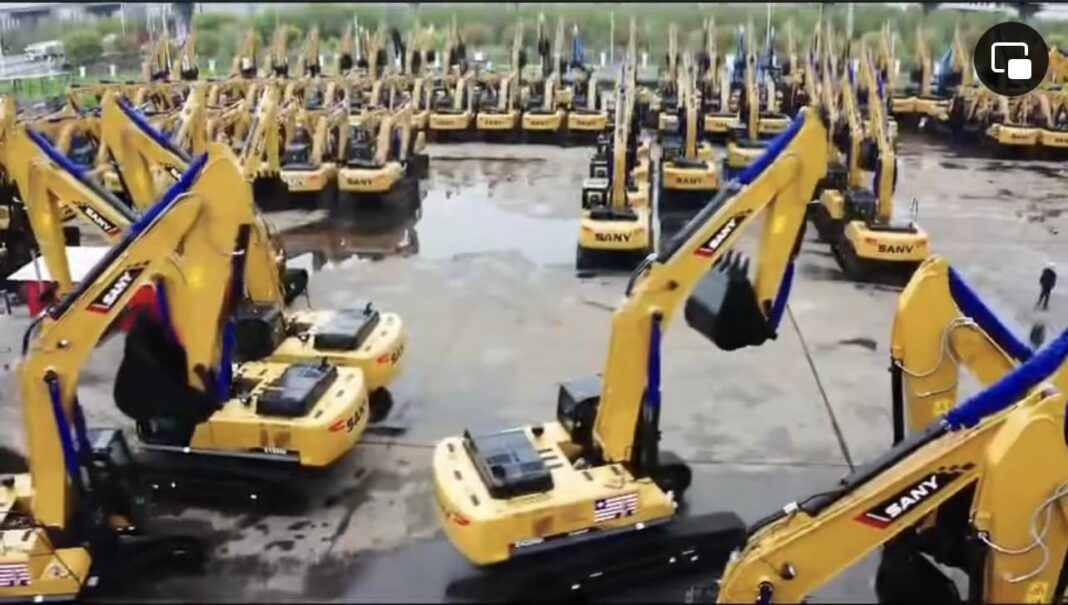
Liberian officials have moved to purchase a fleet of Chinese-made earthmoving equipment for a national road rehabilitation program, a decision that government sources say reflects cost and scale considerations even as the presidency signaled a preference for U.S. manufactured machinery.
The Ministry of Public Works (MPW) confirmed that 134 earthmoving machines — the first tranche of a planned 285-unit national fleet are being loaded in China for shipment to Liberia.
The equipment, sourced through Evergreen Import and Export (Liberia) Corporation from SHANTUI, includes bulldozers, excavators, low bed trailers, fuel and water tankers, service trucks and utility pickups, and is intended to strengthen road rehabilitation and routine maintenance across the country.
Government officials told media that U.S. brand Caterpillar was considered but ultimately rejected on the basis of price. “Caterpillar would have been the best option in terms of durability,” a senior official said, “but the cost was too high. We had to make a fiscally responsible decision that allows us to acquire more equipment within the available budget.”
Officials framed the procurement as a tradeoff between long-term durability and the immediate need to scale up Liberia’s own road maintenance capacity without overreliance on private contractors.
The procurement has been politically and administratively contentious. The “yellow machines” initiative, launched in 2024 to build a government fleet capable of routine roadworks, stalled amid questions about an earlier arrangement led by Minister of State without Portfolio Mamaka Bility.
Critics flagged possible procurement irregularities, including lack of competitive bidding, unclear financing terms and insufficient disclosure under the Public Procurement and Concessions Act (PPCA).
In early 2025 President Joseph Boakai appointed Vice President Jeremiah Koung to chair a Special Committee to renegotiate and review the procurement, emphasizing durability, training and legal compliance. But a letter from President Boakai to Vice President Koung — disclosed during reporting — took a different tone.
The president set out comparative prices submitted to him (SANY US$22 million; Shantui US$27 million; Caterpillar US$24 million) and argued that Caterpillar’s reputation and its offer to train 1,000 Liberians made the higher cost worth accepting. “I accordingly interpose no objection to the selection of Caterpillar and direct that you proceed to conclude the acquisition,” President Boakai wrote.
Despite that directive, the government proceeded with the award to the Chinese linked Evergreen Import and Export firm after the bid review and renegotiations. The Public Procurement and Concessions Commission (PPCC) issued a formal “No Objection” on August 20, 2025, approving the award for the supply of 285 earthmoving machines and 20 utility pickup trucks at an estimated cost of US$21.65 million.
MPW later signed a contract valued at US$21.04 million; Evergreen is required to deliver the full consignment, including spare parts and related services, within 120 days of the contract’s effective date.
MPW officials say the Chinese procurement allows Liberia to acquire a larger fleet within existing budget limits and that the equipment meets technical specifications, while also noting plans for operator training and maintenance support.
Liberia’s trade with China significantly outweighs its trade with the U.S., with China being a major source of imports (machinery, electronics, infrastructure materials) and a key destination for exports like iron ore and wood, while the U.S. remains a crucial market for rubber, gold, and cocoa, though with a smaller overall trade volume compared to China’s vast imports of Liberian raw materials.

