

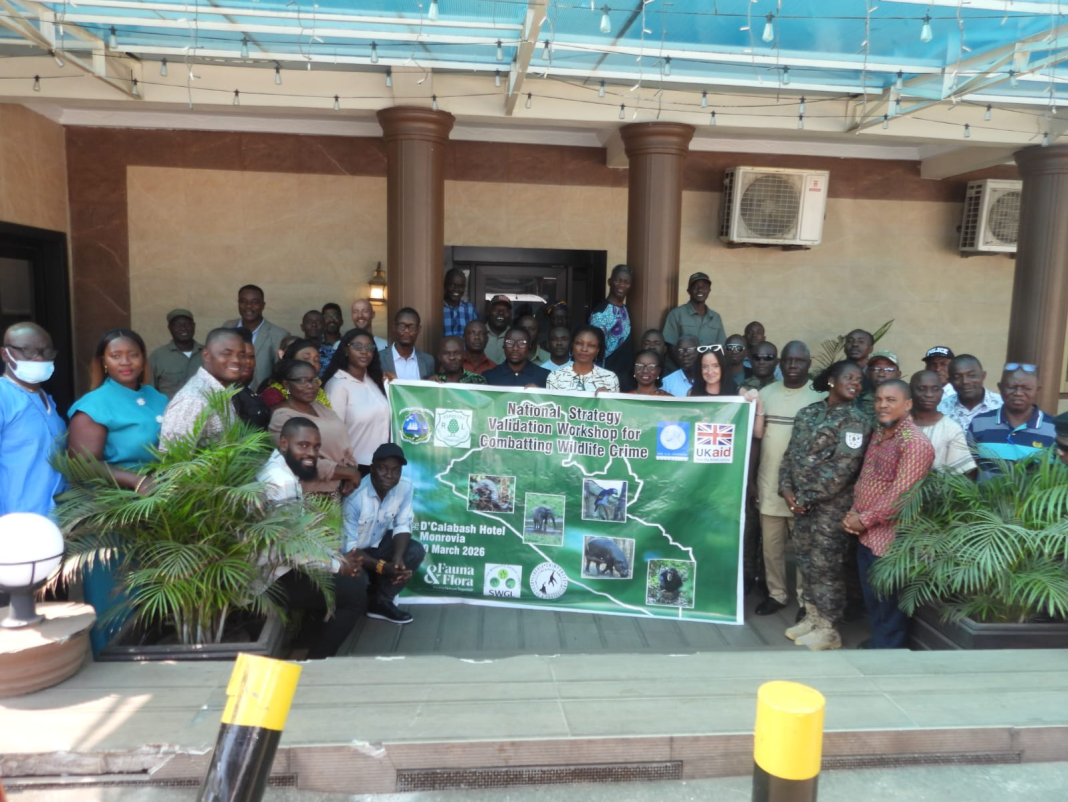
The Forestry Development Authority (FDA), in partnership with international conservation organizations, has officially validated Liberia’s National Strategy for Combating Wildlife Crime (2026–2030) and launched the country’s first National Wildlife Crime Database. The milestone was marked at a workshop held on March 10, 2026, at D’Calabash in Monrovia, bringing together security chiefs, judiciary representatives, park wardens, and stakeholders from across Liberia’s counties.
Opening the session, Jerry Yonmah, Technical Manager for FDA’s Conservation Department, underscored the urgency of tackling human–wildlife conflict and the need for a unified national response. He welcomed participants on behalf of FDA management, stressing that Liberia requires strong instruments to guide enforcement and coordination against wildlife crime.
Delivering a special statement, Madam Nora G. Bowier, FDA’s senior representative, traced the authority’s statutory mandate to the Forest Act of 1953. She acknowledged decades of collaboration with communities, ministries, donors, and conservation partners, but noted persistent challenges: forest loss, weak legislation, limited alternative livelihoods, and rising wildlife crime. Bowier emphasized that the new strategy will: Strengthen enforcement capacity and coordination against trafficking, enhance intelligence gathering and public awareness, establish effective mandates and mechanisms, and develop robust data management systems.

She added that the strategy aligns Liberia with its international commitments under the African Strategy on Combatting Illegal Exploitation and Trade in Wild Fauna and Flora, the ECOWAS Forest Convergence Plan, the West African Strategy on Combatting Wildlife Crime, and obligations under the Convention on International Trade in Endangered Species of Wild Fauna and Flora (CITES).
Dr. Mary Molokwu Odozi, Country Director for Fauna & Flora, described the validation as the culmination of a long journey. She explained that ECOWAS requires member states to develop national strategies as part of the regional fight against wildlife crime. She highlighted the significance of the FDA‑managed database, which will help Liberia meet CITES requirements and provide critical intelligence to protect globally important species such as the critically endangered African forest elephant and the western chimpanzee.
Odozi noted that both the strategy and database were developed by Fauna & Flora International with funding from the UK Government’s Illegal Wildlife Trade Challenge Fund in 2020. She acknowledged contributions from the Liberia Chimpanzee Rescue & Protection (LCRP), the Wild Chimpanzee Foundation (WCF), and the Royal Society for the Protection of Birds (RSPB). RSPB technical adviser Tarik Bodasing played a key role in training law enforcement personnel on database use and management. Odozi called for renewed collaboration among partners to confront illegal wildlife trade in Liberia and the wider West African sub‑region.
The workshop featured presentations from Abednego Gbarway, Wildlife Manager at FDA; Jenny Desmond, Founder of LCRP; Edward Appleton, FDA Law Enforcement Manager; and Tarik Bodasing of RSPB. Their sessions reviewed the draft national strategy, assessed wildlife crime trends locally and globally, and demonstrated the functionality of the new database.
The database is expected to serve as a central repository for intelligence on wildlife crime, enabling authorities to track cases, identify trafficking routes, and strengthen prosecutions. Officials say it will also improve coordination among law enforcement agencies and conservation partners, ensuring that Liberia’s response is data‑driven and internationally compliant.

Stakeholders at the workshop welcomed the initiative, noting that Liberia’s forests—home to rare and endangered species—remain under threat from poaching, trafficking, and habitat destruction. With the new strategy and database, Liberia positions itself as a regional leader in combating wildlife crime, while fulfilling obligations to global conservation frameworks.
The FDA and its partners emphasized that success would depend on sustained political will, adequate resources, and community engagement. As Liberia moves into the implementation phase, conservationists hope the strategy will not only protect biodiversity but also strengthen governance, safeguard livelihoods, and reinforce the country’s reputation as a responsible steward of its natural heritage.

