

Cultural anthropology is the branch of Anthropology that studies how people live, think, and make meaning—how belief, ritual, language, and social practices shape the way communities understand and respond to the world. It is concerned not just with what people do, but how those actions make sense within their cultural systems.
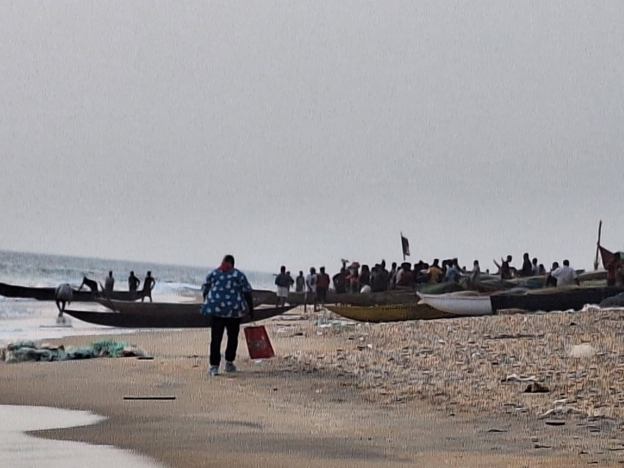
I live in Marshall, Liberia—a narrow stretch of land, a few minutes’ walk from the Atlantic Ocean, hemmed in by lagoons, almost a peninsula. It is quiet, elemental. Sometimes, it feels like I have stepped back into childhood.
My days begin in one world and end in another. I work from home, moving from meeting to meeting on Microsoft Teams and Zoom, speaking the language of strategy, systems, and outcomes. Then I step outside, and the language changes. The air is salt and smoke. Nets are being repaired. Canoes are tilted into the sand. Women prepare food. Fishermen read the tides like text. In the bushes nearby are young men and women living on the margins, invisible but present. Two economies. Two moral worlds. One geography.
Then one morning, everything stopped.
No fishing. No movement. No urgency. The beach went still.
The fish had become scarce. The sea, once generous, had turned uncertain. So the fishermen did what their system of meaning required: they consulted a fortune teller. The diagnosis was not ecological; it was spiritual. The prescription followed: a white cow, rice, and drinks.
There was no white cow. There were white chickens.
And so the ritual adapted, but the logic held.
Right there on the beach, between canoes and sails, women cooked. Not fish—but chickens. Rice boiled in large pots. Drinks circulated. The odor of cane juice filled the air—sweet, fermented, thick—mixing with salt and smoke. People ate. Music played. Libation was poured. A plate of food was carried into the sea and released into the water.
An offering. A negotiation. A restoration of balance.
This is where Cultural Anthropology sharpens the lens. From the outside, this is superstition. From within, it is system. When the material world becomes unpredictable, the social and symbolic systems expand to absorb the shock. Ritual becomes a method of control in a context where control is otherwise absent.
At the end of the ritual, another decision emerged—seemingly unrelated, but deeply connected.
No one should speak Kru on the beach.
Three Kru fishermen among many. Yet language itself was drawn into the field of meaning. In moments of uncertainty, communities reorder not just behavior, but symbols—speech, identity, belonging. Culture moves quickly when survival feels threatened.
Later that evening, a fisherman greeted me in Bassa.
I laughed. He explained the rule.
And just like that, language had shifted—not because of policy, but because of belief.
That moment took me back to Grand Cess. To Dormon Sugbe. To a childhood where explanation did not come from data, but from ancestors. A cow slaughtered. A head thrown into the river where it meets the sea—neck intact, enough flesh remaining, or the offering would be rejected. Precision mattered. Ritual has its own rigor.
I remember a season when four girls drowned in River Nugba. No explanation satisfied. The prophetess spoke: the ancestors were angry. The community had erred. A response was required.
And so there was one.
Years later, in Kumasi, I sat under Archbishop Peter Kwasi Sarpong, who taught young priests, brothers, and sisters cultural anthropology—and sometimes canon law. He insisted on one thing: before you judge a belief, understand the system that produces it.
That lesson has stayed.
Because the real question is not whether these practices are “true” in a scientific sense. The question is: what work are they doing?
They organize uncertainty.
They create collective action.
They restore psychological balance.
They produce order where randomness threatens survival.
A fisherman facing empty nets does not only need data on ocean currents. He needs a framework that explains loss and offers a pathway—any pathway—back to abundance.
That is what ritual provides: structured hope.
Not perfect. Not always benign. But functional.
Standing on that beach in Marshall, I did not see contradiction between modern life and traditional belief. I saw coexistence. I saw a man who will check his phone, join a fishing crew, pour libation, and adapt his language—all in the same day.
Anthropology teaches us to resist the easy conclusion that belief is ignorance.
It is not.
It is interpretation.
It is response.
It is survival.
Marshall reminded me that culture is not static. It adjusts, substitutes, reinterprets. A white cow becomes white chickens. A language is suspended. A ritual absorbs new conditions. The form may change, but the need does not.
And perhaps that is the deepest lesson.
We do not outgrow belief.
We redesign it.

