

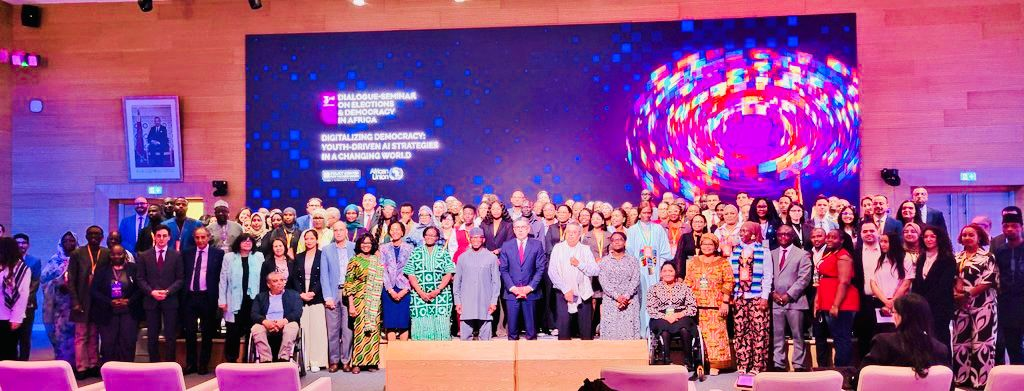
Gwendolyn Myers, Executive Director of Messengers of Peace-Liberia, a Liberian peacebuilding leader, has urged African governments and institutions to adopt stronger, people-focused oversight of artificial intelligence (AI) in electoral systems, warning that unchecked technological expansion could undermine public trust in democratic processes.
Executive Director Myers appealed the 3rd Dialogue-Seminar on Elections and Democracy in Africa. The gathering brought together policymakers, civil society representatives, and technology experts to assess the growing influence of AI on governance across the continent.
Held under the theme: “Digitalizing Democracy: Youth-Driven AI Strategies in a Changing World,” the forum examined how emerging technologies are transforming electoral systems, with particular attention to both their benefits and risks.
Speaking during a session on Integrity and Governance: AI in the Electoral Cycle, Myers acknowledged that AI can enhance efficiency and transparency. However, she stressed that its application must be grounded in Africa’s socio-political realities and democratic values.
“Technology must be intentionally designed to protect voter dignity and reinforce public confidence,” Myers said. She warned that systems lacking cultural awareness and contextual relevance could distort, rather than strengthen, democratic outcomes.
The seminar, organized by the African Union’s Department of Political Affairs, Peace and Security, in collaboration with the Policy Center for the New South, highlighted key concerns, including misinformation, deep-fakes, and the misuse of data. Participants also pointed to systemic challenges such as limited transparency in algorithmic processes and weak data protection regimes.
Discussions further identified vulnerabilities throughout the electoral cycle, from voter registration to results management. Participants emphasized the need for stronger regulatory safeguards and increased citizen participation to mitigate these risks.
The Messenger of Peace Executive Director underscored the importance of youth engagement, noting that young people’s digital literacy positions them as critical actors in monitoring AI systems and countering misinformation. She referenced community-driven initiatives such as Open Space Theatre and Theatre for Peace, programs led by Messenger of Peace, as an effective model for promoting civic awareness and digital literacy at the grassroots level.
“Empowering young people to take part in oversight efforts is vital to safeguarding information integrity in elections,” she added. The Dialogue-Seminar was part of a broader continental effort to align technological innovation with democratic governance. It complements ongoing initiatives aimed at strengthening the capacity of election observers across Africa.
Founded in 2008 and headquartered in Monrovia, Messengers of Peace-Liberia focuses on youth empowerment through peace education, mediation, and civic engagement. The organization has mobilized thousands of volunteers nationwide and remains active in promoting social cohesion and preventing electoral violence.
Myers also reiterated the need for African-led regulatory frameworks that balance traditional governance principles with modern technological oversight. Without such an approach, she cautioned, confidence in democratic institutions could continue to erode.
The forum produced policy recommendations aimed at curbing digital manipulation, supporting youth-led innovation, and strengthening the resilience of electoral systems in an increasingly digital environment.
As African nations navigate the intersection of democracy and rapid technological change, participants agreed that ethical, transparent, and accountable AI governance will be essential to ensuring credible and inclusive elections.
By Abraham K. Morris, Sr.

