

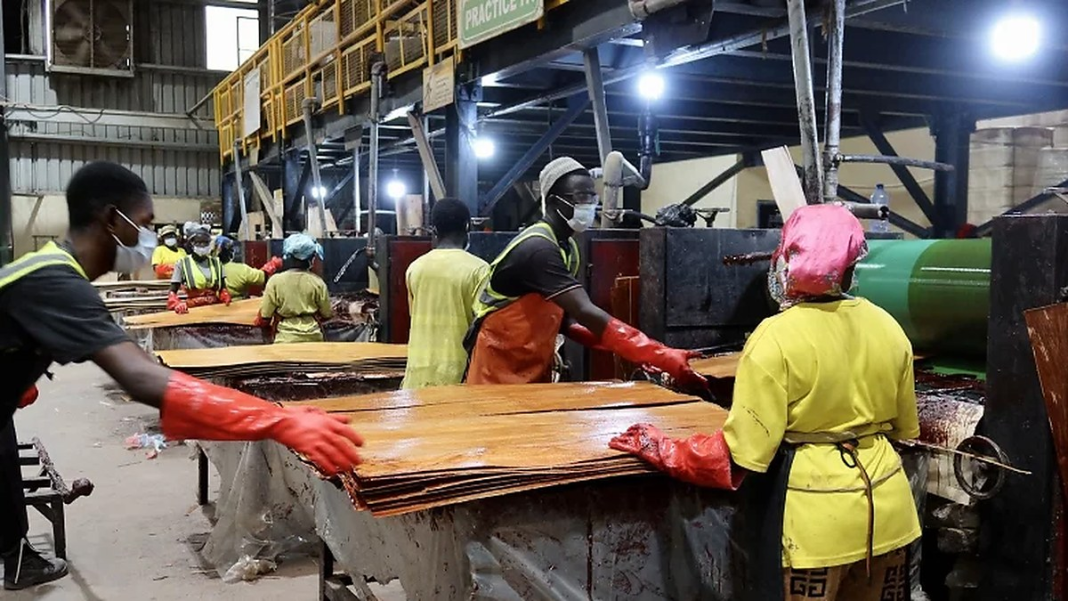
Liberia is shifting away from unprocessed log exports toward value-added domestic timber processing, with the country’s Forest Development Authority (FDA) treating the move as the route to formal jobs in a sector.
The sector already employs about 40,000 workers and contributes 10 per cent to GDP, according to the World Bank, which is backing the strategy through its Liberia Sustainable Forest Economy Project (LiFE-P) and a recent South-South Knowledge Exchange between the FDA and the Ghana Forestry Commission.
The exchange, supported by the multi-donor PROGREEN Trust Fund, saw FDA officials tour private operators in Ghana that have built sustained employment under a clear regulatory framework, including one foreign-owned processing facility that reportedly employs more than 2,000 people, 40 per cent of them women.
That single facility has become the benchmark Liberia is working towards as it weighs how to convert standing forest into formal-sector jobs without accelerating the deforestation already running at 30,000 hectares per year.
Liberia retains 69 per cent of its land under forest cover and is home to the last great stronghold of the Upper Guinea Forest, a globally irreplaceable ecosystem stretching across West Africa. Half its population lives within two and a half kilometres of a forest, seven in ten households collect forest products to eat or sell, and the sector formally employs about 40,000 workers whilst contributing a tenth of GDP.
Government as enabler, not operator
The central lesson from the Accra exchange is that private operators working within a clear regulatory framework have outperformed government-owned mills on employment, retention and output, with the World Bank concluding that the FDA’s role is to set the rules and resolve bottlenecks whilst the private sector runs commercial operations. That model only holds, however, when the fundamentals are locked in first.
Wood Central understands the LiFE-P framework hinges on a hard sequencing rule, with rules, leases, traceability and community benefit-sharing all locked in before processing capacity scales rather than bolted on once the mills are running.
The bank’s design prioritises public-private partnership structures and long-term leases over Community Forest Management Agreements that already define community land rights, with a market-led strategy that starts with validated buyer demand and infrastructure investment running parallel to the mills.
Each of those conditions addresses a known fault line in West African forestry, and the cost of getting them wrong is already well-documented across the sub-region.
Traceability gaps let illegal logging enter the supply chain and lock domestic operators out of the premium-market certifications that make value-added processing economic, whilst weak community benefit-sharing strips the people living beside concessions of any reason to keep forests intact — what the bank repeatedly describes as the most durable defence against illegal harvesting.
It comes as the World Bank has set out to make job creation an explicit aim across its lending portfolio, with more than 1.2 billion young people in developing countries set to reach working age in the next decade.
Liberia exported 187,000 cubic metres of round logs against just 185 cubic metres of sawnwood in 2018, with the FDA now working through the LiFE-P framework to scope the resource allocation procedures, manuals of procedures and public-private partnership rules the bank’s appraisal identifies as absent from the country’s timber subsector.
Source: Wood Central

