

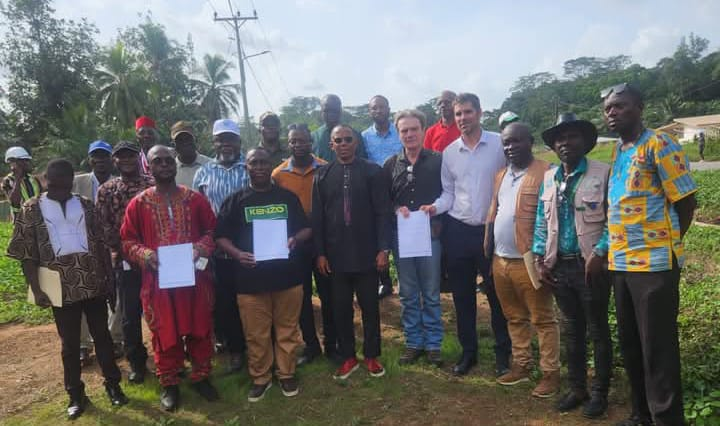
Sarbo Chiefdom has joined forces with Cavalla Rubber Corporation (CRC), acting on behalf of SIPH/SIFCA, to sign a groundbreaking 15 year Memorandum of Understanding (MoU) establishing the Sarbo Nature Reserve. The pact, hailed as a landmark in forest conservation, signals a dramatic shift from commercial rubber expansion to the preservation of Liberia’s fragile ecosystems.
The signing ceremony, held in Sarbo Woffiken Town, drew an extraordinary crowd — chiefs, elders, youth leaders, women representatives, county superintendents, civil society organizations, and government officials all converged to witness history in the making. The atmosphere was charged with anticipation as the agreement, running from 2026 to 2041, was unveiled with promises of transparency, accountability, and a bold new vision for environmental stewardship.
Under the MoU, more than 2,123 hectares of forest — including high carbon stock and degraded areas — will be shielded from exploitation. The Sarbo Nature Reserve is poised to become a sanctuary for biodiversity, a bulwark against climate change, and a living testament to Liberia’s zero deforestation commitments. Illegal logging, farming, hunting, and encroachment will be outlawed, while degraded landscapes will be restored to their natural glory.
Oversight will rest with the newly formed Sarbo Nature Reserve Committee (SNRC), a powerful body blending community voices with corporate and government representation. With five members from Sarbo communities, five from CRC/SIPH, one from the Forestry Development Authority (FDA), and the River Gee County Agriculture Coordinator, the SNRC will meet thrice yearly to enforce conservation rules and chart the reserve’s future. Within three years, it is expected to evolve into an independent legal entity — a bold experiment in shared governance.
Adding muscle to the pact, a specialized security force — the Community Based Forest Guards (CBFG) — will patrol the reserve. These guardians will monitor buffer zones, restrict unauthorized entry, and stand as sentinels against poachers and encroachers. Their mission: to defend biodiversity and ensure the forest remains untouchable.
Strict safeguards accompany the agreement: bans on farming, hunting, bush burning, and agrochemical use within the reserve. Warning signs, monitoring systems, and community
To soften the impact on livelihoods, the MoU pledges annual compensation of US$5 per hectare, supporting rice, cassava, bananas, pineapples, and vegetables. Livestock, poultry, fish farming, beekeeping, and piggery projects will receive backing, while market access for local produce will be expanded.
An annual US$30,000 community development budget will fund schools, health services, and livelihood projects, including US$5,000 for volunteer teachers across five towns and US$25,000 for community initiatives. A health post in Sarbo Woffiken will also be constructed and handed over to the Ministry of Health.
FDA Region Five Coordinator Evans Momodu Kiatamba declared, “The FDA owns the forest, while the community serves as custodians. With this agreement, we expect both sides to fulfill their responsibilities.” CRC Executive Director John Lootvoet pledged full corporate compliance, while River Gee Superintendent Mike Tarpeh Swengbe praised Sarbo Chiefdom’s courage in choosing conservation over exploitation, urging other communities to follow suit.
As signatures dried on the historic document, Liberia witnessed a defining moment in its environmental journey. The Sarbo Nature Reserve is more than a conservation project — it is a clarion call to protect national heritage, empower communities, and confront climate change head-on. For Sarbo Chiefdom, the forest is no longer a resource to be consumed, but a legacy to be defended for generations.

