

By Festus Poquie
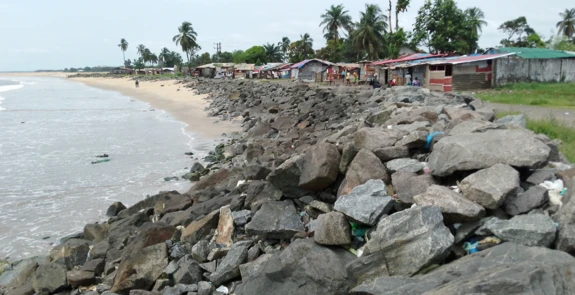
On a wet morning in Buchanan, where the Atlantic arrives like an eraser, parents teach children to measure loss. They name the distance from the market to the vanished playground in yards and memory, point to the line of scarred earth where a road used to be, and tell the story of a town that is being eaten by the sea.
Along the ravaged seacoast, people watch the surf, as if waiting for it to decide whether to take another house or spare it for another winter.
According to Earth Journalism publication, for the past 40 years, communities along the Atlantic Ocean in Liberia have been experiencing coastal erosion due to climate change. Liberia is located on the Gulf of Guinea coastline, exposing it to the southern Atlantic annual sea storm surges. These surges lead to average tidal rises of over two meters during a brief period in the dry season – a major driver of coastal erosion.
Counties like Grand Bassa, Montserrado, Grand Cape Mount, and Sinoe have seen storm surges cause severe damage to coastal homes and streets. Climate change-induced sea level rise, combined with increasing storms and sea surges, is the leading cause of such erosion.
This can destroy the lives and livelihoods of fishermen and petty traders in those communities. An increasing number of people are being displaced, and vital economic sectors such as fishing, farming, and trade are at risk. A 2010 UNDP report on climate change in Liberia said since 1969, sea erosion has removed at least 250 meters of the coastline at Balawudeh Town in Buchanan, representing an average loss of 6.6 meters per year. The sea continues to advance towards houses and other infrastructure nearby.
Global and regional climate predictions on sea level rise in Liberia state that by 2090, relative to 1980-1999, Liberia will experience a rise of between 0.13m and 0.43m. The Special Report on Emissions Scenarios (SARESA1) also predicts a rise of between 0.18m and 0.56m.
Against that shore, and in a climate of international urgency, Liberia’s vote at the United Nations this spring landed like a contradiction: the country joined a small block of nations — among them the United States, Russia, Saudi Arabia, and Belarus — in opposing a UN General Assembly resolution that endorsed an International Court of Justice advisory opinion declaring that states have legal obligations to act on the climate crisis.
The vote was 141 in favor, eight against. Liberia’s ballot, a single word on a global ledger, read as if a nation’s conscience and its foreign-policy calculus had diverged.
It is especially striking because President Joseph Boakai, a Baptist deacon who has made environmental stewardship a flag of state policy, has repeatedly promised to place climate resilience at the center of Liberia’s development.
His administration has drafted ambitious emissions reductions, launched coastal-defense projects, created a carbon-market authority, and spoken in international fora about the need for climate finance and justice.
Yet the man who speaks in church pews of stewardship, and in capitals of global responsibility, was the same leader whose government registered Liberia as part of the dissenting eight.
The scene is intimate and everyday in Buchanan and other coastal towns and villages. The children in Balawles play where their parents once planted cassava. A makeshift sea wall of tires and nets sagged under the weight of saltwater. Vendors haul goods through ankle-deep water after each high tide. The coastline has moved inward so far that landmarks — a church, a primary school, a marketplace — now sit precariously like props on a stage set being dismantled in plain sight.
For residents here, the international language of “loss and damage” is not theoretical. It is the language of ruined livelihoods and houses with foundations eaten to stumps.
The vote did not happen in a vacuum. The UN resolution, advanced by Vanuatu and supported by 141 states, sought to translate an ICJ advisory opinion into a political and moral force: that states bear legal obligations to reduce fossil fuel dependence and to protect populations from the escalating harms of warming.
It was, for many small island states and climate-vulnerable nations, a moment of juridical affirmation and moral vindication. The Secretary-General of the United Nations António Guterres called it a reinvigoration of “international law, climate justice, science + the responsibility of states to protect people from the escalating climate crisis.”
Yet Liberia sided with those who argued the resolution carried “inappropriate political demands,” in the words offered by some detractors, or that it risked overreaching the established bounds of international legal procedure. What was Monrovia thinking here? Alliance-making, legal caution, and geopolitical pressure. For communities on the coast, it read more starkly: as a betrayal.
Civil-society groups — Green Advocates International, the Alliance for Rural Democracy, the Natural Resource Women Platform and others — filed a statement Friday that read less like a policy brief than like a lament.
“How can a climate-vulnerable nation demand international solidarity and financial support for climate resilience while simultaneously voting against a resolution aimed at strengthening global accountability and climate justice?” asked Radiatu Sherif-Kahnplaye of the Natural Resource Women Platform.
For activists who have spent years mapping Liberia’s vulnerabilities — from receding shorelines to projected drops in rice yields — the vote felt like a dissonant chord in what should have been a clear hymn.
That dissonance becomes personal when traced to President Boakai’s policy record. He has championed a 64% emissions-reduction pledge by 2030, pushed for mining-sector transparency to reduce pollution, and brokered coastal-defense projects funded in part by international climate donors, mainly Europeans. In speeches he has invoked stewardship — a theological claim familiar to many faiths. This Baptist leader knows the world as God’s creation, entrusted to human care.
Across faith traditions, this stewardship argument presents environmental protection not merely as policy but as moral vocation. In Liberia, where churches and mosques sit at the center of civic life, those words matter.
Yet on the day of the vote, the state’s diplomatic hand in Lewis Brown – the Ambassador at the United Nations appeared at odds with that moral vocabulary. The image of a Baptist deacon, who preaches care for creation, implicitly aligning with countries that have resisted stronger legal accountability for emissions, delivered a portrait of uncomfortable irony.
To critics, it was no longer a theological question but a question of trust: can the state earn the financing and international solidarity it seeks while rejecting a global measure aimed at solidifying responsibilities? This has remained the pondering line for climate and environmental rights group in Liberia.
The government’s rationale has been thinly argued in public spaces. Officials have hinted at legal concerns and the need to preserve diplomatic room for maneuver, and they have framed the decision within a larger tapestry of bilateral ties and geopolitical pressures. They argue that Liberia’s commitments at home remain intact — the Nationally Determined Contributions, coastal defenses, national parks protection — even as they question the political utility of the resolution. But for grassroots organizers who trudge to town meetings with satellite images of lost land, the justification rings hollow.
There is also a regional and continental dimension. Liberia’s “no” was notable because it was the lone African country among the dissenting votes. The decision rippled through pan-African coalitions that had expected solidarity on an issue that disproportionally affects the continent’s least-resourced communities.
“Liberia, holding a seat on the UN Security Council representing Africa, should have stood with affected communities,” warned Alfred Brownell of Green Advocates International. The vote, he said, risked weakening Africa’s collective bargaining power on climate justice at a moment when court opinions, climate litigation, and litigation strategies are becoming part of the architecture of international pressure.
In Buchanan and similar towns, the stakes are immediate. Coastal erosion is not a future projection here; it is the present arithmetic. The World Bank’s recent warnings that Liberia risks severe economic contraction and expanded poverty under climate inaction are not hypothetical; they are the ledger residents check each time a tide cuts a road in half. The children who kick the ball through puddles will be the next generation to reckon with reduced rice harvests, with public-health crises triggered by contaminated water, with migration choices that are not hopeful but forced.
Yet the paradox of Liberia’s vote also opens a window into how small, vulnerable states are sometimes compelled by alliances and diplomatic pressures to make choices that domestically feel at odds with their most urgent needs.
The United States’ own posture — a history of ambivalence under administrations that have rolled back environmental commitments — has a gravitational pull that can redraw other countries’ ballots. The diplomatic world is full of trade-offs. Moral clarity is often negotiated against strategic ties, aid dependencies, and the fear of isolation.
An environmental lawyer who asked not to be named described the vote as a moment of “policy schizophrenia.” The lawyer said Liberia’s domestic climate commitments and its international posture must not be allowed to drift apart.
“If you tell the world your forests are a national asset and must be protected, you do not then turn away from instruments that might give your people leverage to secure reparations and finance,” she said.
The debate also illuminates the uneasy relationship between faith and policy. For many Liberians, stewardship is not a slogan but a scriptural imperative: God gave the earth into human care. When state action contradicts that ethic, the dissonance is felt in parish halls and in the small sermons’ women give each other while mending nets at dusk.
One cleric, whose congregation has lost members to rising waters, the vote looked less like a geopolitical artifact than like a moral lapse.
“We pastor our people to love and protect what God has given,” he said. “When the state chooses otherwise, we ask: who is speaking for the land?”
The government has been urged to explain its vote publicly and in detail. Civil-society coalitions have filed petitions, sought advisory opinions from continental courts, and demanded accountability. They have not asked for triumph; they ask for coherence: that the words “climate justice” translate into policy and diplomacy that fit the lived realities of Liberians whose homes have become casualty lines on a map of rising seas.
The question at the center of this story is not merely legal. It is theological, economic, and intimately human: when a nation witnesses the erosion of its coasts, when its leadership preaches care for creation, what does it mean to turn down a global instrument that might shore up claims for aid, liability, and responsibility? Liberia’s vote was small in number but large in symbolism: a country whose children play where the sea once was chosen, in the halls of the United Nations, a posture that many at home read as standing against the very thing their president has promised to protect.
In Buchanan and other regions, the sea continues to come and go, indifferent to ball games and to ballots. The children who run along its edge will measure their lives in what remains: the bits of shoreline left to them, the promises fulfilled or broken by those who represent them, and the way the moral language of stewardship holds up against the calculations of statecraft. There is silence from the podium in Monrovia that many want filled — an explanation, a reconciliation, or a course correction. Until then, the tidal line keeps moving inland, and the country that voted against a global statement on climate justice keeps counting what it has already lost.

