

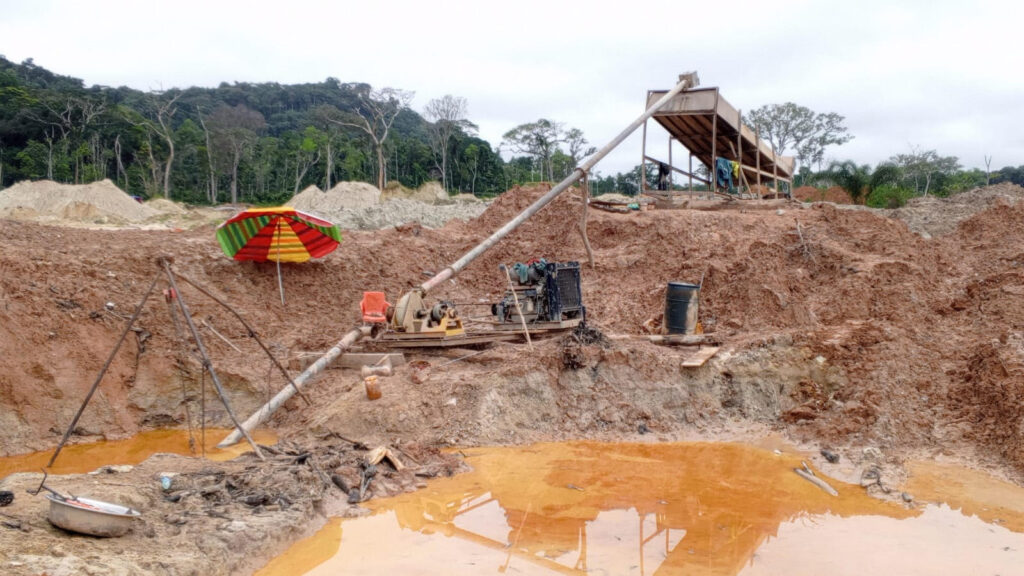
Liberia stands at a perilous crossroads as illegal mining activities in Henry Town, Gbarpolu County, spiral into a national emergency, threatening not only the environment but also the country’s fragile development prospects.
During a tense inspection of the AB Conteh Mining Company site on May 25, Mines and Energy Minister Hon. R. Matenokay Tingban declared the situation “an emergency,” warning that unchecked exploitation could echo historic disasters that once crippled Liberia’s economy.
Minister Tingban revealed that operators are deploying washing plants to dig deeper into the land in pursuit of high-grade minerals, bypassing legal safeguards. “As a nation, we are not going to wait for them to get to the high rack first,” he cautioned, underscoring that Liberia is hemorrhaging revenue as gold slips across borders without records or taxes.
This crisis recalls Liberia’s troubled past, when resource plunder during the civil wars of the 1990s and early 2000s fueled conflict rather than development. Today, history threatens to repeat itself as illicit mining undermines national growth.
To stem the losses, the Ministry of Mines and Energy is rolling out new reporting systems requiring companies to declare mineral recovery and destinations. Taxes and royalties, Tingban stressed, must be collected to fund infrastructure and community development. “We need that money to develop our country,” he said.
But beyond lost revenue, residents and local leaders fear the destruction of farmland and rivers. The scars of uncontrolled mining mirror the devastation of Liberia’s coastal sand mining crisis, which eroded communities and displaced families.
The Minister condemned a shocking incident in which his inspection team was attacked. Workers allegedly erected roadblocks and assaulted officials, a brazen act that highlights the lawlessness gripping mining zones. “When authority comes to ask you for documents, you don’t attack them,” Tingban declared.
Adding to the controversy is the dominance of foreign workers at the site, raising questions about why Liberians remain unemployed while outsiders reap the benefits. Tingban insisted that mining must generate jobs for citizens, not exclude them.
Describing the situation as urgent, Tingban announced the creation of a national task force — uniting the Police, Armed Forces of Liberia, Immigration, Liberia Revenue Authority, Ministry of Justice, and other agencies — to enforce mining laws, track mineral recovery, and ensure compliance.
Already, several operations have been shut down for violating regulations. The Minister vowed that Liberia’s natural wealth must serve its people, not vanish into private hands. “The resources of this country must be used to develop this country,” he said.
Liberia’s mining sector has long been a double-edged sword: a source of promise and peril. From the iron ore boom of the 1960s that built roads and schools, to the resource-fueled conflicts that tore the nation apart, the lesson is clear — mismanaged wealth breeds instability.
Today, Henry Town’s illegal mining crisis is more than a local scandal; it is a defining test of Liberia’s governance. If unchecked, it risks becoming another chapter in the tragic history of squandered resources. If confronted with resolve, it could mark the beginning of a new era where natural wealth finally fuels national progress.

