

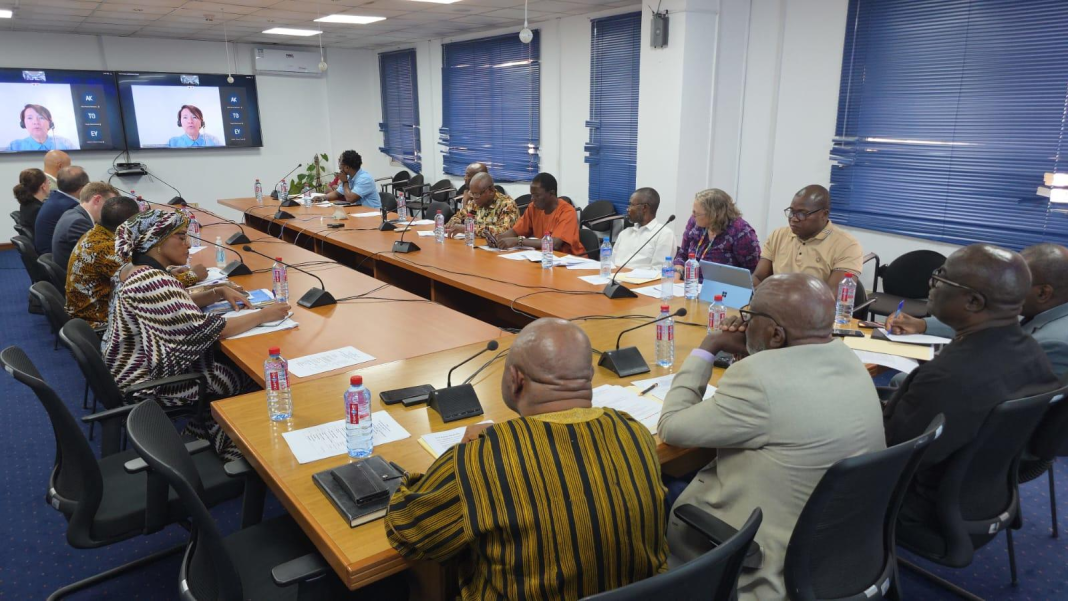
Two years after Liberia’s historic 2023 General Elections, the country’s democratic journey continues, not at the ballot box, but around the tables where institutions, government, and development partners come together to solve tomorrow’s challenges today.
Under the theme, “safeguarding democracy requires sustained collaboration throughout the electoral cycle, not only during elections,” representatives of the Government of Liberia, the National Elections Commission (NEC), ECOWAS, the European Union and other diplomatic missions, the United Nations, civil society, and electoral partners gathered for the sixth High-Level Coordination Platform on Elections at One UN House in Monrovia on August 21, 2026.
The meeting reflected Liberia’s growing commitment to treating elections as a continuous process of institutional strengthening, legal reform, civic engagement, and accountability.
Opening the meeting on behalf of Minister of Justice and Attorney-General, Deputy Minister of Justice Cllr. Augustine Toe welcomed participants and reaffirmed the Government’s commitment to implementing electoral reforms that strengthen public confidence in Liberia’s democracy.
Toe acknowledged the leadership transitions that have taken place since the Platform last met in March, welcoming the newly confirmed NEC Chairperson, Hon. Jonathan K. Weedor, and ECOWAS Resident Representative Ambassador Mohamed Konneh, while recognizing the contributions of their predecessors.
“The Government remains committed to advancing electoral reform in line with recommendations from both international and domestic election observers,” he noted, emphasizing that credible elections remain fundamental to Liberia’s democratic future.
Building stronger institutions between elections
For the new NEC leadership, the meeting offered an opportunity not only to report on progress but also to outline a vision for the Commission’s institutional renewal.
NEC Chairperson Hon. Weedor described the responsibility of leading the Commission as a collective effort requiring close collaboration with government institutions, political parties, civil society, the security sector, and development partners.
“Our work does not begin when elections are announced,” he said. “It is continuous. Building stronger institutions today is what guarantees credible elections tomorrow”.
The Commission reported progress since the last meeting of the Platform in March, including the finalization of its Strategic Plan, expected to be launched in September, alongside reforms aimed at modernizing electoral administration and strengthening institutional capacity.
Among the initiatives highlighted were the development of a year-round civic and voter education program supported through the Liberia Electoral Support Project; continued work on a comprehensive electoral reform bill to be submitted to the Legislature; institutional restructuring to clearly distinguish the governance responsibilities of the NEC Board from those of the Secretariat; and an ongoing assessment of polling and voter registration centers using Geographic Information Systems to improve accessibility and service delivery.
The Commission also reported that Liberia now has 49 registered political parties, more than double the number recorded in 2020, underscoring increasing political participation while highlighting the need for stronger regulatory oversight.
Preparing today for the challenges of 2029
Boundary delimitation is one issue that dominated discussions throughout the meeting. Attendees agreed that updating electoral boundaries remains one of the most urgent priorities before the 2029 General Elections. However, progress remains constrained until the Legislature establishes the constitutional population threshold required for constituency delimitation.
In the meantime, NEC has begun technical work on preparatory activities with a view to reducing population disparities between existing electoral districts within counties.
From recommendations to implementation
The meeting also reviewed findings from the European Union Election Follow-Up Mission, conducted in May 2026 to assess progress made on observer recommendations since the 2023 EU Election Observation Mission.
Presenting the findings, Ambassador Nona Deprez, Head of the EU Delegation noted that while Liberia has demonstrated strong political commitment to implementing the recommendations, much of the work now lies in translating commitments into concrete reforms.
The Mission identified several priority areas requiring accelerated action, including, electoral law reform; sustainable financing for NEC; campaign finance oversight; greater political representation of women; and modernization of voter registration, including interoperability between the voter registry and national identification registry. Other priority areas identified include strengthened civic education and progress on constituency delimitation.
The Mission also encouraged continued dialogue among government institutions, NEC, civil society, and international partners to ensure reforms remain on track in time for 2029 general elections.
Partnerships that strengthen democracy
Throughout the discussions, one message resonated repeatedly, Liberia’s democratic gains have been made possible through strong national leadership supported by trusted partnerships.
Representatives commended the close collaboration between the Government, NEC, development partners, civil society organizations, and regional institutions, describing the High-Level Coordination Platform as an important mechanism for maintaining open communication and transparency, coordinating support, and identifying challenges before they become crises.
Keeping democracy moving forward
The High-Level Coordination Platform continues to demonstrate that democracy is built not only through elections, but through the sustained partnerships, dialogue, and institutional reforms that make every future election more credible, inclusive, and peaceful.
The Liberia Electoral Support Project, co-funded by the European Union, Irish Aid, and Sweden, it supports national institutions and processes that promote a more inclusive and accountable democracy in Liberia. The project is managed and coordinated by UNDP and implemented in partnership with UN Women and the Netherlands Institute for Multi-Party Democracy.
- UNDP

