

By E. J. Nathaniel Daygbor
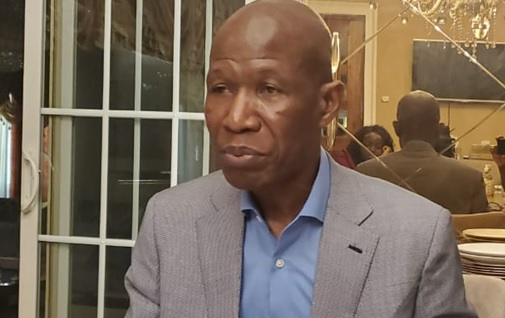
Former Speaker of the Liberian House of Representatives, Dr. Bhofal Chambers, has warns that Liberia’s police force is sliding into dangerous politicization under President Joseph Boakai’s administration. Chambers, who represented Maryland County and served as Speaker from 2018 to 2024, accused the government of presiding over what he branded a “political-era police force,”.
In a statement, Chambers likened the current atmosphere to Haiti’s infamous Tonton Macoute — the feared paramilitary force that became synonymous with intimidation and repression under the Duvalier dynasty.
“The people need leadership to a police force based on non-partisan objectivity,” Chambers declared, warning that Liberia risks repeating the darkest chapters of its history if law enforcement is allowed to serve partisan interests rather than the constitution.
The Haitian force became internationally notorious for brutalizing citizens, silencing dissent, and shielding authoritarian rulers.
Chambers analogy resonates in a nation where memories of militarized policing and civil war abuses remain vivid. Liberia’s modern history has been deeply scarred by the politicization of security forces, making his warning more than rhetorical flourish — it is a reminder of how fragile public trust can be.
Chambers revisited the November 7, 2011, confrontation between Liberian security forces and supporters of the opposition Congress for Democratic Change (CDC). That clash, occurring just one day before the presidential runoff between Ellen Johnson Sirleaf and Winston Tubman, saw riot police deploy tear gas against protesters in Monrovia. At least one person was killed — some reports put the toll at two — and dozens were injured.
The fallout was immediate and severe. President Sirleaf ordered an independent investigation, while then-Inspector General Marc Amblard was removed after accepting responsibility for the police response. For Chambers, the lesson is clear: when security forces are perceived as political actors, public confidence collapses, and violence becomes almost inevitable.
Liberia’s police force was rebuilt after the civil wars with extensive support from the United Nations Mission in Liberia (UNMIL). Established in 2003, UNMIL deployed nearly 15,000 peacekeepers and over 1,000 police officers at its peak, aiming to transform Liberia’s security architecture into a professional, civilian-oriented institution.
While reforms improved capacity, they did not erase longstanding concerns. Human Rights Watch has documented persistent issues of corruption, abuse, and lack of accountability. Academic studies likewise argue that while institutional structures have strengthened, independence and civilian oversight remain fragile.
For President Boakai, the allegations strike at the heart of democratic legitimacy. A police force is not judged solely by its ability to enforce laws, but by whether citizens believe those laws are applied fairly, professionally, and without favoritism. Allegations of political alignment, even if unproven, threaten to undermine that legitimacy.
Observers argue that the government must demonstrate neutrality through transparent recruitment, merit-based promotions, impartial crowd-control practices, and credible disciplinary procedures. Anything less risks reinforcing perceptions of bias and eroding public trust.
Chambers’ intervention is ultimately less about Haiti than Liberia’s own turbulent past. Between 1989 and 2003, civil wars claimed an estimated 250,000 lives, leaving behind a traumatized population and shattered institutions. In such a context, even the perception of partisan policing can trigger fears of repression and instability.
The November 2011 violence remains a cautionary tale of how quickly political confrontation can spiral into crisis when law enforcement loses credibility. Chambers insists he does not want Liberia to relive that history. His warning places the Boakai administration before a delicate test: will Liberia’s police remain visibly loyal to the Constitution and the people, or drift toward loyalty to the government of the day?
Chambers’ alarm may be politically charged, but it resonates with a deeper truth: in a nation still healing from war, the neutrality of security institutions is not optional. It is the difference between democracy’s survival and its unraveling.

