

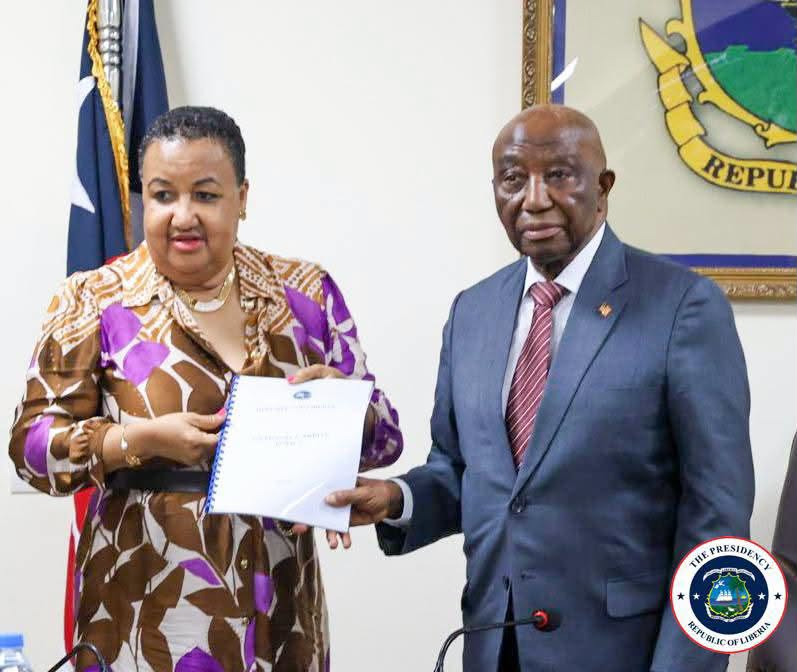
The government has taken a decisive step toward structured participation in the global carbon economy, as President Joseph Boakai, received the nation’s first-ever National Carbon Policy — a framework designed to unlock carbon trading, climate finance, and sustainable development opportunities.
Emerging from months of nationwide consultations, the policy reflects consensus among forest-dependent communities, civil society organizations, government institutions, the Environmental Protection Agency (EPA), and members of the Legislature. It establishes clear roles and responsibilities for state institutions, ensuring that Liberia’s engagement in carbon markets is anchored in transparency, national interest, and broad stakeholder participation.
Boakai hailed the process as a “reflection of shared commitment to Liberia’s future,” emphasizing that the policy provides a foundation for transforming Liberia’s forests — long recognized as vital carbon sinks — into engines of climate resilience and economic benefit.
Liberia’s forests, which absorb vast amounts of carbon and play a critical role in global climate stability, are central to the new framework. The President underscored that these natural assets must generate tangible benefits for the Liberian people, particularly forest communities that have historically protected them.
“The policy offers a structured pathway for Liberia to attract climate finance, participate in carbon-market transactions, and support conservation and climate-related development initiatives,” Boakai declared.
In a striking appeal, President Boakai urged greater confidence in Liberian professionals, stressing that the country possesses capable experts who can drive national development when entrusted with responsibility. He cautioned against endless deliberations that stall progress, insisting that Liberia must act now with an agreed framework, even as future amendments refine the policy.
“There are amendments we will make, but we have to have something done for now, and that’s what we have to do,” he stated firmly.
The President singled out the EPA and the technical team behind the policy, praising their work as evidence of Liberia’s growing capacity to tackle complex national and international challenges. He reminded stakeholders that leadership requires bold decisions made in the best interest of the nation, even when consensus is elusive.
Boakai’s remarks underscored a broader vision: that Liberia’s forests and natural resources must be leveraged not only for conservation but also for sustainable economic growth.
By embedding transparency and accountability into carbon governance, the policy aims to ensure that climate finance directly supports communities and strengthens national development.
The National Carbon Policy is expected to serve as the cornerstone of Liberia’s future engagement with carbon markets and climate finance. It positions the country to attract investment, strengthen coordination among institutions, and ensure that the benefits of its natural resources contribute to sustainable development and the well-being of its people.
With this bold step, Liberia signals its readiness to move from fragmented discussions to concrete action — charting a path toward global relevance in the climate economy and ensuring that its forests are not only preserved but valued as assets in the fight against climate change.

