

By George K. Werner (former education minister)
A few days ago, President Joseph Nyuma Boakai publicly defended his administration’s campaign against narcotics and organized crime. He described it as deliberate, coordinated and directed at criminal conduct—not at any individual, political party or movement. He also reaffirmed his confidence in Police Inspector General Gregory Coleman and his team.
Then, suddenly, the legal leadership of that campaign changed.
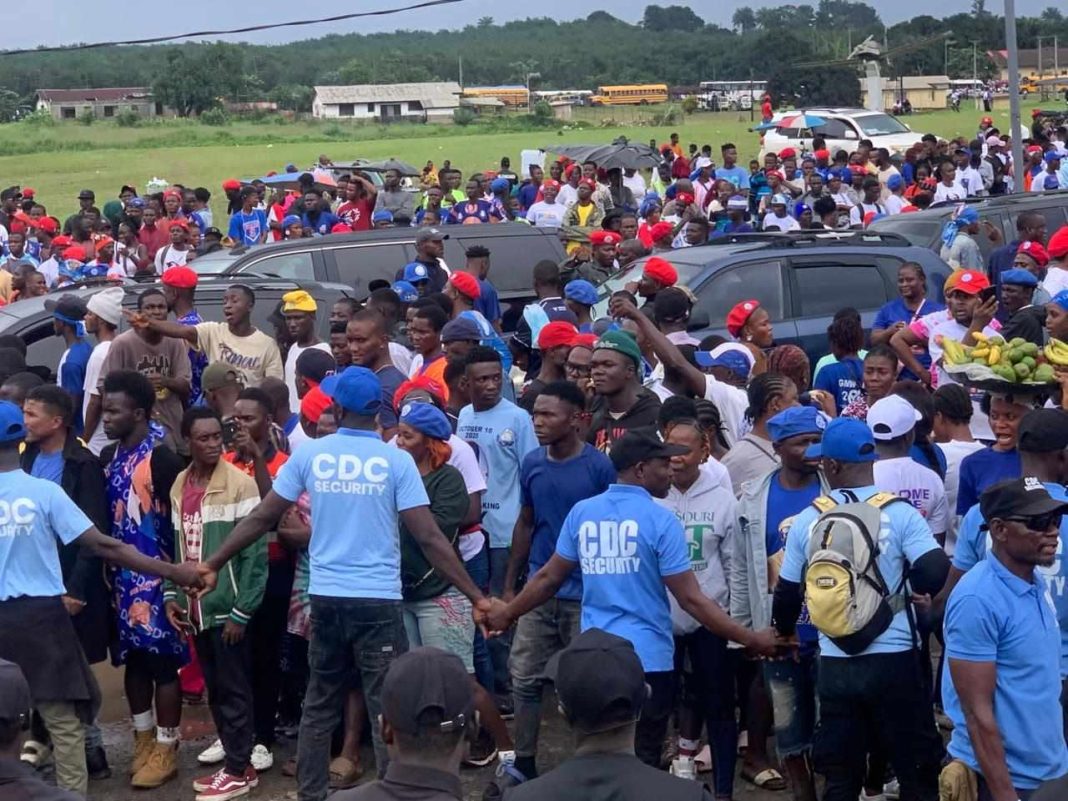
While CDC partisans lined the main route from Roberts International Airport to Rehab Junction to welcome former President George Weah, reports emerged that Justice Minister and Attorney General Cllr. N. Oswald Tweh and Solicitor General Cllr. Augustine Fayiah had been removed. The Executive Mansion later confirmed the changes and announced their replacements.
What happened between the President’s public expression of confidence and these abrupt changes?
That is not an accusation. It is a legitimate question of public accountability.
There are two political principles that appear deeply rooted in President Boakai’s generation of political leadership.
The first is: tell the people what they want to hear.
The second is: do not let the left hand know what the right hand is doing.
The first produces reassuring speeches, declarations of confidence and promises of accountability. The second produces contradictory press releases, unexpected dismissals and decisions that leave one part of government appearing unaware of what another part is doing.
Perhaps this was once considered political wisdom: manage public sentiment while keeping the government’s actual deliberations within a small circle.
But that method is dangerous when applied to criminal justice.
A prosecution cannot be conducted as political theatre. The police cannot say one thing, the Ministry of Justice another and the Executive Mansion something else. Investigators and prosecutors have different responsibilities, but they must preserve the same evidence, follow the same procedures and operate under the same law.
And the public must not merely be told what it wants to hear. It must be told what the government can prove.
The changes have occurred at a particularly sensitive moment. Former Vice President Jewel Howard-Taylor has been charged with drug trafficking, money laundering, conspiracy and related offences. She was subsequently committed to the Monrovia Central Prison at South Beach while the case proceeds. Her preliminary examination has faced postponements.
An important factual distinction must be maintained. Although her arrest occurred amid the national controversy over the record cocaine seizure, the government has treated her prosecution as separate from the case that implicated certain police officers. The State must therefore avoid statements that blur separate investigations or create guilt by association.
The charges against Jewel Howard-Taylor remain allegations. She is presumed innocent unless and until the State proves every essential element of an offence beyond a reasonable doubt.
Meanwhile, allegations circulated concerning the source of the official vehicle used by the former Justice Minister. The Ministry rejected claims that the vehicle was linked to a drug cartel. It said the Liberia National Police assigned the vehicle after a formal request and that it was part of a government fleet.
An allegation is not proof. Public officials, like criminal defendants, are entitled to fairness. But when officials responsible for investigating and prosecuting others face questions about their own conduct, the government should respond with verifiable records and consistent explanations—not indignation alone.
It is possible that no one outside the President’s closest circle knows exactly what he is thinking. That uncertainty may be intentional: disclose little, allow officials to operate with incomplete information and preserve the President’s freedom to change direction without warning.
There is also another possibility. Perhaps the investigation is no longer focused exclusively on the people publicly accused. Perhaps some investigators, prosecutors or security officials involved in constructing and defending these cases are themselves being examined.
There is no verified public evidence establishing that this is happening. It must remain a question, not a claim. Still, the timing naturally invites scrutiny.
Did the President receive information that caused him to reconsider the legal leadership? Were concerns raised about the conduct of particular investigations or prosecutions? Were the changes connected to the controversies surrounding official vehicles, or were they based on entirely separate considerations?
If investigators are themselves being investigated, who is protecting the evidence? Who is reviewing the chain of custody? Who is determining whether witnesses were properly handled? Who is assessing whether any official had an undisclosed interest or conflict?
Investigating the investigators would not necessarily destroy the criminal cases. It could strengthen them by identifying weaknesses, removing compromised officials and subjecting their work to independent scrutiny. But if official misconduct affected how evidence was obtained, preserved or presented, that information must be disclosed where required by law.
Changing officials does not automatically invalidate a prosecution. Criminal cases belong to the Republic, not to an individual minister or solicitor general. Properly obtained evidence does not disappear because the officials who reviewed it have been removed.
But institutional continuity cannot simply be assumed.
The incoming Minister of Justice and Solicitor General must quickly conduct an independent review of the major cases they have inherited. They must examine the charges, evidence, witness statements, electronic recordings, search and arrest procedures, chain-of-custody records and public representations already made by government officials.
They must determine whether the evidence supports every charge, whether investigators followed the law, whether evidence was properly preserved, whether conflicts of interest exist and whether official statements exceeded what the evidence can establish.
They must also take control of the government’s public communications. Criminal cases should be prosecuted in court—not through contradictory press releases or press conferences that risk prejudicing the proceedings.
The new officials cannot simply adopt the conclusions of their predecessors. Their duty is to examine those decisions independently. If the evidence supports the charges, the prosecutions must continue without fear, favor or political interference. If particular charges exceed the evidence, they must be amended or withdrawn. If procedural violations occurred, they must be corrected.
“Catching up” also cannot become a justification for indefinite delay while an accused person remains in detention. Pretrial detention is not punishment. The State must be prepared to present its evidence and allow the court to test whether sufficient legal grounds exist to continue the proceedings.
The President has the authority to appoint and remove executive officials. But that authority does not eliminate public accountability—particularly when the country’s two leading law officers are changed amid cases of enormous national importance.
The government need not disclose privileged legal advice or compromise an active investigation. But it can explain what changed and why new leadership became necessary.
Perhaps the President knows considerably more than he is saying. Perhaps even the officials who publicly defended these prosecutions did not know the full direction of the government’s internal deliberations.
That may be politically strategic. But uncertainty at the top quickly becomes instability throughout the justice system.
Changing the captains does not automatically sink the cases. But the new captains must inspect the vessel, examine its cargo and determine whether it was placed on a lawful course.
The accused must face the law. Public officials must face scrutiny. The new Justice Ministry leadership must face the evidence. And the President must face the questions created by his own decisions.
So, what happened so suddenly?

