

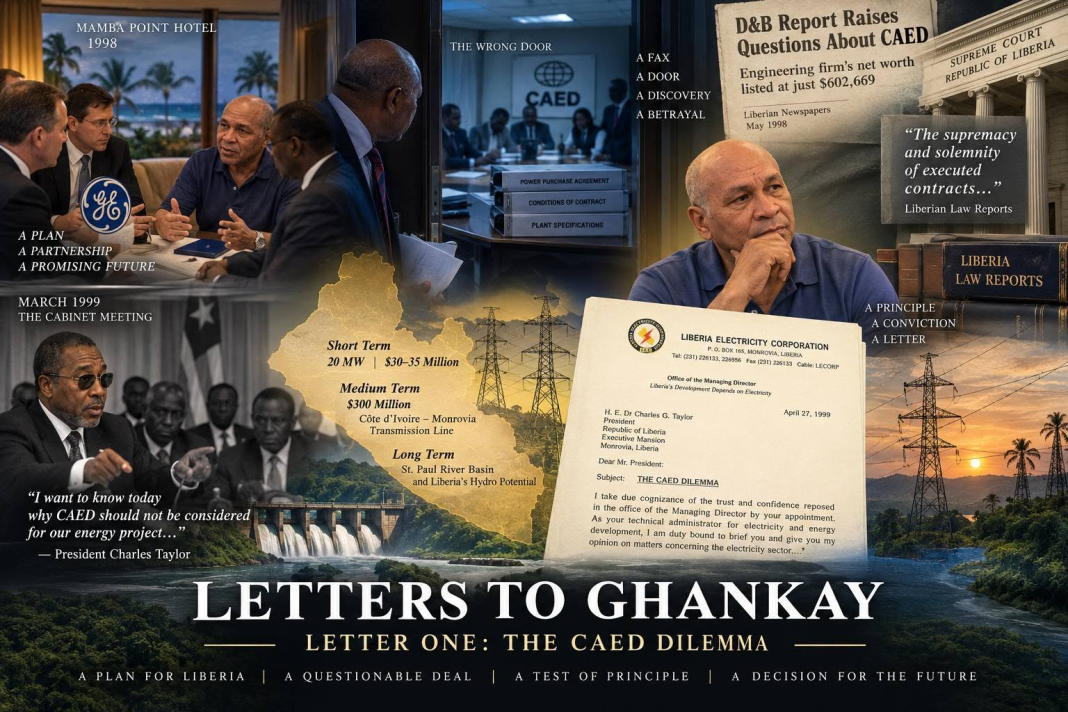
The story of my first letter to President Charles Ghankay Taylor did not begin on April 27, 1999 the date of the letter. It began almost a year earlier, while I was still Deputy Managing Director for Planning and Technical Services of the Liberia Electricity Corporation. It began with a fax, a hotel conference room and a door I was never supposed to open.
By 1998, Ron Quist and I had completed the Master Energy Recovery and Development Plan and had begun testing whether the vision we had conceived could actually work. I had taken the concept to Côte d’Ivoire, where the reception had been encouraging. Back in Liberia, we made presentations to the National Investment Commission and members of the Cabinet.
The response surprised even us. Government officials seemed not only to agree with the concept, but to find it refreshing that, in the midst of all the uncertainty confronting postwar Liberia, somebody was daring to think so far into the future. Ron and I were beginning to feel that perhaps the government had found something around which it could rally.
Very little else was functioning properly at the time. Much of the country’s infrastructure had been devastated. Government institutions were struggling to recover. Immediate problems demanded attention everywhere. Yet here was a plan that said: Yes, we must deal with today’s emergency, but we can still imagine tomorrow and begin to work on it today.
The private sector also seemed to understand that as well. Power development was the precursor to any commercial or industrial development. Companies with the technical experience and financial capacity to participate in both the immediate and long-term development of Liberia’s electricity sector began expressing interest. We had not yet circulated the complete Master Energy Plan. Instead, potential partners were seeing the FrontPage-designed web presentation I had developed to explain the concept in simple non-technical terms.
One of the companies that we were able to convince of the merits of the Energy Plan was General Electric. That excited us.
GE represented precisely the kind of company we hoped the Energy Plan would attract. It possessed technology that could help fast-track Liberia’s immediate generation needs while having the technical and financial muscle to participate in the longer-term development of the sector.
GE responded to our invitation. Three or four GE representatives came to Liberia and stayed at the Mamba Point Hotel. Before their arrival, Ron and I briefed the Managing Director of LEC about the discussions with GE and the progress we had made. His response was encouraging. He gave us his explicit approval to proceed with the negotiations and to report back to him. He would be in full support.
The LEC head office was at the time in no shape to receive visitors. We sat at the Mamba Point hotel discussing the implementation steps and drafting out the terms of a Memorandum of Understanding. Everything seemed to be moving in the right direction. Then I went looking for a fax.
Ron, the GE representatives and I sat in a private dining room at the Mamba Point Hotel. At some point during the discussion, we needed information on technical specifications from GE. Arrangements were made for documents to be sent by facsimile to the hotel. The hotel’s fax machine was in its conference room. I left the dining room, walked over to the conference room and opened the door.
I stopped at the door dumbfounded. Seated around the conference table was virtually the entire senior management of the Liberia Electricity Corporation talking about the purchase of diesel generators. It was my management.
I was Deputy Managing Director for Planning and Technical Services. Nobody had told me there was a meeting. Nobody had invited me. What I chanced into appeared to be undermining the very efforts I was undertaking with Ron and the GE representatives. I was immediately suspicious as to why this meeting was hidden from me given my responsibility at LEC.
And my LEC colleagues were not alone. Around the table were representatives of a company I had never heard of called Central Associated Engineers, Inc., or CAED. With them was their Liberian representative, Senator Hon. Kerkula Kpoto, President Pro Temp of the Senate, who knew me personally, was always courteous, and always addressed me by my first name.
The Managing Director introduced me. I remember him appearing nervous, although at that point there was really no alternative but to acknowledge that his Deputy Managing Director had unexpectedly walked into the room.
Then I looked at the conference table. There were volumes of documents seemingly waiting to be signed. Documents that would have been the responsibility of my office to study and evaluate. They were not introductory brochures from a company hoping someday to do business in Liberia. I saw contract documents. A power-purchase agreement. Conditions of contract. Power-plant specifications. And other documents that appeared to constitute what would be required to commit LEC to a long-term arrangement extending for approximately twenty years.
Such a commitment would be completely divergent to the strategic vision of the Energy Plan and would lock Liberia to high energy prices. A central objective of the Energy Plan was price optimisation–an absolutely necessary condition to attract commercial and industrial investment. I tried hard to hide my growing rage.
I had walked out of one room where Ron and I were talking with General Electric about implementing the national energy strategy we had spent months developing and walked accidentally into another room where the management of my own corporation was discussing an entirely different electricity arrangement of which I knew nothing.
The irony was difficult to miss. Two possible futures for Liberia’s electricity sector were sitting in two different rooms of the same hotel. And I was supposed to be part of the executive management responsible for deciding that country’s electrical energy future.
I took note of the company’s name and address. I greeted everyone as welcoming as I could muster and I collected the necessary business cards, exchanged a few words with Hon. Kpoto, thanked the visitors for coming and left the room.
I had never heard of CAED. Who were they? Could I trust my country’s energy future to this unknown firm? Google search was still in its infancy. The first thing I did was order a Dun & Bradstreet report on Central Associated Engineers.
Then I had to walk back as if all was still well to the private dining room where Ron and the GE representatives were waiting for me. I remember that walk. It could not have taken more than a few minutes but it felt like an hour. I felt like a fraud continuing to work on the now meaningless Memorandum of Understanding with the GE representatives and putting immense pressure on Ron who was supporting the LEC on a pro bono arrangement.
I had no idea how to handle what I had just discovered. There were representatives of one of the world’s major engineering and technology companies waiting for me to continue a serious discussion about investing in Liberia’s electricity recovery.
What was I supposed to tell them? Was I to say while we were discussing one strategy, the senior management of LEC was in another room discussing a twenty-year arrangement with another company without the Deputy Managing Director even knowing that the meeting existed? That we had invited them to travel all the way to Liberia on ‘asstray’? I began to feel nauseous.
I have no idea to this day how we navigated through the rest of the GE meeting but eventually the GE representatives left Liberia.
I was younger then and I must confess that I was angry. More than angry, I felt betrayed and manipulated by my LEC colleagues. I in turn had betrayed GE and of course the efforts of Ron. I had betrayed the Energy Plan. It was a very low point for me.
When the Dun & Bradstreet report arrived, I became even more concerned. The May 1998 report described Central Associated Engineers as an engineering-services company with approximately 62 employees and a reported net worth of only $602,669. Certainly hardly a serious competitor to GE for the implementation of the first phase of the Energy Plan.
That did not automatically mean that CAED was incapable of doing business in Liberia. A company’s net worth, by itself, does not determine how much project financing it may be able to arrange. But the number had to be viewed against the scale and character of what Liberia was attempting to do.
The first stage of the Energy Plan contemplated bringing approximately 20 megawatts of generation into service at 50HZ generation in anticipation of the second phase based on regional power purchase and incorporating the roll out of prepaid metering to improve collections.
We estimated that generation component alone at a minimum of about $20 million, with another $10 million to $15 million required to begin rebuilding the local distribution system and commercial operations necessary to sell that electricity. In other words, even the first meaningful step could require an investment of roughly $30 million to $35 million. This at a time when the immediate post war economy was in shambles.
But there was another difficulty. The generating plant could be installed much faster than LEC’s shattered distribution network and commercial system could be restored. A serious investor therefore had to be prepared for a period in which generating capacity was available but could not immediately earn its full return. We needed a company with enough financial strength, patience, buy-in to the full sequence of the Energy Plan and commitment to absorb short-term losses because it believed in the medium- and long-term opportunity.
And the short term was only the beginning. The medium-term strategy contemplated an investment on the order of $300 million to construct a transmission interconnection from Côte d’Ivoire to Monrovia. Its purpose was not simply to import cheaper electricity into Liberia. That line would also create the electrical highway through which Liberia could eventually connect its own hydroelectric resources to the larger West African power market.
Ron and I had focused particularly on the St. Paul River basin, whose hydroelectric potential we both knew from work we had done in the late 1970s and early 1980s.
Our thinking was straightforward: hydroelectric projects are enormously capital intensive, but once Liberia was physically connected to a regional market, those projects would no longer have to depend solely upon the relatively small Liberian electricity market for their economics. Access to customers beyond our borders could make financing Liberia’s hydro potential considerably more realistic.
That was the scale against which I was looking at CAED.
The Dun & Bradstreet report showed a company with 62 employees and a reported net worth of $602,669. By comparison, the immediate generation and distribution program we were contemplating was roughly fifty times that reported net worth, while the medium-term interconnection concept was approaching five hundred times that figure.
Again, that did not prove that CAED could not assemble financing, partners or other resources. But it certainly raised the most basic due-diligence question: Did this company have the financial depth, technical reach and staying power to become a central participant in an energy-development program of this magnitude?
I believed that question had to be answered before Liberia committed itself to a twenty-year arrangement. And so I raised it publicly.
I published information from the Dun & Bradstreet report in the Liberian newspapers as a warning about the capacity and credibility of the company being considered for such an enormous role in Liberia’s electricity future. I raised considerable hell. Then, around April 1998, I resigned my position at the LEC and left Liberia to return to my job in software development in California.
Given the noise I had made, I assumed I had probably made myself an outcast and the enemy of some very powerful people. I certainly did not expect what happened next.
In November 1998, President Taylor asked me to return to Liberia. This time, not as Deputy Managing Director. He appointed me Managing Director of the Liberia Electricity Corporation. I assumed that the government’s policy was now fully in line with the Energy Plan and so this would be my mission as the Managing Director.
I found that truly remarkable because I had publicly challenged an arrangement apparently supported by influential people in his government. I had published the Dun & Bradstreet findings. If the president considered what I had done improper or disloyal, he had every opportunity simply to leave me outside the government. Instead, he brought me back and placed the entire responsibility for LEC on my shoulders.
I interpreted that appointment as meaning that somewhere, somehow, someone had recognized that there was value in what I had been trying to do. That maybe there had been a reconsideration, or even better, the Energy Plan had prevailed. I did not know what to think but me, ever the optimist, chalked it down to a fortuitous situation. I gave in my notice at the software development firm and came back home.
CAED did not raise its head when I first returned. So I went back to work.
The Master Energy Recovery and Development Plan was ambitious. But ambition without money produces very little electricity. Given the earlier fiasco with GE, I did not have the confidence to approach them again. We needed a way to begin again. An opportunity emerged through Taiwan.
Richard Tolbert introduced me to Colin Kao, then Second Secretary at the Taiwanese Embassy in Liberia. Colin and Richard had been classmates at Harvard, and Richard was then a Vice President at Merrill Lynch.
That introduction accelerated my access to the Taiwanese considerably and before long, I was able to secure $2.5 million for LEC from Taiwan’s annual $10 million grant allocation to Liberia.
Nobody, including the Taiwanese, pretended that $2.5 million was enough to rebuild Liberia’s electricity system but I had proposed something different. Rather than treating the money as the entire project budget, why not use it as seed capital?
Use the $2.5 million to establish credibility and leverage the financing necessary to develop approximately 20 megawatts of generation together with the distribution infrastructure required to deliver that electricity. The Taiwanese agreed with the proviso that equipment bought under the program would carry a logo or plaque that reflect their grant contribution to the project.
My impression was that they had seen relatively little tangible evidence from some of the grant assistance they had provided over the years. The Master Energy Recovery and Development Plan, however, appeared to them to offer a credible framework within which their contribution could produce something visible and expandable.
I began testing the concept with potential partners.
Cummins Engine Company was then involved in an Independent Power Producer project in Ghana. We explored possibilities with them.
Wilbert Stubblefield, a local businessman with considerable experience arranging financing for power projects, brought British Engineering Services into the discussion for the distribution component.
Once again, things appeared to be moving. We had lost valuable time but we were moving. And then, in March 1999, CAED suddenly returned.
I was driving to work one morning when presidential security intercepted me enroute. The President wanted me at a Cabinet meeting at the Executive Mansion. I would not ordinarily have been attending that meeting, and I had no idea why I had been summoned. Fortunately, I had documents in my car. I followed the security to the mansion, gathered whatever I thought might be useful and proceeded to join the meeting.
When I entered the meeting, President Taylor eventually announced the issue. As I remember his words:
“I want to know today why CAED should not be considered for our energy project. If there is any reason why they should not be considered, let’s know it now so that we can put the matter to rest.”
I was stunned. CAED? I did not even know that CAED was still in play.
In answer to the president, the Chairman of the National Investment Commission gave his opinion first. Perhaps another two people spoke. I decided that my safest course was to say nothing and I intended to maintain that stance but before another person could speak, President Taylor stopped the discussion.
“I want to hear from Ian.” He always called me by my first name. Now I had no choice but to answer. I had rehearsed nothing and was still stunned that CAED was being discussed.
I opened the documents I had carried into the meeting. The first thing that came before me was the Master Energy Recovery and Development Plan and my response was spontaneous:
“Mr. President, what CAED offers is not consistent with our aspirations, which are enshrined in the Master Energy Recovery and Development Plan.”
I had much more to say but I never got the chance to say it. I had said enough and it appeared that the room was just waiting for me to open my big mouth.
The room erupted in unfavorable loud chatters and low murmurs all seeming directed at me. And when a close adviser to Taylor, shouted words to the effect:
“The President has asked you about CAED and you change the subject to Energy Plan?”
More uproar and what seemed like total confusion followed. The impression was that I had dared to challenge the president and I was ridiculed from around the room.
But I never felt that I had changed the subject. The Energy Plan, to me, was always the subject. At least that was how I understood my responsibility. The question before us could not simply be whether CAED could produce electricity. The question was whether what CAED proposed was consistent with the direction Liberia had decided to take its electricity sector.
Private companies were welcome. Independent Power Producers were necessary. Foreign investment was indispensable. But they were supposed to fit within a national energy strategy. The national strategy was not supposed to be redesigned around whichever company happened to arrive with the most politically attractive proposal.
For perhaps five minutes, the meeting descended into what I remember as uncontrolled verbal anger directed toward me. Then Taylor suddenly ended it.
“This meeting is over. Ian, you can leave now.”
There was nothing courteous about the instruction.
As I gathered my papers, the words had not fully escaped the presidents mouth when his female special assistant came over and aggressively warned me:
“Didn’t the President ask you to leave? Why are you still here?”
I left.
That may be the strangest part of the story. Nothing happened. There was no follow-up meeting. No clear instruction. No resolution of the disagreement.
I had been summoned before the Cabinet, specifically asked by the President to give my opinion, publicly ridiculed when I gave it, and dismissed from the meeting.
But I was still Managing Director of LEC, still carried the responsibility, and CAED was apparently still alive. So I began pondering my fate. What exactly was I supposed to do? If CAED was going to become the vehicle through which Liberia’s electricity sector would be developed, what was I supposed to do with the Master Energy Recovery and Development Plan? If MERDP remained the government’s policy, shouldn’t CAED be evaluated against it?
And if my professional judgment as Managing Director was no longer wanted, then perhaps somebody needed to tell me that too. The silence gave me no answer and so eventually, I decided that I had to provoke one. And my answer came from the most unlikely of places, the Supreme Court; but not in its usual sitting.
It was during those depressing days that I happened upon something in the old Liberian Law Reports. An opinion of the Supreme Court caught my attention. The Court wrote of:
“The supremacy and solemnity of executed contracts…”
I kept reading. The opinion dealt with the government’s responsibility to exercise prudence before entering contractual arrangements that could ultimately injure the nation.
I found the language so striking, and so perfectly suited to the argument I had been struggling to make, that I decided there was no point trying to improve upon it. I would simply lift the Court’s words verbatim and let Liberia’s own Supreme Court make the point for me. The phrasing had a solemnity and authority that no paraphrase of mine could match.
I had just been shouted down in a political room. Now, in Liberia’s own jurisprudence, I had stumbled upon a principle that seemed to express precisely what I had been trying to say.
Once a government executes a contract, the consequences do not disappear when the meeting ends. Presidents eventually leave, ministers leave, and managing directors leave. But Contracts remain. And sometimes their consequences remain for generations. That was my concern about CAED.
The proposed agreement was not simply about getting electricity into Monrovia during an emergency. It contemplated commitments that could influence the direction of Liberia’s electricity sector for approximately twenty years.
I found a certain courage in that Supreme Court opinion. Someone before me had apparently wrestled with the same fundamental principle: government has an obligation to exercise prudence because today’s expedient agreement can become tomorrow’s national burden. I decided to write.
APRIL 27, 1999
I addressed the letter directly to:
His Excellency
Charles Ghankay Taylor
President of the Republic of Liberia
I titled it:
“THE CAED DILEMMA”
I began by invoking the “trust and confidence” President Taylor had placed in the office of Managing Director.
That was intentional. Taylor had appointed me. Whatever had happened in that Cabinet meeting, I was still the technical administrator he had placed in charge of the national electricity corporation. I therefore believed I was duty bound to give him my professional judgment, whether he wanted to hear it or not.
Then I invoked the Supreme Court. And from there I laid out my case. I questioned the proposed contractual arrangement. I questioned the concessions Liberia was being asked to make. I questioned CAED’s capacity. I examined what alternatives were available. And I attempted to place the entire matter back where I believed it belonged: within Liberia’s long-term national energy strategy.
Near the end of the letter, I wrote:
“Economic planners and political technocrats have a proclivity to make seemingly rational decisions of solving the problems of now while wittingly or unwittingly creating malaise for tomorrow.”
Reading those words today, I realize that the argument Ron Quist and I had been making from the beginning still remained sound and advantageous to the achievement of low cost, stable, reliable power supply in Liberia.
Liberia had two clocks running. One measured the desperate requirements of now. The other measured the consequences for tomorrow.
The challenge was never to stop the first clock. People needed electricity, the government needed results, and Liberia needed investment. The challenge was to prevent the urgency of the first clock from destroying the possibilities represented by the second.
On April 27, 1999, I was still trying to reconcile them. And so, after everything that had happened, I finally put my recommendation to President Taylor in writing.
If you remove all of the legal arguments, technical explanations and diplomatic language, my advice was simple:
- PRESIDENT, DO NOT SIGN THIS AGREEMENT.
What follows is the actual letter I sent to President Charles Ghankay Taylor on April 27, 1999.
It was not written twenty-seven years later with the benefit of hindsight. It was written then, while the argument was still raging, while the decisions were still being made, and while none of us knew how the story would end.
LETTER ONE
THE CAED DILEMMA
April 27, 1999

