

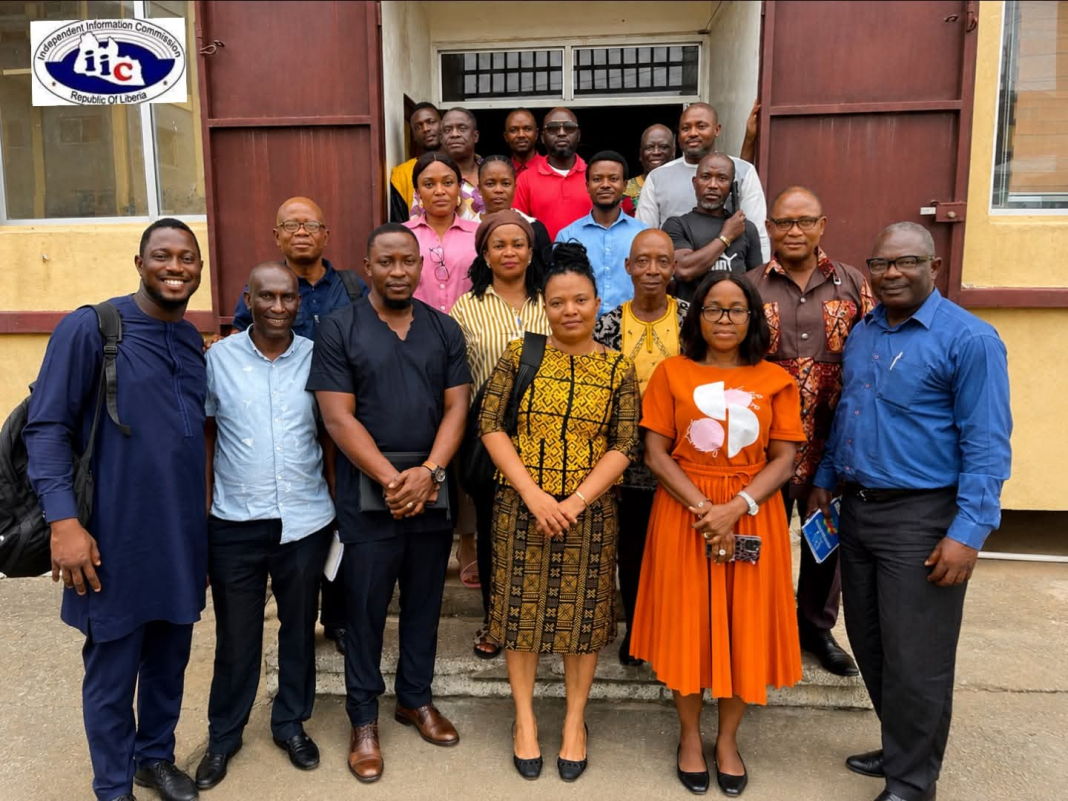
The Independent Information Commission (IIC), in partnership with the Center for Transparency and Accountability in Liberia (CENTAL), is stepping up efforts to move public institutions beyond awareness of Liberia’s Freedom of Information Act toward practical and measurable compliance.
The latest phase of the initiative, carried out by the IIC’s Department of Compliance and Outreach from August 11 to September 2, 2026, engaged officials of the National Identification Registry (NIR), Liberia Institute of Statistics and Geo-Information Services (LISGIS), Liberia Agency for Community Empowerment (LACE), and Liberia Water and Sewer Corporation (LWSC).
The engagements focused on strengthening institutional systems for receiving and responding to requests for information, proactive disclosure, records management, accountability and anti-corruption.
Providing the executive overview, IIC Executive Director and Head of Secretariat, Hon. Lorpu P. Page, stressed that compliance with the FOI Law must be viewed as an institutional obligation rather than a task assigned exclusively to a Public Information Officer or a single department.
She urged participating institutions to use the engagements to improve their internal systems, strengthen public service delivery and build greater public confidence.
The legal and practical aspects of freedom of information were presented by Acting Outreach Director Jutomue Doetein, who explained the legal foundation of the right to information, the mandate of the IIC, procedures for submitting FOI requests, citizens’ rights and the statutory exemptions under which information may lawfully be withheld.
Director Doetein reminded participants that an individual does not have to demonstrate a personal interest or provide a reason for requesting public information. He also explained that searching for and providing information is free, although reasonable reproduction costs may be charged to the requester.
Acting Compliance Director Armah Boimah Johnson focused on the responsibilities of public institutions to establish systems capable of delivering the rights guaranteed under the law.
His presentation addressed the appointment and effective functioning of Public Information Officers (PIOs), establishment of Internal Information Request Review Bodies (IIRRBs), publication schemes, proactive disclosure, FOI request handling, records management and annual FOI reporting.
Johnson emphasized that effective FOI implementation requires the involvement of institutional leadership, records officers, legal officers, communications personnel and others involved in creating, maintaining and managing public records.
He particularly encouraged Ministries, Agencies and Commissions (MACs) to proactively publish information that citizens routinely need, including enabling legislation, policies, strategic plans, budgets, procurement contracts, expenditure reports, annual reports and procedures and costs for public services.
According to the IIC, proactive disclosure can reduce the need for individual FOI requests while allowing citizens, journalists and civil society organizations to monitor government decisions, public spending and institutional performance.
Participants were also reminded that the current FOI Act provides a maximum response period of 30 calendar days, subject to applicable provisions concerning extensions.
The anti-corruption component of the engagements was facilitated by CENTAL Program Officer Siafa S. Kamara, whose presentation examined transparency, accountability, integrity and corruption risks within public institutions.
Participants explored corruption risks associated with procurement, employment, financial management, asset management and administration, including bribery, favoritism, conflicts of interest, kickbacks, extortion, illicit enrichment and bid rigging.
The IIC and CENTAL stressed that access to information is an important tool in preventing and exposing corruption because public access to government records enables citizens and other stakeholders to scrutinize public decisions, expenditures, contracts and institutional performance.
The engagements also underscored the importance of organized records and functional FOI request registers in ensuring that institutions can locate information, respond within the required period and produce accurate annual FOI activity reports.
The latest phase builds on previous IIC compliance and awareness interventions involving institutions including NTA, NASSCORP, LIPO, BSE, Ministry of Public Works, CSA, MoL, MoC, MoE, MoA, Internal Audit Agency, NBC, NCD, LPRC, NaFAA, NPA, NIC, AITB, Liberia National Fire Service, NHA, LRA and LNP, among others.
The Commission says its broader objective is to move public institutions from FOI awareness to functional compliance, supported by operational PIO systems, Internal Review Bodies, proactive disclosure, proper records management, FOI request registers and timely reporting.
The campaign is expected to continue with engagements at the Liberia Immigration Service (LIS), Liberia Electricity Corporation (LEC) and Food Authority of Liberia (FAL) on September 8, 9 and 10, respectively.
Through its collaboration with CENTAL, the IIC says it will continue strengthening the connection between access to information, transparency, accountability and anti-corruption as part of broader efforts to improve governance and make the right to information meaningful to citizens across Liberia.

