

By E. J. Nathaniel Daygbor
Liberia has shattered a historic ceiling, collecting more than US$1 billion in domestic revenue for the first time in its 179‑year history. Finance and Development Planning Minister Augustine Kpehe Ngafuan insists the achievement is not “audio money” or empty political theater, but a transformative milestone that must be measured in roads, bridges, buses, and the daily lives of Liberians.
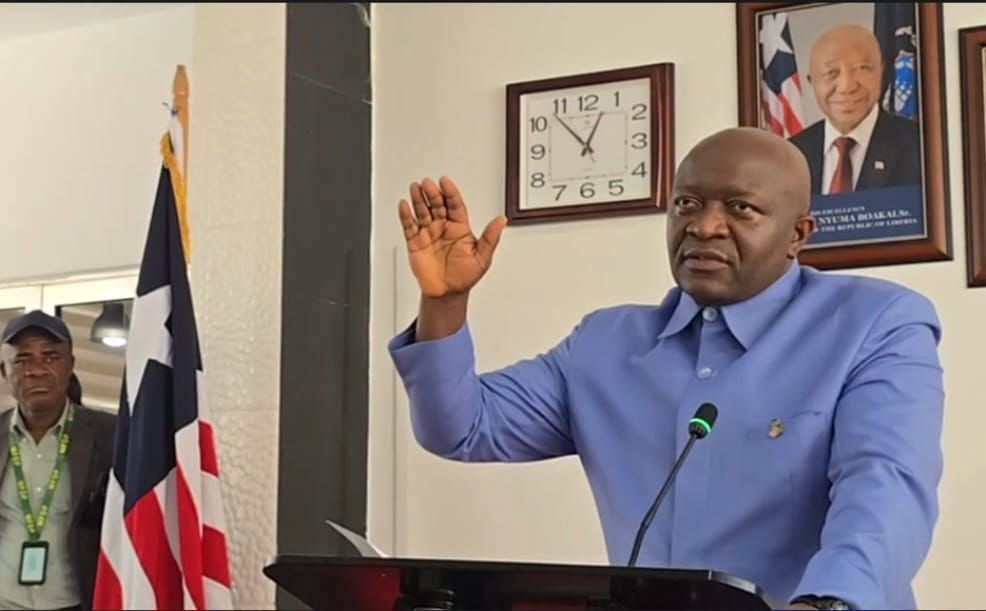
Addressing professional women of the Ministry of Finance during the second anniversary of his assumption of office, Ngafuan pushed back against critics who dismiss the billion-dollar figure as abstract.
“I’m knocking on the billion because some people, you will have to knock the billion before they know,” he declared, stressing that the number represents more than a ledger entry — it is the fuel for Liberia’s development rocket.
The Liberia Revenue Authority (LRA) reported collections rising from US$699 million in 2024 to US$848 million in 2025, surpassing targets. By August 2026, receipts had already hit US$904.7 million, before finally breaking the billion-dollar ceiling in September. President Joseph Nyuma Boakai hailed the achievement as unprecedented: Liberia generated the sum without borrowing or foreign aid, setting a broader target of US$1.3 billion for fiscal year 2026.
Ngafuan framed the achievement as a turning point. “A billion for an entire country is not too big, especially when all our neighbors had been in the billions long ago,” he said, noting Liberia’s comparatively small economic base. World Bank data show Liberia’s GDP at US$5.25 billion in 2025, dwarfed by Sierra Leone’s US$7.46 billion and Guinea’s US$28.35 billion.
The minister pointed to roads in southeastern Liberia and the operation of National Transit Authority buses connecting Monrovia to Harper as evidence of progress. “Before, that was inconceivable,” he said. He highlighted the Cavalla River Bridge project, linking Liberia with Côte d’Ivoire, as a symbol of regional integration and future commerce. Scheduled for completion in March 2028, the bridge will replace unreliable ferry crossings and strengthen cross-border trade.
Ngafuan’s message was clear: development must be judged by what citizens can see and use. “Those who do not see development, tell me what you see. The best way to unite this country is through development,” he told the gathering.
The minister acknowledged the weight of responsibility. “Based on what we do or fail to do, people could cry or laugh,” he said, likening fiscal management to the fire that propels a rocket into space. He described President Boakai’s oversight as “positive pressure” cascading down to ensure delivery.
He rejected partisan framing of the achievement. “It is not the matter of UP, CDC, or whatever; it is a matter of the country as a whole,” he said, urging Liberians to see the billion-dollar milestone as a national victory.
Liberia’s FY2026 budget, presented at US$1.211 billion, relies on domestic resources for 94 percent of financing. The surge in collections creates fiscal space but also intensifies scrutiny over how revenue is spent.
The LRA’s new 2025–2029 Corporate Strategic Plan promises stronger tax compliance, digital transformation, and better taxpayer services. The challenge now is converting numbers into schools, healthcare, jobs, and institutions.
Ngafuan reflected on his return to government after four years in Uganda, where he managed a US$2.2 billion portfolio. Initially reluctant, he said President Boakai’s persistence — and a promise to his mother — drew him back. “It was difficult to tell him no,” he admitted.
For Ngafuan, the billion-dollar milestone is only the beginning. “The enormity of the burden should serve as the fire to our rocket,” he said. As Liberia enters a new fiscal era, the debate shifts from whether the country can raise US$1 billion to whether it can deliver tangible improvements in the lives of its citizens.

