

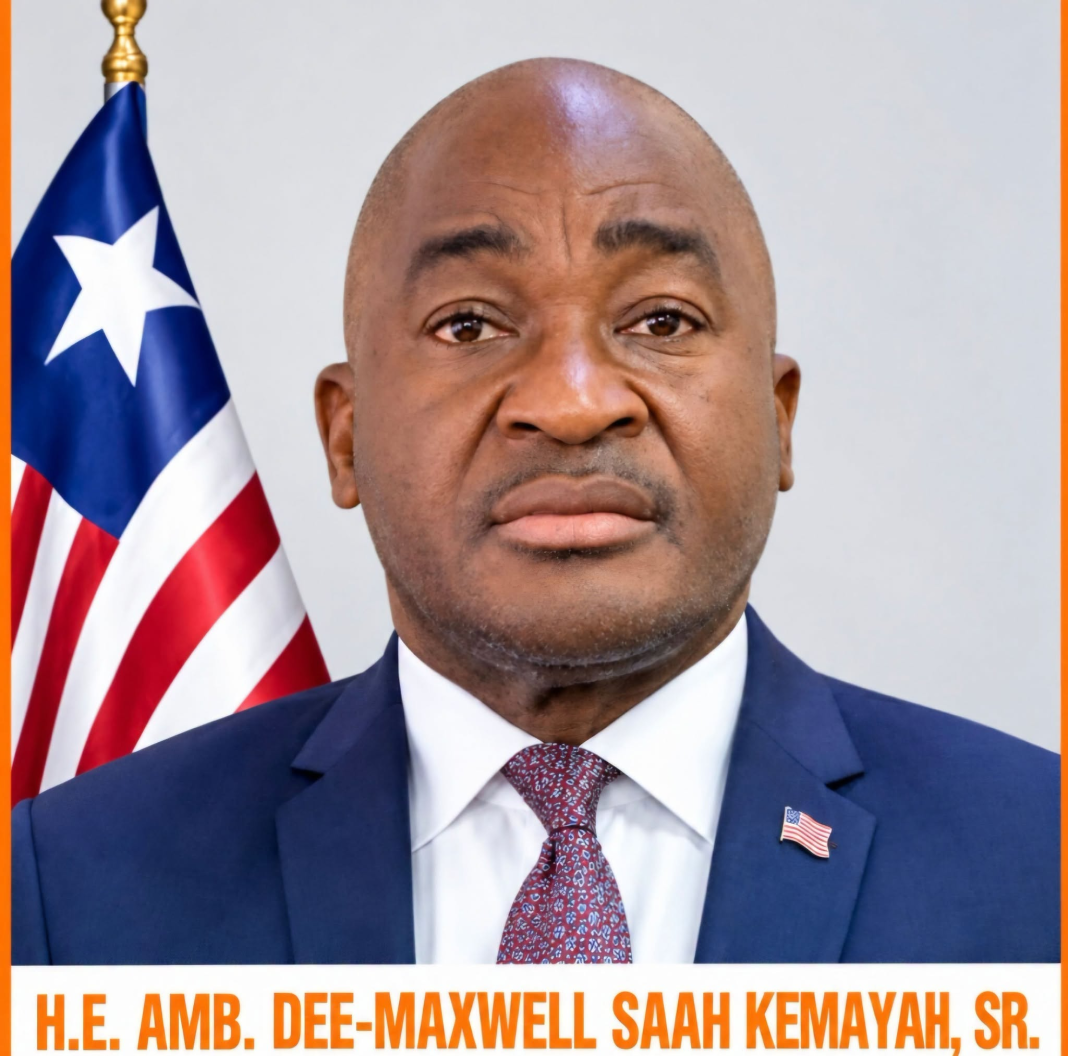
At the First International Peace Summit 2026, former Liberian Foreign Minister and Dean of the Cabinet, Ambassador Dee-Maxwell Saah Kemayah Sr., issued a stark warning: without preventive diplomacy, impartial justice, and credible institutions, societies risk sliding into new conflicts.
Delivering the keynote address on the International Day of Peace, Kemayah stressed that peace cannot be secured simply by ending wars once they erupt. Instead, governments and international organizations must act early identifying tensions, maintaining dialogue, and strengthening institutions capable of resolving disputes peacefully.
The summit, themed “Peace in a Fractured World: Restoring Dialogue, Justice and Confidence in Institutions”, echoed the United Nations’ 2026 Peace Day message, “Invest in Peace: For Everyone, Everywhere, Every Day.” Both underscored the urgency of diplomacy and trust-building amid rising global instability.
Kemayah’s remarks come against a backdrop of worsening violence worldwide. The Institute for Economics & Peace’s Global Peace Index 2025 recorded 59 active state-based conflicts—the highest since World War II—with 152,000 conflict-related deaths in 2024. Internal conflicts with foreign involvement have surged since 2010, underscoring the complexity of modern wars.
“Diplomacy must be treated not as crisis management but as the first line of defense,” Kemayah argued. “It is always less costly to prevent a conflict than to resolve one after it begins.”
He called for investment in early-warning systems, mediation, confidence-building measures, and sustained dialogue. “Dialogue is not capitulation. Negotiation is not surrender. Diplomacy is not weakness,” he declared, describing diplomacy as “the disciplined search for alternatives to destruction.”
Kemayah placed the rule of law at the center of sustainable peace. “Peace without justice is inherently fragile,” he said, warning that selective justice undermines stability.
He urged impartial accountability for both serving and former officials, stressing that prosecutions must be evidence-based, transparent, and fair. “Otherwise, prosecution can be persecution in disguise,” he cautioned.
Kemayah highlighted two dangers: impunity on one side and politically motivated prosecutions on the other. “The answer to impunity is credible justice—not selective justice and political witch-hunt,” he said.
Drawing on Liberia’s history, Kemayah reminded the audience of the devastating civil wars between 1989 and 2003, which killed nearly 250,000 people and displaced one-third of the population. The United Nations Mission in Liberia (UNMIL) disarmed more than 100,000 combatants and spent $7.5 billion over 15 years to stabilize the country.
“Conflict does not begin with the firing of the first gun,” Kemayah said. “It begins when trust dies, institutions lose credibility, political opponents become enemies, and citizens cease to believe that justice will protect them equally.”
He warned that Liberia’s current political climate—marked by contentious prosecutions and questions over judicial independence—could erode public trust and spark unrest. “We have paid too high a price for peace to gamble with it again,” he said.
Kemayah outlined a five-point agenda to strengthen peace architecture nationally and globally:
Preventive Diplomacy: Establish early-warning systems to detect instability, deploy standing mediation teams, and maintain confidential communication channels between political actors.
Independent Institutions: Protect judicial bodies, electoral commissions, legislatures, and accountability agencies through transparent appointments, lawful procedures, and predictable financing.
Rule of Law: Expand access to justice, reduce court delays, and ensure accountability operates alongside due process.
Dialogue Mechanisms: Institutionalize forums that bring together government, opposition, civil society, youth, women, and traditional leaders.
Multilateral Confidence: Reform international institutions to be more transparent, representative, and responsive, particularly toward smaller states.
Kemayah emphasized that democracy requires tolerance of criticism and opposition. “A healthy democracy requires a government to be capable of tolerating criticism and opposition,” he said.
Extending the principle to international relations, he argued that states will inevitably disagree over trade, security, and ideology, but disagreement need not lead to confrontation.
“The measure of statesmanship is not simply the ability to defeat opponents but the capacity to find enough common ground for competing interests to coexist peacefully.”
Kemayah concluded with a powerful reminder that peace is not a one-time achievement but a continuing responsibility.
“Peace is preserved when governments exercise power responsibly. Peace is preserved when opposition is respected. Peace is preserved when courts are independent. Peace is preserved when justice is impartial,” he said.

