

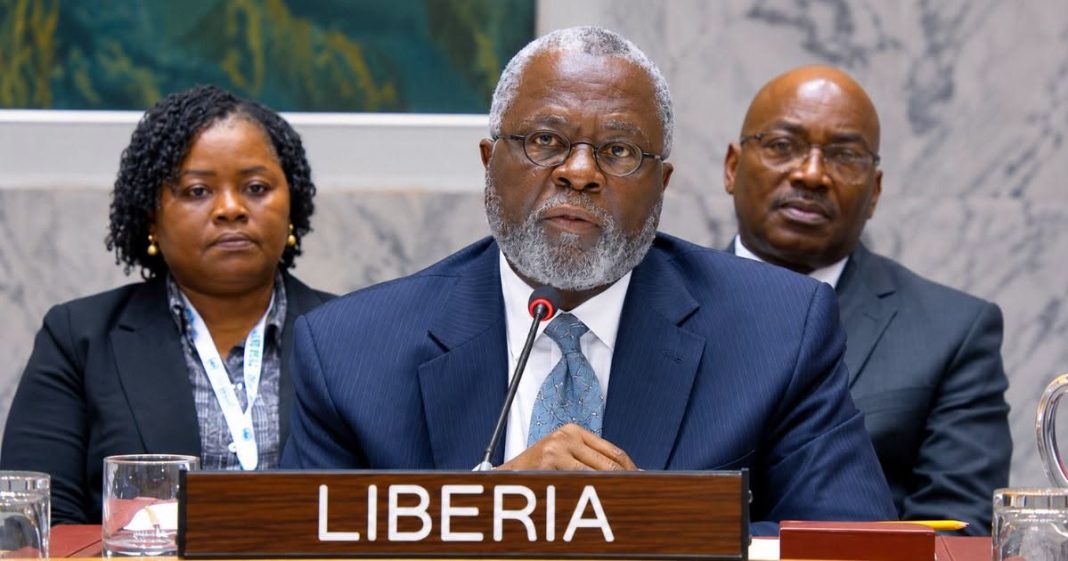
Liberia has reaffirmed its strong support for Ukraine’s sovereignty, independence and territorial integrity, calling for an immediate ceasefire and intensified diplomatic efforts to secure a sustainable and lasting resolution to the ongoing conflict.
Speaking before the United Nations Security Council on Monday, November 9, Liberia’s Permanent Representative to the United Nations, Ambassador Lewis G. Brown II, emphasized that any pathway to peace must be firmly rooted in the principles of the United Nations Charter, international law and respect for internationally recognized borders.
Addressing a Security Council briefing on the maintenance of international peace and security in Ukraine, Ambassador Brown reiterated Liberia’s longstanding commitment to multilateral diplomacy and the peaceful settlement of disputes, stressing that a durable peace can only be achieved through meaningful dialogue and adherence to international norms.
“Any resolution of the conflict must be consistent with international law and the sovereignty and territorial integrity of states,” Brown told the Council, underscoring Liberia’s position that peace initiatives should preserve the fundamental principles upon which the international system is built.
The Liberian envoy also delivered a strong appeal for the protection of civilians caught in the war, condemning attacks on civilian populations and critical infrastructure. He urged all parties to comply fully with international humanitarian law and take concrete measures to reduce the suffering endured by millions affected by the conflict.
Brown drew particular attention to the vulnerability of civilian facilities, including hospitals, schools and other essential infrastructure that communities depend on for their survival and wellbeing.
He stressed that the continued targeting or destruction of such facilities not only deepens the humanitarian crisis but also undermines prospects for recovery and long-term stability.
In addition, Ambassador Brown called for greater humanitarian access across conflict-affected areas and urged all parties to facilitate the work of international humanitarian organizations. He emphasized that humanitarian workers must be able to operate safely and without obstruction while delivering life-saving assistance to communities most affected by the war.
The Liberian diplomat also advocated for full access by the International Committee of the Red Cross (ICRC) to prisoners of war in accordance with the Geneva Conventions. Such access, he noted, is critical to ensuring humane treatment and protecting the rights of those detained during the conflict.
Brown further welcomed ongoing humanitarian efforts aimed at addressing some of the war’s most devastating consequences, including initiatives focused on reuniting children separated from their families.
He acknowledged the efforts of Mrs. Trump in supporting humanitarian engagement and described recent cooperation on family reunification as a positive development. However, he stressed that humanitarian arrangements should not remain isolated achievements but should evolve into sustained mechanisms capable of providing long-term protection and relief for affected civilians.
“The task now is to make such cooperation sustained and repeatable,” he said.
Ambassador Brown also advocated for additional humanitarian agreements to facilitate safe and voluntary evacuations, increase assistance to civilians trapped in conflict zones, broaden humanitarian access across both sides of the front line, and support additional exchanges of prisoners of war as well as the release of civilians unlawfully detained.
He urged the parties involved in the conflict, together with governments and mediators facilitating diplomatic contacts, to make full use of existing communication channels to negotiate practical humanitarian measures while pursuing broader political dialogue aimed at ending the war.
Liberia’s intervention comes as the conflict in Ukraine remains one of the most significant security and humanitarian crises in Europe since the Second World War.
Russia launched its full-scale invasion of Ukraine on February 24, 2022, escalating hostilities that began in 2014 following the annexation of Crimea and armed conflict in eastern Ukraine.
More than four years later, the war continues to inflict a heavy toll on civilians, resulting in widespread displacement, extensive damage to infrastructure and persistent humanitarian challenges.
According to figures from the United Nations Human Rights Monitoring Mission in Ukraine, at least 17,605 civilians had been killed and 55,846 injured as of September 30, 2026, bringing the verified civilian casualty total to 73,451. The United Nations has cautioned that the actual figures may be significantly higher due to limitations in accessing some conflict-affected areas and independently verifying reported casualties.
The humanitarian situation has continued to deteriorate. Between January and September 2026 alone, the UN recorded 2,570 civilian deaths and 15,211 injuries, representing a 59 percent increase in combined civilian casualties compared with the same period in 2025.
The figures underscore growing international concerns about civilian protection and reinforce calls for renewed diplomatic engagement to prevent further loss of life.
Concluding his remarks, Ambassador Brown stressed that the war’s consequences extend far beyond military objectives and territorial disputes, affecting millions of ordinary people whose lives have been disrupted by violence, uncertainty and displacement.
He maintained that the people of Ukraine, as well as civilians in the Russian Federation impacted by the conflict, deserve a future marked by peace, security and opportunity rather than continued suffering.
Liberia’s statement at the UN Security Council reaffirmed the country’s commitment to diplomacy, international law and humanitarian protection, while stressing that any lasting settlement must safeguard Ukraine’s sovereignty and territorial integrity and address the broader security challenges necessary for a durable peace.

